



 Chat with AI
Exam 19: Elasticity

Exam 1: What Economics Is About174 Questions
Exam 2: Production Possibilities Frontier Framework156 Questions
Exam 3: Supply and Demand Theory224 Questions
Exam 4: Prices Free Controlled and Relative122 Questions
Exam 5: Supply Demand and Price Applications76 Questions
Exam 6: Macroeconomic Measurements Part I Prices and Unemployment151 Questions
Exam 7: Macroeconomic Measurements Part II Gdp and Real Gdp150 Questions
Exam 8: Aggregate Demand and Aggregate Supply204 Questions
Exam 9: Classical Macroeconomics and the Self Regulating Economy172 Questions
Exam 10: Keynesian Macroeconomics and Economic Instability a Critique of the Self Regulating Economy200 Questions
Exam 11: Fiscal Policy and the Federal Budget167 Questions
Exam 12: Money Banking and the Financial System150 Questions
Exam 13: The Federal Reserve System180 Questions
Exam 14: Money and the Economy150 Questions
Exam 15: Monetary Policy185 Questions
Exam 16: Expectations Theory and the Economy150 Questions
Exam 17: Economic Growth Resources Technology Ideas and Institutions103 Questions
Exam 18: Debates in Macroeconomics Over the Role and Effects of Government100 Questions
Exam 19: Elasticity204 Questions
Exam 20: Consumer Choice and Behavioral Economics179 Questions
Exam 21: Production and Costs245 Questions
Exam 22: Perfect Competition187 Questions
Exam 23: Monopoly195 Questions
Exam 24: Monopolistic Competition Oligopoly and Game Theory172 Questions
Exam 25: Government and Product Markets Antitrust and Regulation158 Questions
Exam 26: Factor Markets With Emphasis on the Labor Market184 Questions
Exam 27: Wages Unions and Labor138 Questions
Exam 28: The Distribution of Income and Poverty99 Questions
Exam 29: Interest Rent and Profit198 Questions
Exam 30: Market Failure Externalities Public Goods and Asymmetric Information187 Questions
Exam 31: Public Choice and Special Interest Group Politics135 Questions
Exam 32: Building Theories to Explain Everyday Life From Observations to Questions to Theories to Predictions62 Questions
Exam 33: International Trade152 Questions
Exam 34: International Finance122 Questions
Exam 35: The Economic Case for and Against Government Five Topics Considered87 Questions
Exam 36: Stocks Bonds Futures and Options110 Questions
Select questions type


If goods A and B have a cross elasticity of demand that is positive, this is evidence that goods A and B are __________ goods.
(Multiple Choice)
4.9/5  (89)
(89) If the cross elasticity of demand for good A with respect to good B is -0.87, then good A is
(Multiple Choice)
4.9/5 (90)
(90) If tobacco is a normal, income inelastic good, it follows that a 10 percent decrease in income will __________ quantity demanded by __________ than 10 percent.
(Multiple Choice)
5.0/5 (80)
(80) Exhibit 19-6
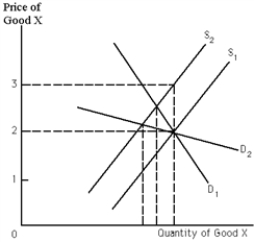 -Refer to Exhibit 19-6. Suppose the three equilibrium quantities are 700, 800, and 900, and the two other equilibrium prices are $2.20 and $2.75. What is the change in total revenue when a per-unit tax shifts S1 to S2, given that D2 is the relevant demand curve?
 (Multiple Choice)
4.8/5 (77)
(77) From the sellers' perspective, it is most desirable for a product to be perfectly elastic in demand.
(True/False)
4.9/5 (83)
(83) Suppose a producer decides that if the price of his or her product is $10, the quantity supplied will be 1,000 units, and if the price is $11, the quantity supplied will be 1,100. The supply of the good is
(Multiple Choice)
4.7/5 (85)
(85) It is very important for the seller of a good to know whether the good is elastic, unit elastic, or inelastic in demand so that she will know what will happen to total revenue when she changes the price of the good.
(True/False)
4.9/5 (74)
(74) Price elasticity of supply and price elasticity of demand are likely to be __________ in the __________ than in the __________.
(Multiple Choice)
4.7/5 (72)
(72) Exhibit 19-9
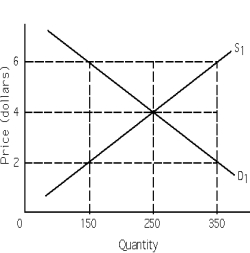 -Refer to Exhibit 19-9. What is the price elasticity of supply between $2 and $4?
 (Multiple Choice)
4.8/5 (70)
(70) If a 5 percent reduction in the price of a commodity results in a 3 percent increase in the quantity demanded, demand is said to be
(Multiple Choice)
4.9/5 (94)
(94) Exhibit 19-2
 -Refer to Exhibit 19-2. The market for good X is initially in equilibrium at $5. The government then places a per-unit tax on good X, as shown by the shift of S1 to S2. As a result, the equilibrium price
 (Multiple Choice)
4.8/5 (73)
(73) Exhibit 19-3
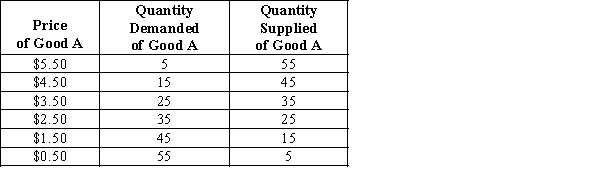 -Refer to Exhibit 19-3. If price decreases from $1.50 to $0.50, total revenue along the demand curve
 (Multiple Choice)
4.8/5 (84)
(84) Which of the following is a determinant of price elasticity of demand for good Z?
(Multiple Choice)
4.7/5 (88)
(88) Exhibit 19-2
-Refer to Exhibit 19-2. The market for good X is initially in equilibrium at $5. The government then places a tax on the producers of good X, taxing them on each unit of good X they sell. As a result, the supply curve
-Refer to Exhibit 19-2. The market for good X is initially in equilibrium at $5. The government then places a tax on the producers of good X, taxing them on each unit of good X they sell. As a result, the supply curve (Multiple Choice)
4.9/5 (84)
(84) Exhibit 19-4
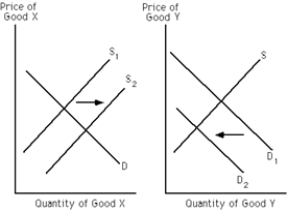 -Refer to Exhibit 19-4. As a consequence of the depicted change in supply of X, the demand curve for Y shifted from D1 to D2. What is true of the cross elasticity of demand for Y?
 (Multiple Choice)
4.9/5 (80)
(80) Exhibit 19-3
-Refer to Exhibit 19-3. When price decreases from $5.50 to $4.50, the price elasticity of supply is
-Refer to Exhibit 19-3. When price decreases from $5.50 to $4.50, the price elasticity of supply is (Multiple Choice)
4.8/5 (77)
(77) Cross elasticity of demand measures the responsiveness of the
(Multiple Choice)
4.7/5 (80)
(80) Which of the following would result in higher price elasticity of good X?
(Multiple Choice)
4.8/5 (80)
(80) Exhibit 19-8
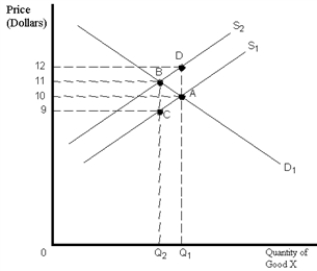 -Refer to Exhibit 19-8. The market for good X is initially at point A. A tax is then placed on the production of good X. As a result, the equilibrium price changes to __________, and sellers now receive __________ per unit they sell and they get to keep __________ for each unit they sell.
 (Multiple Choice)
4.7/5 (94)
(94) 
Filters
- Essay(0)
- Multiple Choice(0)
- Short Answer(0)
- True False(0)
- Matching(0)