



 Chat with AI
Exam 19: Elasticity

Exam 1: What Economics Is About174 Questions
Exam 2: Production Possibilities Frontier Framework156 Questions
Exam 3: Supply and Demand Theory224 Questions
Exam 4: Prices Free Controlled and Relative122 Questions
Exam 5: Supply Demand and Price Applications76 Questions
Exam 6: Macroeconomic Measurements Part I Prices and Unemployment151 Questions
Exam 7: Macroeconomic Measurements Part II Gdp and Real Gdp150 Questions
Exam 8: Aggregate Demand and Aggregate Supply204 Questions
Exam 9: Classical Macroeconomics and the Self Regulating Economy172 Questions
Exam 10: Keynesian Macroeconomics and Economic Instability a Critique of the Self Regulating Economy200 Questions
Exam 11: Fiscal Policy and the Federal Budget167 Questions
Exam 12: Money Banking and the Financial System150 Questions
Exam 13: The Federal Reserve System180 Questions
Exam 14: Money and the Economy150 Questions
Exam 15: Monetary Policy185 Questions
Exam 16: Expectations Theory and the Economy150 Questions
Exam 17: Economic Growth Resources Technology Ideas and Institutions103 Questions
Exam 18: Debates in Macroeconomics Over the Role and Effects of Government100 Questions
Exam 19: Elasticity204 Questions
Exam 20: Consumer Choice and Behavioral Economics179 Questions
Exam 21: Production and Costs245 Questions
Exam 22: Perfect Competition187 Questions
Exam 23: Monopoly195 Questions
Exam 24: Monopolistic Competition Oligopoly and Game Theory172 Questions
Exam 25: Government and Product Markets Antitrust and Regulation158 Questions
Exam 26: Factor Markets With Emphasis on the Labor Market184 Questions
Exam 27: Wages Unions and Labor138 Questions
Exam 28: The Distribution of Income and Poverty99 Questions
Exam 29: Interest Rent and Profit198 Questions
Exam 30: Market Failure Externalities Public Goods and Asymmetric Information187 Questions
Exam 31: Public Choice and Special Interest Group Politics135 Questions
Exam 32: Building Theories to Explain Everyday Life From Observations to Questions to Theories to Predictions62 Questions
Exam 33: International Trade152 Questions
Exam 34: International Finance122 Questions
Exam 35: The Economic Case for and Against Government Five Topics Considered87 Questions
Exam 36: Stocks Bonds Futures and Options110 Questions
Select questions type


If the percentage change in quantity demanded is greater than the percentage change in price for good X, then the demand for good X is
(Multiple Choice)
4.9/5  (77)
(77) For a normal good, __________ falls as income __________; for an inferior good, __________ rises as income __________.
(Multiple Choice)
4.9/5 (86)
(86) As the price of good X rises from $1.50 to $1.75 the result is a decrease in the quantity demanded of good X from 650 units to 590 units. The price elasticity of demand for good X is _____________ and total revenue __________ as the price of good X rises from $1.50 to $1.75.
(Multiple Choice)
4.9/5 (78)
(78) Exhibit 19-2
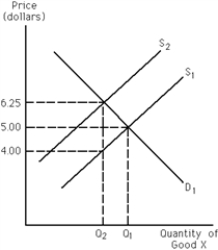 -Refer to Exhibit 19-2. The market for good X is initially in equilibrium at $5. The government then places a per-unit tax on good X, as shown by the shift of S1 to S2. What is the per-unit tax equal to?
 (Multiple Choice)
4.8/5 (73)
(73) For a straight-line downward-sloping demand curve, price elasticity of demand
(Multiple Choice)
4.7/5 (77)
(77) If Jack bought 12 DVDs last year when his income was $40,000 and he buys 14 DVDs this year when his income is $43,000, then his income elasticity of demand is ______________ which means that DVDs are a(n) ______________ good for Jack.
(Multiple Choice)
4.8/5 (75)
(75) For a certain good, when price rises from $90 to $98, quantity demanded falls from 7,400 to 6,500. The price elasticity of demand here is approximately _____________, making the demand for this good ____________ in the price range between $90 and $98.
(Multiple Choice)
4.8/5 (80)
(80) What does price elasticity of supply measure? Explain the relationship that exists between price elasticity of supply and the length of time sellers have to adjust to the price change.
(Essay)
4.9/5 (81)
(81) Suppose someone believes that if a per-unit tax is placed on the producers of good Y, the consumers of good Y will end up paying the full tax. This person assumes that the demand curve for good Y is
(Multiple Choice)
4.9/5 (92)
(92) If the percentage change in quantity demanded is equal to the percentage change in price for good Z, then demand for good Z is
(Multiple Choice)
4.8/5 (76)
(76) If the price of good X rises and the demand for good X is inelastic, then the percentage fall in quantity demanded is __________ the percentage rise in price, and total revenue __________.
(Multiple Choice)
4.9/5 (81)
(81) The demand curve for good X is a straight downward-sloping line. It follows that the demand for good X is ________ elastic at __________ prices than at __________ prices.
(Multiple Choice)
4.7/5 (84)
(84) Suppose that when the price of water rises by 30 percent, the quantity demanded falls by 10 percent. The price elasticity of demand for water is ____________, making water an _______________ good (in this example).
(Multiple Choice)
4.8/5 (75)
(75) If a 7 percent increase in the price of a commodity results in a 12 percent increase in the quantity supplied, supply is said to be
(Multiple Choice)
4.9/5 (76)
(76) If the cross elasticity of demand for two goods is negative,
(Multiple Choice)
4.8/5 (75)
(75) If a demand curve is a straight downward sloping line, demand is
(Multiple Choice)
4.9/5 (87)
(87) If the seller of good X raises the price of good X, it follows that the total revenue of good X will __________, if demand is __________.
(Multiple Choice)
4.8/5 (81)
(81) 
Filters
- Essay(0)
- Multiple Choice(0)
- Short Answer(0)
- True False(0)
- Matching(0)