



 Chat with AI
Exam 21: Production and Costs

Exam 1: What Economics Is About174 Questions
Exam 2: Production Possibilities Frontier Framework156 Questions
Exam 3: Supply and Demand Theory224 Questions
Exam 4: Prices Free Controlled and Relative122 Questions
Exam 5: Supply Demand and Price Applications76 Questions
Exam 6: Macroeconomic Measurements Part I Prices and Unemployment151 Questions
Exam 7: Macroeconomic Measurements Part II Gdp and Real Gdp150 Questions
Exam 8: Aggregate Demand and Aggregate Supply204 Questions
Exam 9: Classical Macroeconomics and the Self Regulating Economy172 Questions
Exam 10: Keynesian Macroeconomics and Economic Instability a Critique of the Self Regulating Economy200 Questions
Exam 11: Fiscal Policy and the Federal Budget167 Questions
Exam 12: Money Banking and the Financial System150 Questions
Exam 13: The Federal Reserve System180 Questions
Exam 14: Money and the Economy150 Questions
Exam 15: Monetary Policy185 Questions
Exam 16: Expectations Theory and the Economy150 Questions
Exam 17: Economic Growth Resources Technology Ideas and Institutions103 Questions
Exam 18: Debates in Macroeconomics Over the Role and Effects of Government100 Questions
Exam 19: Elasticity204 Questions
Exam 20: Consumer Choice and Behavioral Economics179 Questions
Exam 21: Production and Costs245 Questions
Exam 22: Perfect Competition187 Questions
Exam 23: Monopoly195 Questions
Exam 24: Monopolistic Competition Oligopoly and Game Theory172 Questions
Exam 25: Government and Product Markets Antitrust and Regulation158 Questions
Exam 26: Factor Markets With Emphasis on the Labor Market184 Questions
Exam 27: Wages Unions and Labor138 Questions
Exam 28: The Distribution of Income and Poverty99 Questions
Exam 29: Interest Rent and Profit198 Questions
Exam 30: Market Failure Externalities Public Goods and Asymmetric Information187 Questions
Exam 31: Public Choice and Special Interest Group Politics135 Questions
Exam 32: Building Theories to Explain Everyday Life From Observations to Questions to Theories to Predictions62 Questions
Exam 33: International Trade152 Questions
Exam 34: International Finance122 Questions
Exam 35: The Economic Case for and Against Government Five Topics Considered87 Questions
Exam 36: Stocks Bonds Futures and Options110 Questions
Select questions type


Exhibit 21-14
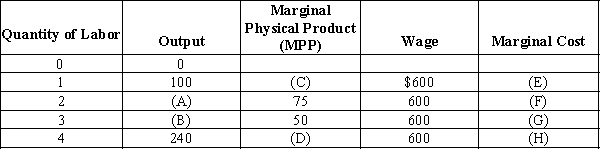 Assume that labor is the only variable input and that each additional laborer is paid $600.
-Refer to Exhibit 21-14. What is the MPP of the first unit of labor [blank (C)]?
Assume that labor is the only variable input and that each additional laborer is paid $600.
-Refer to Exhibit 21-14. What is the MPP of the first unit of labor [blank (C)]? (Multiple Choice)
4.9/5  (81)
(81) Exhibit 21-11
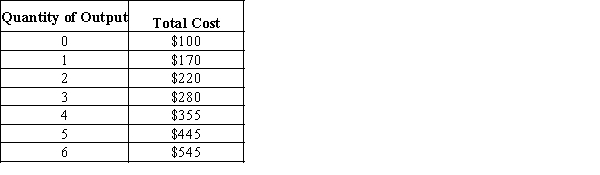 -Refer to Exhibit 21-11. Average variable cost at two units of output is
 (Multiple Choice)
4.9/5 (75)
(75)  -For ABC, Inc., 250,000 units of output per year represent minimum efficient scale. If ABC, Inc. decides to produce 200,000 units this year, it will be operating in the region of
 (Multiple Choice)
4.7/5 (78)
(78) __________ scale exist when inputs are increased by some percentage and output increases by a smaller percentage, whereas __________ scale exist when inputs are increased by some percentage and output increases by the same percentage.
(Multiple Choice)
5.0/5 (75)
(75) Exhibit 21-11
-Refer to Exhibit 21-11. Marginal cost of the first unit of output is
-Refer to Exhibit 21-11. Marginal cost of the first unit of output is (Multiple Choice)
4.8/5 (75)
(75) Using the concept of marginal cost, explain how a parent could structure a teenager's punishment for misbehavior so as to achieve the parent's goal (for example, having the teen home by a certain time).
(Essay)
4.9/5 (77)
(77) Costs that do not change with output are called __________ costs.
(Multiple Choice)
4.9/5 (80)
(80) The average-marginal rule states that if the marginal magnitude is
(Multiple Choice)
4.8/5 (89)
(89) When a firm is experiencing constant returns to scale, it follows that
(Multiple Choice)
4.9/5 (77)
(77) Define economies of scale and give two reasons why firms may experience economies of scale. Is economies of scale a long-run concept or a short-run concept?
(Essay)
4.8/5 (75)
(75) Exhibit 21-10
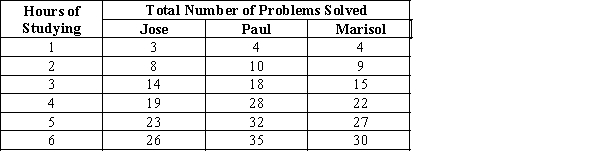
-Refer to Exhibit 21-10. Paul's marginal productivity of the fourth hour of studying is
-Refer to Exhibit 21-10. Paul's marginal productivity of the fourth hour of studying is (Multiple Choice)
4.8/5 (80)
(80) Exhibit 21-2
 -Refer to Exhibit 21-2. What is the average total cost of producing 120 units of output?
 (Multiple Choice)
5.0/5 (76)
(76) Carol says the following to an economist: "I hate playing the guitar, but I have taken lessons for 10 years, so I might as well continue. There is a chance I will become a professional guitarist one day." An economist would probably make which of the following statements?
(Multiple Choice)
4.9/5 (78)
(78) There is a link between production and cost. We know this because
(Multiple Choice)
4.8/5 (82)
(82) Diseconomies of scale are said to exist when inputs are increased by some percentage and output increases by a(n) __________ percentage, causing unit costs to __________.
(Multiple Choice)
4.9/5 (88)
(88) If the marginal cost (MC) curve is rising and is above the average fixed cost (AFC) curve, then
(Multiple Choice)
4.8/5 (86)
(86) Exhibit 21-3
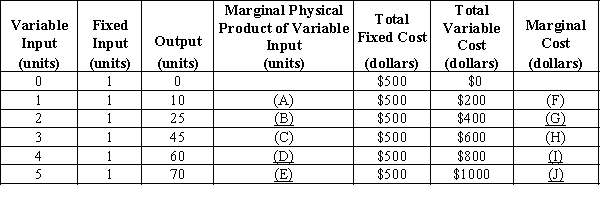 -The law of diminishing marginal returns states that as ever larger amounts of a variable input are combined with
 (Multiple Choice)
4.8/5 (84)
(84) 
Filters
- Essay(0)
- Multiple Choice(0)
- Short Answer(0)
- True False(0)
- Matching(0)