



 Chat with AI
Exam 21: Production and Costs

Exam 1: What Economics Is About174 Questions
Exam 2: Production Possibilities Frontier Framework156 Questions
Exam 3: Supply and Demand Theory224 Questions
Exam 4: Prices Free Controlled and Relative122 Questions
Exam 5: Supply Demand and Price Applications76 Questions
Exam 6: Macroeconomic Measurements Part I Prices and Unemployment151 Questions
Exam 7: Macroeconomic Measurements Part II Gdp and Real Gdp150 Questions
Exam 8: Aggregate Demand and Aggregate Supply204 Questions
Exam 9: Classical Macroeconomics and the Self Regulating Economy172 Questions
Exam 10: Keynesian Macroeconomics and Economic Instability a Critique of the Self Regulating Economy200 Questions
Exam 11: Fiscal Policy and the Federal Budget167 Questions
Exam 12: Money Banking and the Financial System150 Questions
Exam 13: The Federal Reserve System180 Questions
Exam 14: Money and the Economy150 Questions
Exam 15: Monetary Policy185 Questions
Exam 16: Expectations Theory and the Economy150 Questions
Exam 17: Economic Growth Resources Technology Ideas and Institutions103 Questions
Exam 18: Debates in Macroeconomics Over the Role and Effects of Government100 Questions
Exam 19: Elasticity204 Questions
Exam 20: Consumer Choice and Behavioral Economics179 Questions
Exam 21: Production and Costs245 Questions
Exam 22: Perfect Competition187 Questions
Exam 23: Monopoly195 Questions
Exam 24: Monopolistic Competition Oligopoly and Game Theory172 Questions
Exam 25: Government and Product Markets Antitrust and Regulation158 Questions
Exam 26: Factor Markets With Emphasis on the Labor Market184 Questions
Exam 27: Wages Unions and Labor138 Questions
Exam 28: The Distribution of Income and Poverty99 Questions
Exam 29: Interest Rent and Profit198 Questions
Exam 30: Market Failure Externalities Public Goods and Asymmetric Information187 Questions
Exam 31: Public Choice and Special Interest Group Politics135 Questions
Exam 32: Building Theories to Explain Everyday Life From Observations to Questions to Theories to Predictions62 Questions
Exam 33: International Trade152 Questions
Exam 34: International Finance122 Questions
Exam 35: The Economic Case for and Against Government Five Topics Considered87 Questions
Exam 36: Stocks Bonds Futures and Options110 Questions
Select questions type


Exhibit 21-3
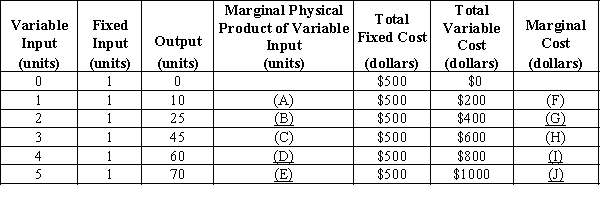 -Refer to Exhibit 21-3. The marginal cost figures in blanks (F) and (G), respectively, are
 (Multiple Choice)
4.8/5  (87)
(87) Exhibit 21-2
 -Refer to Exhibit 21-2. What is the average total cost of producing 90 units of output?
 (Multiple Choice)
4.9/5 (70)
(70) Exhibit 21-2
-Refer to Exhibit 21-2. The dollar amounts that go in blanks (C) and (D), respectively, are
-Refer to Exhibit 21-2. The dollar amounts that go in blanks (C) and (D), respectively, are (Multiple Choice)
4.7/5 (72)
(72) If the owner of a firm earns zero economic profit, he or she has earned total revenue equal to his or her
(Multiple Choice)
4.9/5 (63)
(63) Describe the average-marginal rule. Give a hypothetical numerical example that illustrates the average-marginal rule.
(Essay)
4.8/5 (93)
(93) Economists predict that the __________ the cost of shirking to an individual, the __________ shirking that individual will undertake, ceteris paribus.
(Multiple Choice)
4.7/5 (86)
(86) If the wage rate is constant and diminishing marginal returns have already set in, then
(Multiple Choice)
4.9/5 (88)
(88) Exhibit 21-14
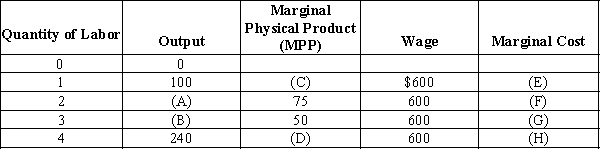 Assume that labor is the only variable input and that each additional laborer is paid $600.
-Refer to Exhibit 21-14. What is the marginal cost of producing this good with 1 and 2 laborers working [blanks (E) and (F)], respectively?
Assume that labor is the only variable input and that each additional laborer is paid $600.
-Refer to Exhibit 21-14. What is the marginal cost of producing this good with 1 and 2 laborers working [blanks (E) and (F)], respectively? (Multiple Choice)
5.0/5 (69)
(69) Exhibit 21-11
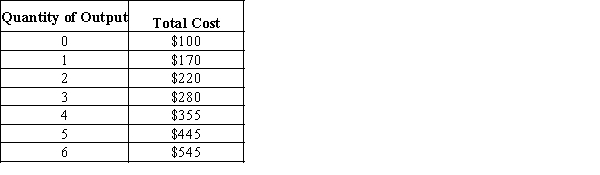 -Refer to Exhibit 21-11. Average total cost of the sixth unit of output is
 (Multiple Choice)
4.9/5 (82)
(82) Economies of scale are relevant to the __________, whereas the law of diminishing marginal returns is relevant to the __________.
(Multiple Choice)
4.8/5 (83)
(83) Exhibit 21-1
 -Refer to Exhibit 21-1. Diminishing marginal returns set in with the addition of which unit of the variable input?
 (Multiple Choice)
4.7/5 (60)
(60) Exhibit 21-3
-Refer to Exhibit 21-3. The marginal physical product figures in blanks (D) and (E) are, respectively,
-Refer to Exhibit 21-3. The marginal physical product figures in blanks (D) and (E) are, respectively, (Multiple Choice)
4.9/5 (84)
(84) Accounting profit equals economic profit if __________ equals __________.
(Multiple Choice)
4.9/5 (72)
(72) Economies of scale are said to exist when inputs are increased by some percentage and output increases by a(n) __________ percentage, causing unit costs to __________.
(Multiple Choice)
4.9/5 (80)
(80) 
Filters
- Essay(0)
- Multiple Choice(0)
- Short Answer(0)
- True False(0)
- Matching(0)