



 Chat with AI
Exam 11: Depreciation, Depletion, Impairment, and Disposal

Exam 1: The Demand for and Supply of Financial Accounting Information85 Questions
Exam 2: Financial Reporting: Its Conceptual Framework83 Questions
Exam 3: Review of a Company S Accounting System148 Questions
Exam 4: The Balance Sheet and the Statement of Shareholders Equity127 Questions
Exam 5: The Income Statement and the Statement of Cash Flows Time Value of Money Module136 Questions
Exam 6: Cash and Receivables172 Questions
Exam 7: Inventories: Cost Measurement and Flow Assumptions114 Questions
Exam 8: Inventories: Special Valuation Issues141 Questions
Exam 9: Current Liabilities and Contingent Obligations125 Questions
Exam 10: Property, Plant, and Equipment: Acquisition and Subsequent Investments111 Questions
Exam 11: Depreciation, Depletion, Impairment, and Disposal136 Questions
Exam 12: Intangibles136 Questions
Exam 13: Investments and Long-Term Receivables135 Questions
Exam 14: Financing Liabilities: Bonds and Long-Term Notes Payable192 Questions
Exam 15: Contributed Capital153 Questions
Exam 16: Retained Earnings and Earnings Per Share110 Questions
Exam 17: Advanced Issues in Revenue Recognition103 Questions
Exam 18: Accounting for Income Taxes113 Questions
Exam 19: Accounting for Post-Retirement Benefits94 Questions
Exam 20: Accounting for Leases116 Questions
Exam 21: The Statement of Cash Flows103 Questions
Exam 22: Accounting for Changes and Errors130 Questions
Exam 23: Understanding Time Value of Money Formulas and Concepts142 Questions
Select questions type


On January 1, 2016, World Inc. purchased five machines at a cost of $14,000 each. The company adopted the group straight-line) depreciation method, using an eight-year life with a $2,800 salvage value per machine. Correct depreciation was recorded in 2014 and 2015. On January 1, 2018, one of the machines was sold for $6,500. On January 3, 2018, a new unrelated piece of equipment was purchased for $15,000 with no salvage value and a six- year life. It will be depreciated using the straight-line method.
Required:
Prepare appropriate journal entries for
a. January 1, 2018
b. December 31, 2018, to record depreciation expense
(Essay)
4.9/5  (88)
(88) Five skid steers costing $20,000 each were purchased by the Biggs Excavating Company at the beginning of 2016. Biggs capitalized the skid steers in a single asset account and depreciates them using the group method. Each skid steer was expected to have a residual value of $6,000 in four years. At the end of 2019, Biggs sold one skid steer for
$8,000. For what amount is accumulated depreciation debited in the journal entry to record the disposal of that skid steer?
(Multiple Choice)
4.8/5 (88)
(88) Since the purpose of depreciation is to match the total cost of the asset with the benefits to be derived from the asset, the costs of repairs and maintenance associated with the asset should be considered when choosing a depreciation method.
(True/False)
4.9/5 (63)
(63) The service life of an asset can only be measured in units of activity or output.
(True/False)
4.9/5 (75)
(75) Willis Limo Service purchased three used assets with the following characteristics:  Assuming Willis uses straight-line depreciation, the composite depreciation rate is
 (Multiple Choice)
4.7/5 (82)
(82) Acquisition costs, exploration costs, development costs, and reclamation costs can all be added to the cost of obtaining the rights to natural resources.
(True/False)
4.8/5 (72)
(72) On July 9, 2015, Marcus Company purchased an asset for $18,000. Marcus estimated a four-year life and no salvage value. Marcus uses sum-of-the-years'-digits depreciation to the nearest whole month. Depreciation expense for 2018 will be
(Multiple Choice)
4.8/5 (80)
(80) Which of the following depreciation methods should be used when the expected benefits to be received from an asset will decline each period?
(Multiple Choice)
4.8/5 (79)
(79) Exhibit 11-04
Kieso Company purchased a tract of land for $4,500,000 in anticipation of extracting 1,425,000 tons of ore. The residual value of the land is expected to be $480,000. The company mines 125,000 tons of ore in the first year.
-Refer to Exhibit 11-04, what amount of depletion was recorded in that first year?
(Multiple Choice)
5.0/5 (99)
(99) What effect does depreciation have on the calculation of the rate of return on total assets?
(Multiple Choice)
4.8/5 (83)
(83) On July 1, 2016, American Stereo purchased stereo equipment for $5,000. The estimated life of the equipment was ten years and the residual value was estimated to be $2,000. Double-declining-balance depreciation was used. If calculations are based on the nearest whole month, depreciation expense for the year 2018 was
(Multiple Choice)
4.9/5 (81)
(81) A student is defending a certain depreciation method. She uses the argument that repairs and maintenance costs will probably increase as the asset gets older. She also argues that the asset will produce less as it gets older. What depreciation method is she probably defending?
(Multiple Choice)
4.8/5 (80)
(80) The straight-line and accelerated depreciation methods differ significantly in the amount and timing of the depreciation expense recognized and reported each year.
Required:
Discuss the factors that should be considered when choosing between the straight-line and accelerated depreciation methods.
(Essay)
4.9/5 (85)
(85) The following are a list of terms:
______ 1 depletion
______ 2 useful life
______ 3 depreciation base
______ 4 double-declining-balance method
______ 5 rational method of cost allocation
______ 6 salvage value
______ 7 depreciable cost
______ 8 amortization
______ 9 activity method
______ 10 declining-balance method
______ 11 systematic method of cost allocation
______ 12 service life
Required:
Match each term with the appropriate definition by entering the letter from below into the blank in the table above.
a. The allocation of costs as they relate to copyrights, patents, and trademarks. b. Based on the decline in the asset's service potential each period.
c. Calculated based upon a formula rather than an arbitrary manner. d. Can be measured in units, hours, or time.
e. A constant rate applied to the book value of the asset. f. Based upon the amount of use versus time periods.
g. The allocation of costs related to natural resources.
h. The difference between the original cost of the asset and an estimate of its residual value.
i. Uses two times the straight-line depreciation rate applied to the book value of the asset at the beginning of each period.
j. The amount of time the company expects the asset to be viable. k. Computed as: Asset Cost - Estimated Residual Value
l. The expected book value at the end of the depreciation period.
(Essay)
4.9/5 (73)
(73) Exhibit 11-03
On January 1, 2016, Wheeler, Inc. purchased some equipment for $3,900. The equipment had an estimated life of five years and an expected residual value of $200. On July, 1, 2018, the equipment was sold for $1,000. Wheeler uses straight-line depreciation.
-Refer to Exhibit 11-03, what was the balance in the accumulated depreciation account prior to bringing the depreciation expense up to date before the disposal?
(Multiple Choice)
4.9/5 (69)
(69) On January 1, 2015, the Wintergreen Co. acquired three assets that it intends to combine into a single account and depreciate using the composite depreciation straight-line) method. The assets have the following characteristics:  Required:
a. Determine the composite rate for depreciation of these assets.
b. Why did Wintergreen Co. use a composite rate than a group depreciation rate?
Required:
a. Determine the composite rate for depreciation of these assets.
b. Why did Wintergreen Co. use a composite rate than a group depreciation rate? (Essay)
4.8/5 (88)
(88) Exhibit 11-05
Wilson is preparing his tax returns using the MACRS convention. The following information relates to the purchase of an asset on January 1, Year 1.
MACRS Depreciation as a Percentage of the Cost of the Asset 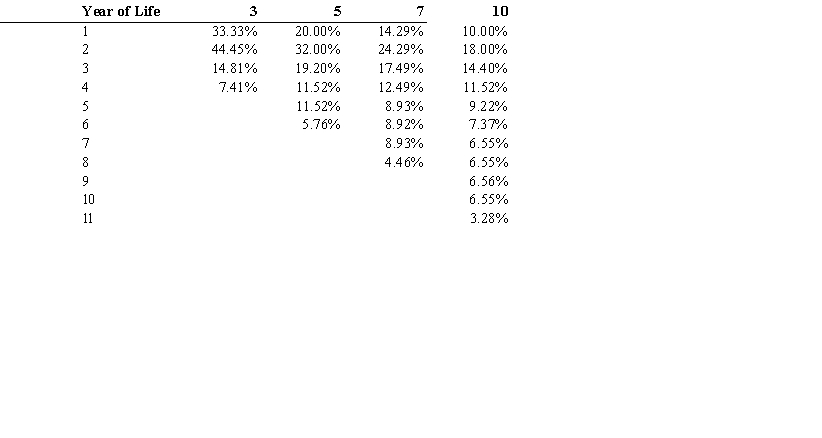
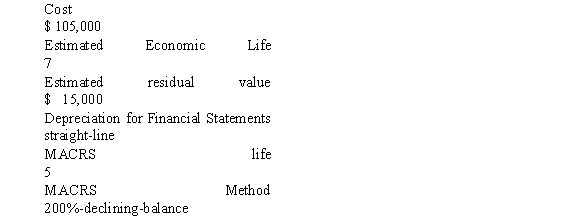 -Refer to Exhibit 11-05, what amount of depreciation would be recorded on the income tax returns for year 3?
 (Multiple Choice)
4.7/5 (77)
(77) On January 1, 2015, Morgantown Co. purchased five machines at a price of $10,000 per machine. Because the estimated life was five years and no salvage value was expected, a group depreciation rate of 20% was used. On January 1, 2017, one of the machines was sold for $5,000. The correct entry to record the sale of the machine is 
(Short Answer)
4.8/5 (89)
(89) On January 1, 2015, the Jones-Smith Corp. acquired a parcel of land for $6,000,000 from which it expects to extract
300,000 tons of coal over the next ten years. Afterwards, the land will be reclaimed at an estimated cost of $650,000 and sold for an estimated $350,000. In 2016, a building was constructed on the mine site at a cost of $680,000. It is estimated that the building will have zero residual value when mining is completed.
During 2015, 15,000 tons of ore were mined, and in 2016, 19,000 tons of ore were mined. At the beginning of 2016, the estimated amount of ore remaining was revised to 250,000 tons.
Required:
a. Prepare the depletion entry for 2015.
b. Determine the total amount of inventoriable costs to be recorded in 2016.
(Essay)
5.0/5 (80)
(80) Development costs incurred for purchasing equipment can be included as part of the cost of a natural resource.
(True/False)
4.8/5 (77)
(77) 
Filters
- Essay(0)
- Multiple Choice(0)
- Short Answer(0)
- True False(0)
- Matching(0)