



 Chat with AI
Exam 11: Depreciation, Depletion, Impairment, and Disposal

Exam 1: The Demand for and Supply of Financial Accounting Information85 Questions
Exam 2: Financial Reporting: Its Conceptual Framework83 Questions
Exam 3: Review of a Company S Accounting System148 Questions
Exam 4: The Balance Sheet and the Statement of Shareholders Equity127 Questions
Exam 5: The Income Statement and the Statement of Cash Flows Time Value of Money Module136 Questions
Exam 6: Cash and Receivables172 Questions
Exam 7: Inventories: Cost Measurement and Flow Assumptions114 Questions
Exam 8: Inventories: Special Valuation Issues141 Questions
Exam 9: Current Liabilities and Contingent Obligations125 Questions
Exam 10: Property, Plant, and Equipment: Acquisition and Subsequent Investments111 Questions
Exam 11: Depreciation, Depletion, Impairment, and Disposal136 Questions
Exam 12: Intangibles136 Questions
Exam 13: Investments and Long-Term Receivables135 Questions
Exam 14: Financing Liabilities: Bonds and Long-Term Notes Payable192 Questions
Exam 15: Contributed Capital153 Questions
Exam 16: Retained Earnings and Earnings Per Share110 Questions
Exam 17: Advanced Issues in Revenue Recognition103 Questions
Exam 18: Accounting for Income Taxes113 Questions
Exam 19: Accounting for Post-Retirement Benefits94 Questions
Exam 20: Accounting for Leases116 Questions
Exam 21: The Statement of Cash Flows103 Questions
Exam 22: Accounting for Changes and Errors130 Questions
Exam 23: Understanding Time Value of Money Formulas and Concepts142 Questions
Select questions type


On January 1, 2016, Bauer Co. had purchased a machine for $60,000. This machine had an estimated service life of eight years and an estimated residual value of $4,000. It has been depreciated by the straight-line method since acquisition. On January 1, 2019, it was determined that the remaining service life for this machine was nine years and that the residual value would be $3,000.
Required:
Record the depreciation expense for 2019.
(Essay)
4.8/5  (77)
(77) Assets sold on or before the 15th are not considered owned for the month based on the nearest whole month convention.
(True/False)
4.7/5 (76)
(76) Which one of the following statements is not a disclosure requirement for depreciation?
(Multiple Choice)
5.0/5 (62)
(62) What costs can be capitalized as part of the cost of a natural resource?
(Essay)
4.8/5 (62)
(62) The Antarctica Co. acquired a machine on January 1, 2016, at a cost of $60,000. The machine is expected to have a ten-year life and a residual value of $5,000. The estimated lifetime output from the machine is expected to be 55,000 units. Under which of the following depreciation methods would the depreciation charge be the greatest in 2016 if 9,100 units were produced during the year?
(Multiple Choice)
4.7/5 (85)
(85) On January 1, 2016, Lefty, Inc. purchased a machine for $6,000. The estimated life and residual value were five years and $150, respectively. The machine will produce approximately 80,000 units over its life. In 2016 and 2017, the machine produced 10,000 and 15,000 units, respectively. In 2017, Lefty recorded $1,440 of depreciation expense. The depreciation method in use was the
(Multiple Choice)
4.8/5 (69)
(69) Choice Mining Co. paid $9,000 for some land that was expected to have 50,000 units of a natural resource on it. Development costs amounted to $520. It was expected that the land would require $780 of reclamation costs after production. In the first year of mining, 5,000 units of the natural resource were mined. At the beginning of the second year, it was estimated that only 40,000 units of the natural resource remained and estimated reclamation costs should be increased to $960. In the second year, 8,000 units were mined. What was the amount of depletion for the second year?
(Multiple Choice)
4.7/5 (69)
(69) Under the MACRS principles, the residual value of the asset is not included in the computation of depreciation.
(True/False)
5.0/5 (77)
(77) Information concerning a mine is as follows: 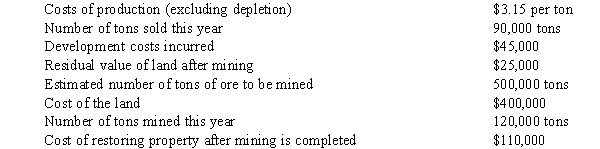 Required:
Compute the total cost of inventory at the end of the year.
Required:
Compute the total cost of inventory at the end of the year. (Essay)
4.9/5 (77)
(77) Tangible assets that are attached to natural resources are depreciated over
(Multiple Choice)
4.9/5 (72)
(72) On June 15, 2015, Jupiter Corporation purchased a machine for $50,000 with an estimated useful life of six years and a residual value of $8,000. The company uses units-of-production depreciation and estimates the machine will last 300,000 units. The machine made 15,000 units in 2015 and 45,000 units in 2016. The accumulated depreciation balance on December 31, 2016, after the adjusting entries have been posted should be
(Multiple Choice)
4.8/5 (89)
(89) On January 2, 2016, Karen's Culinary Delights purchased a piece of equipment for $42,000 with a useful life of seven years and a residual value of $6,000. If Karen's used the sum-of-the-years'-digits method with the half-year convention, depreciation expense for 2016 was
(Multiple Choice)
4.8/5 (78)
(78) Green Vegetable Mfg. Co. purchased equipment on January 1, 2016, at a cost of $800,000. The equipment is expected to have a service life of ten years, or 40,000 hours, and a residual value of $70,000. During 2016, the equipment was operated for 5,000 hours, and during 2017, it was operated for 7,000 hours.
Required:
Fill in the blanks below with the depreciation expense to the nearest whole dollar) for this machine in 2016 and 2017 under each of the following depreciation methods: 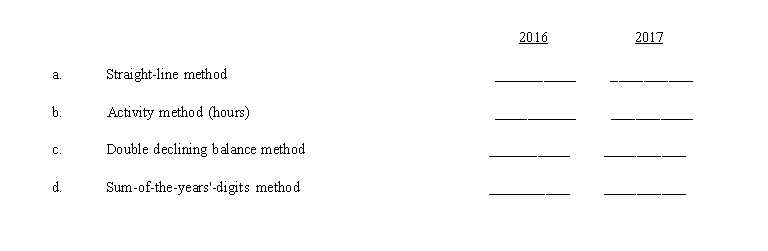
(Essay)
4.8/5 (80)
(80) Many companies that use the declining-balance method of depreciation switch to the straight-line method at some point in the life of a depreciable asset. When does that switch normally occur?
(Multiple Choice)
4.8/5 (93)
(93) A company must include impairment disclosures in the year of an impairment write-down and the subsequent three years following to ensure comparability in reporting.
(True/False)
4.9/5 (89)
(89) 
Filters
- Essay(0)
- Multiple Choice(0)
- Short Answer(0)
- True False(0)
- Matching(0)