



 Chat with AI
Exam 19: Accounting for Post-Retirement Benefits

Exam 1: The Demand for and Supply of Financial Accounting Information85 Questions
Exam 2: Financial Reporting: Its Conceptual Framework83 Questions
Exam 3: Review of a Company S Accounting System148 Questions
Exam 4: The Balance Sheet and the Statement of Shareholders Equity127 Questions
Exam 5: The Income Statement and the Statement of Cash Flows Time Value of Money Module136 Questions
Exam 6: Cash and Receivables172 Questions
Exam 7: Inventories: Cost Measurement and Flow Assumptions114 Questions
Exam 8: Inventories: Special Valuation Issues141 Questions
Exam 9: Current Liabilities and Contingent Obligations125 Questions
Exam 10: Property, Plant, and Equipment: Acquisition and Subsequent Investments111 Questions
Exam 11: Depreciation, Depletion, Impairment, and Disposal136 Questions
Exam 12: Intangibles136 Questions
Exam 13: Investments and Long-Term Receivables135 Questions
Exam 14: Financing Liabilities: Bonds and Long-Term Notes Payable192 Questions
Exam 15: Contributed Capital153 Questions
Exam 16: Retained Earnings and Earnings Per Share110 Questions
Exam 17: Advanced Issues in Revenue Recognition103 Questions
Exam 18: Accounting for Income Taxes113 Questions
Exam 19: Accounting for Post-Retirement Benefits94 Questions
Exam 20: Accounting for Leases116 Questions
Exam 21: The Statement of Cash Flows103 Questions
Exam 22: Accounting for Changes and Errors130 Questions
Exam 23: Understanding Time Value of Money Formulas and Concepts142 Questions
Select questions type


According to GAAP pension expense for a defined benefit pension plan consists of five components.
Required:
List and briefly describe each of the five components of net periodic pension cost that a company must recognize.
(Essay)
4.8/5  (80)
(80) Which of the following is typically the most significant OPEB other postemployment benefits)?
(Multiple Choice)
5.0/5 (87)
(87) Karen Company began a defined benefit pension plan on January 1, 2016. No prior service credit was granted to employees. Service costs amounted to $34,000 in 2016 and $37,000 in 2017. All contributions to the fund were made at the end of the year. A 10% discount rate was used. The expected and actual) rate of return of plan assets was
12%.
Required:
Prepare journal entries for December 31, 2016 and 2017, assuming:
a. Funding equaled expense.
b. $31,000 was funded each year.
c. $38,000 was funded each year.
(Essay)
4.9/5 (68)
(68) The cost of retroactive benefits granted in a plan amendment or at the initial adoption of a pension plan is called
(Multiple Choice)
4.9/5 (64)
(64) A company's pension expense includes all of the following items except
(Multiple Choice)
4.8/5 (81)
(81) Code: A = amortization of unrecognized prior service cost
B = interest cost
C = gain or loss to the extent recognized) D = service cost
E = expected return on plan assets
F = pension expense
Which equation would be correct for the calculation of pension expense?
(Multiple Choice)
4.8/5 (89)
(89) What estimates are necessary to account for a defined benefit pension plan?
(Essay)
4.8/5 (97)
(97) On December 31, 2015, Clemson Company determined that the 2015 service cost on its defined benefit pension plan was $245,000. At the beginning of 2015, Clemson had pension plan assets totaling $990,000 and a projected benefit obligation of $750,000. Its discount rate and expected long-term rate of return on plan assets for 2015 were both 12%.
Required:
1) Compute the amount of Clemson's pension expense for 2015.
2) Record the journal entries for Clemson's 2015 pension expense if it funds the pension plan in the amount of a)
$225,000 and b) $210,000.
(Essay)
4.8/5 (86)
(86) GAAP requires that a company record a loss and liability for termination benefits when
(Multiple Choice)
4.9/5 (86)
(86) Gage began a defined benefit pension plan on January 1, 2015. During 2015, the service cost was $450,000. Gage contributed $450,000 to the pension plan for 2015. The actuary said the projected benefit obligation at December 31, 2015 was $450,000. As of December 31, 2015, what statements can Gage make about the pension plan? I. The pension plan is fully funded.
II) Gage does not need to report a liability regarding the pension plan at December 31, 2015.
(Multiple Choice)
4.8/5 (69)
(69) Which of the following statements regarding postretirement benefits other than pensions is true?
(Multiple Choice)
4.8/5 (80)
(80) Which of the following would not be a component of pension expense?
(Multiple Choice)
4.8/5 (76)
(76) The Maggie Company has a defined benefit pension plan for its employees. The following information pertains to the pension plan as of December 31, 2015: 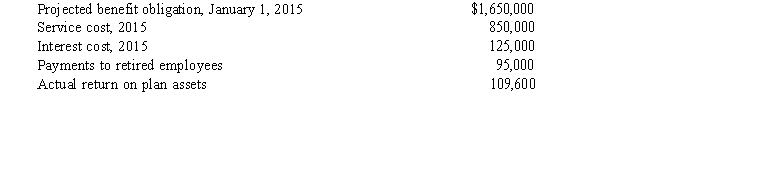 The amount of the December 31, 2015, projected benefit obligation is
 (Multiple Choice)
4.8/5 (71)
(71) A company must fund its pension plan each year at an amount that at least equals service cost for the year plus the amount needed to amortize any underfunding over a
(Multiple Choice)
4.7/5 (84)
(84) The Peanut Company has a defined benefit pension plan for its employees. The following information pertains to the pension plan:  The December 31, 2015 adjusting journal entries include a
 (Multiple Choice)
4.9/5 (78)
(78) In addition to providing pensions to their employees, many companies also offer other postemployment benefits.
These are benefits going to former employees after employment but before retirement.
Required:
Describe how the cost of these benefits is to be accounted for under current GAAP.
(Essay)
4.9/5 (88)
(88) 
Filters
- Essay(0)
- Multiple Choice(0)
- Short Answer(0)
- True False(0)
- Matching(0)