



 Chat with AI
Exam 34: The Influence of Monetary and Fiscal Policy on Aggregate Demand

Exam 1: Ten Principles of Economics455 Questions
Exam 2: Thinking Like an Economist643 Questions
Exam 3: Interdependence and the Gains From Trade547 Questions
Exam 4: The Market Forces of Supply and Demand693 Questions
Exam 5: Elasticity and Its Application626 Questions
Exam 6: Supply, Demand, and Government Policies668 Questions
Exam 7: Consumers, Producers, and the Efficiency of Markets547 Questions
Exam 8: Applications: the Costs of Taxation509 Questions
Exam 9: Application: International Trade521 Questions
Exam 10: Externalities543 Questions
Exam 11: Public Goods and Common Resources452 Questions
Exam 12: The Design of the Tax System664 Questions
Exam 13: The Costs of Production649 Questions
Exam 14: Firms in Competitive Markets604 Questions
Exam 15: Monopoly662 Questions
Exam 16: Monopolistic Competition649 Questions
Exam 17: Oligopoly522 Questions
Exam 18: The Markets for the Factors of Production592 Questions
Exam 19: Earnings and Discrimination511 Questions
Exam 20: Income Inequality and Poverty478 Questions
Exam 21: The Theory of Consumer Choice570 Questions
Exam 22: Frontiers in Microeconomics461 Questions
Exam 23: Measuring a Nation S Income547 Questions
Exam 24: Measuring the Cost of Living565 Questions
Exam 25: Production and Growth527 Questions
Exam 26: Saving, Investment, and the Financial System637 Questions
Exam 27: Tools of Finance534 Questions
Exam 28: Unemployment and Its Natural Rate701 Questions
Exam 29: The Monetary System540 Questions
Exam 30: Money Growth and Inflation504 Questions
Exam 31: Open-Economy Macroeconomics: Basic Concepts540 Questions
Exam 32: A Macroeconomic Theory of the Open Economy511 Questions
Exam 33: Aggregate Demand and Aggregate Supply572 Questions
Exam 34: The Influence of Monetary and Fiscal Policy on Aggregate Demand523 Questions
Exam 35: The Short-Run Tradeoff Between Inflation and Unemployment536 Questions
Exam 36: Six Debates Over Macroeconomic Policy354 Questions
Select questions type


Which of the following sequences best explains the negative slope of the aggregate-demand curve?
(Multiple Choice)
4.8/5  (69)
(69) Suppose there is an increase in government spending. To stabilize output, the Federal Reserve would
(Multiple Choice)
4.8/5 (88)
(88) Suppose the Federal Reserve lowers the target on the interest rate in the Federal Funds market. The Federal Reserve will _____ the money supply and aggregate demand will _____.
(Short Answer)
4.7/5 (83)
(83) The theory of liquidity preference was developed by Irving Fisher.
(True/False)
4.8/5 (81)
(81) Assume the multiplier is 5 and that the crowding-out effect is $30 billion. An increase in government purchases of $20 billion will shift the aggregate-demand curve to the
(Multiple Choice)
4.9/5 (90)
(90) What actions could be taken to stabilize output in response to a large decrease in U.S. net exports?
(Multiple Choice)
4.9/5 (67)
(67) While a television news reporter might state that "Today the Fed raised the federal funds rate from 1 percent to 1.25 percent," a more precise account of the Fed's action would be as follows:
(Multiple Choice)
4.9/5 (72)
(72) Figure 34-4. On the figure, MS represents money supply and MD represents money demand. 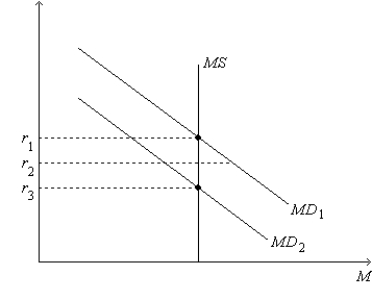 -Refer to Figure 34-4. Suppose the current equilibrium interest rate is r3. Let Y3 represent the corresponding quantity of goods and services demanded, and let P3 represent the corresponding price level. Starting from this situation, if the Federal Reserve decreases the money supply and if the price level remains at P3, then
 (Multiple Choice)
4.9/5 (81)
(81) Which of the following shifts aggregate demand to the right?
(Multiple Choice)
4.9/5 (73)
(73) Figure 34-2. On the left-hand graph, MS represents the supply of money and MD represents the demand for money; on the right-hand graph, AD represents aggregate demand. The usual quantities are measured along the axes of both graphs.
. 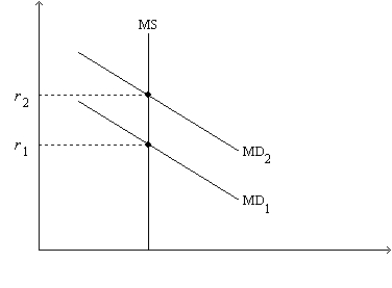
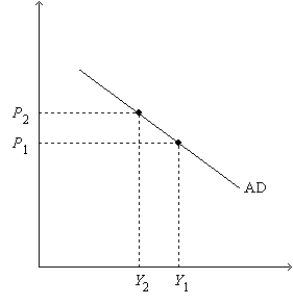 -Refer to Figure 34-2. Which of the following quantities is held constant as we move from one point to another on either graph?
 (Multiple Choice)
4.8/5 (70)
(70) What is the value of the multiplier if the marginal propensity to consume is 0.5?
(Short Answer)
4.9/5 (94)
(94) For a country such as the U.S., the wealth effect exerts a very important influence on the slope of the aggregate-demand curve, since U.S. wealth is large relative to wealth in most other countries.
(True/False)
4.8/5 (79)
(79) A reduction in U.S net exports would shift U.S. aggregate demand
(Multiple Choice)
4.9/5 (73)
(73) The theory of liquidity preference illustrates the principle that
(Multiple Choice)
4.9/5 (76)
(76) Other things equal, in the short run a lower price level leads households to
(Multiple Choice)
4.7/5 (66)
(66) A tax cut shifts the aggregate demand curve the farthest if
(Multiple Choice)
4.8/5 (74)
(74) The interest rate would fall and the quantity of money demanded would
(Multiple Choice)
4.7/5 (88)
(88) If the Federal Reserve increases the money supply, then initially there is a
(Multiple Choice)
4.9/5 (86)
(86) 
Filters
- Essay(0)
- Multiple Choice(0)
- Short Answer(0)
- True False(0)
- Matching(0)