



 Chat with AI
Exam 34: The Influence of Monetary and Fiscal Policy on Aggregate Demand

Exam 1: Ten Principles of Economics455 Questions
Exam 2: Thinking Like an Economist643 Questions
Exam 3: Interdependence and the Gains From Trade547 Questions
Exam 4: The Market Forces of Supply and Demand693 Questions
Exam 5: Elasticity and Its Application626 Questions
Exam 6: Supply, Demand, and Government Policies668 Questions
Exam 7: Consumers, Producers, and the Efficiency of Markets547 Questions
Exam 8: Applications: the Costs of Taxation509 Questions
Exam 9: Application: International Trade521 Questions
Exam 10: Externalities543 Questions
Exam 11: Public Goods and Common Resources452 Questions
Exam 12: The Design of the Tax System664 Questions
Exam 13: The Costs of Production649 Questions
Exam 14: Firms in Competitive Markets604 Questions
Exam 15: Monopoly662 Questions
Exam 16: Monopolistic Competition649 Questions
Exam 17: Oligopoly522 Questions
Exam 18: The Markets for the Factors of Production592 Questions
Exam 19: Earnings and Discrimination511 Questions
Exam 20: Income Inequality and Poverty478 Questions
Exam 21: The Theory of Consumer Choice570 Questions
Exam 22: Frontiers in Microeconomics461 Questions
Exam 23: Measuring a Nation S Income547 Questions
Exam 24: Measuring the Cost of Living565 Questions
Exam 25: Production and Growth527 Questions
Exam 26: Saving, Investment, and the Financial System637 Questions
Exam 27: Tools of Finance534 Questions
Exam 28: Unemployment and Its Natural Rate701 Questions
Exam 29: The Monetary System540 Questions
Exam 30: Money Growth and Inflation504 Questions
Exam 31: Open-Economy Macroeconomics: Basic Concepts540 Questions
Exam 32: A Macroeconomic Theory of the Open Economy511 Questions
Exam 33: Aggregate Demand and Aggregate Supply572 Questions
Exam 34: The Influence of Monetary and Fiscal Policy on Aggregate Demand523 Questions
Exam 35: The Short-Run Tradeoff Between Inflation and Unemployment536 Questions
Exam 36: Six Debates Over Macroeconomic Policy354 Questions
Select questions type


To stabilize interest rates, the Federal Reserve will respond to an increase in money demand by
(Multiple Choice)
4.8/5  (79)
(79) Which U.S. president, when asked why he had proposed a tax cut, responded by saying "To stimulate the economy. Don't you remember your Economics 101?"
(Multiple Choice)
4.7/5 (86)
(86) If net exports fall $40 billion, the MPC is 9/11, and there is a multiplier effect but no crowding out and no investment accelerator, then
(Multiple Choice)
4.7/5 (78)
(78) Figure 34-4. On the figure, MS represents money supply and MD represents money demand. 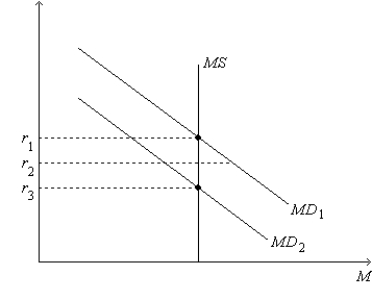 -Refer to Figure 34-4. Which of the following events could explain a decrease in the equilibrium interest rate from r1 to r3?
 (Multiple Choice)
4.9/5 (80)
(80) Supply-side economists focus more than other economists on
(Multiple Choice)
4.8/5 (68)
(68) According to the IGM poll, most economists think that the crowding out effects were stronger than the stimulative effects of ARRA.
(True/False)
4.7/5 (80)
(80) Changes in monetary policy aimed at reducing aggregate demand involve decreasing the money supply or increasing the interest rate.
(True/False)
4.7/5 (88)
(88) Suppose an economy's marginal propensity to consume (MPC) is 0.6. Then
(Multiple Choice)
4.8/5 (83)
(83) Which of the following would not be an expected response from a decrease in the price level and so help to explain the slope of the aggregate-demand curve?
(Multiple Choice)
4.8/5 (83)
(83) The Fed can influence the money supply by changing the interest rate it pays banks on the reserves they are holding.
(True/False)
4.7/5 (79)
(79) Suppose that businesses and consumers become much more optimistic about the future of the economy. To stabilize output, the Federal Reserve could
(Multiple Choice)
4.8/5 (74)
(74) Shifts in the aggregate-demand curve can cause fluctuations in
(Multiple Choice)
4.8/5 (86)
(86) Last year, total income increased $1,000 and consumption increased $800. An increase in government spending equal to $10 would cause output to increase by $_____ because the multiplier is ______.
(Short Answer)
4.7/5 (68)
(68) If the MPC is 0.8 and there are no crowding-out or accelerator effects, then an initial increase in aggregate demand of $120 billion will eventually shift the aggregate demand curve to the right by
(Multiple Choice)
4.9/5 (80)
(80) Open-market purchases cause a(n) _____ in interest rates and a(n) _____ in real GDP in the short run.
(Short Answer)
4.7/5 (89)
(89) The exchange-rate effect is based, in part, on the idea that
(Multiple Choice)
4.9/5 (72)
(72) When the Federal Reserve decreases the Federal Funds target rate, the lower rate is achieved through
(Multiple Choice)
4.8/5 (78)
(78) When the interest rate is above equilibrium, there is excess _____ of money. Households will _____ interest-earning assets, which _____ the interest rate.
(Short Answer)
4.9/5 (90)
(90) According to the theory of liquidity preference, which variable adjusts to balance the supply and demand for money?
(Multiple Choice)
4.8/5 (80)
(80) 
Filters
- Essay(0)
- Multiple Choice(0)
- Short Answer(0)
- True False(0)
- Matching(0)