



 Chat with AI
Exam 35: The Short-Run Tradeoff Between Inflation and Unemployment

Exam 1: Ten Principles of Economics455 Questions
Exam 2: Thinking Like an Economist643 Questions
Exam 3: Interdependence and the Gains From Trade547 Questions
Exam 4: The Market Forces of Supply and Demand693 Questions
Exam 5: Elasticity and Its Application626 Questions
Exam 6: Supply, Demand, and Government Policies668 Questions
Exam 7: Consumers, Producers, and the Efficiency of Markets547 Questions
Exam 8: Applications: the Costs of Taxation509 Questions
Exam 9: Application: International Trade521 Questions
Exam 10: Externalities543 Questions
Exam 11: Public Goods and Common Resources452 Questions
Exam 12: The Design of the Tax System664 Questions
Exam 13: The Costs of Production649 Questions
Exam 14: Firms in Competitive Markets604 Questions
Exam 15: Monopoly662 Questions
Exam 16: Monopolistic Competition649 Questions
Exam 17: Oligopoly522 Questions
Exam 18: The Markets for the Factors of Production592 Questions
Exam 19: Earnings and Discrimination511 Questions
Exam 20: Income Inequality and Poverty478 Questions
Exam 21: The Theory of Consumer Choice570 Questions
Exam 22: Frontiers in Microeconomics461 Questions
Exam 23: Measuring a Nation S Income547 Questions
Exam 24: Measuring the Cost of Living565 Questions
Exam 25: Production and Growth527 Questions
Exam 26: Saving, Investment, and the Financial System637 Questions
Exam 27: Tools of Finance534 Questions
Exam 28: Unemployment and Its Natural Rate701 Questions
Exam 29: The Monetary System540 Questions
Exam 30: Money Growth and Inflation504 Questions
Exam 31: Open-Economy Macroeconomics: Basic Concepts540 Questions
Exam 32: A Macroeconomic Theory of the Open Economy511 Questions
Exam 33: Aggregate Demand and Aggregate Supply572 Questions
Exam 34: The Influence of Monetary and Fiscal Policy on Aggregate Demand523 Questions
Exam 35: The Short-Run Tradeoff Between Inflation and Unemployment536 Questions
Exam 36: Six Debates Over Macroeconomic Policy354 Questions
Select questions type


In the long run, a decrease in the money supply growth rate
(Multiple Choice)
4.9/5  (85)
(85) Suppose that an economy is currently experiencing 10 percent unemployment and 15 percent inflation. If in the process of bringing inflation down by 2 percentage points, real GDP falls by 6 percent for a year, the sacrifice ratio is
(Multiple Choice)
4.9/5 (75)
(75) If inflation expectations rise, the short-run Phillips curve shifts
(Multiple Choice)
4.7/5 (57)
(57) In 1980, the combination of inflation and unemployment the U.S. was experiencing
(Multiple Choice)
4.8/5 (91)
(91) If the central bank increases the growth rate of the money supply and initially inflation expectations are unchanged, then in the short run
(Multiple Choice)
4.8/5 (97)
(97) Use the sticky-wage theory of aggregate demand to explain the short-run Phillips curve.
(Essay)
4.8/5 (67)
(67) Suppose that as a result of a stock market boom, consumers become less concerned about saving for retirement and increase their current consumption expenditures. Which of the following would you expect to occur as a result of this change?
(Multiple Choice)
4.9/5 (81)
(81) In 2001, Congress and President Bush instituted tax cuts. According to the short-run Phillips curve, in the short run this change should have
(Multiple Choice)
4.7/5 (90)
(90) According to the short-run Phillips curve, if the central bank increases the money supply, then
(Multiple Choice)
4.9/5 (78)
(78) The experience of the Volcker disinflation of the early 1980s
(Multiple Choice)
4.9/5 (70)
(70) Suppose the central bank increases the growth rate of the money supply. In the long run, which of the following is unaffected by this change in policy?
(Multiple Choice)
4.9/5 (87)
(87) According to classical macroeconomic theory, in the long run
(Multiple Choice)
4.7/5 (68)
(68) A.W. Phillips's discovery of a particular relationship between unemployment and inflation for the United Kingdom
(Multiple Choice)
4.7/5 (74)
(74) Figure 35-3. The left-hand graph shows a short-run aggregate-supply (SRAS) curve and two aggregate-demand (AD) curves. On the left-hand diagram, Y represents output and on the right-hand diagram, U represents the unemployment rate. 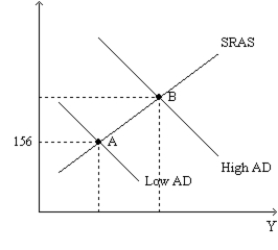
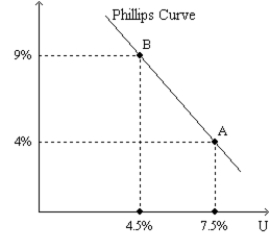 -Refer to Figure 35-3. Assume the figure depicts possible outcomes for the year 2018. In 2018, the economy is at point A on the left-hand graph, which corresponds to point A on the right-hand graph. The price level in the year 2017 was
 (Multiple Choice)
4.8/5 (74)
(74) Which of the following is an example of an adverse supply shock?
(Multiple Choice)
4.9/5 (73)
(73) Which of the following is correct concerning the long-run Phillips curve?
(Multiple Choice)
4.9/5 (76)
(76) Suppose the economy is in long-run equilibrium at an inflation rate of 1% Then inflation expectations rise to 2% and inflation rises to 3%. The increase in expected inflation shifts the short-run Phillips curve
(Multiple Choice)
4.9/5 (77)
(77) 
Filters
- Essay(0)
- Multiple Choice(0)
- Short Answer(0)
- True False(0)
- Matching(0)