



 Chat with AI
Exam 35: The Short-Run Tradeoff Between Inflation and Unemployment

Exam 1: Ten Principles of Economics455 Questions
Exam 2: Thinking Like an Economist643 Questions
Exam 3: Interdependence and the Gains From Trade547 Questions
Exam 4: The Market Forces of Supply and Demand693 Questions
Exam 5: Elasticity and Its Application626 Questions
Exam 6: Supply, Demand, and Government Policies668 Questions
Exam 7: Consumers, Producers, and the Efficiency of Markets547 Questions
Exam 8: Applications: the Costs of Taxation509 Questions
Exam 9: Application: International Trade521 Questions
Exam 10: Externalities543 Questions
Exam 11: Public Goods and Common Resources452 Questions
Exam 12: The Design of the Tax System664 Questions
Exam 13: The Costs of Production649 Questions
Exam 14: Firms in Competitive Markets604 Questions
Exam 15: Monopoly662 Questions
Exam 16: Monopolistic Competition649 Questions
Exam 17: Oligopoly522 Questions
Exam 18: The Markets for the Factors of Production592 Questions
Exam 19: Earnings and Discrimination511 Questions
Exam 20: Income Inequality and Poverty478 Questions
Exam 21: The Theory of Consumer Choice570 Questions
Exam 22: Frontiers in Microeconomics461 Questions
Exam 23: Measuring a Nation S Income547 Questions
Exam 24: Measuring the Cost of Living565 Questions
Exam 25: Production and Growth527 Questions
Exam 26: Saving, Investment, and the Financial System637 Questions
Exam 27: Tools of Finance534 Questions
Exam 28: Unemployment and Its Natural Rate701 Questions
Exam 29: The Monetary System540 Questions
Exam 30: Money Growth and Inflation504 Questions
Exam 31: Open-Economy Macroeconomics: Basic Concepts540 Questions
Exam 32: A Macroeconomic Theory of the Open Economy511 Questions
Exam 33: Aggregate Demand and Aggregate Supply572 Questions
Exam 34: The Influence of Monetary and Fiscal Policy on Aggregate Demand523 Questions
Exam 35: The Short-Run Tradeoff Between Inflation and Unemployment536 Questions
Exam 36: Six Debates Over Macroeconomic Policy354 Questions
Select questions type


If consumer confidence falls, then aggregate demand shifts
(Multiple Choice)
4.8/5  (80)
(80) The economy will move to a point on the short-run Phillips curve where unemployment is higher if
(Multiple Choice)
4.8/5 (70)
(70) To say that the natural rate of unemployment changes over time is to say that
(Multiple Choice)
4.8/5 (65)
(65) In the long run, if the Fed decreases the rate at which it increases the money supply,
(Multiple Choice)
5.0/5 (77)
(77) If the Fed reduces inflation 1 percentage point and this makes output fall 2 percentage points and unemployment rise 3 percentage points for six months, the sacrifice ratio is
(Multiple Choice)
4.9/5 (82)
(82) Figure 35-6
Use the graph below to answer the following questions. 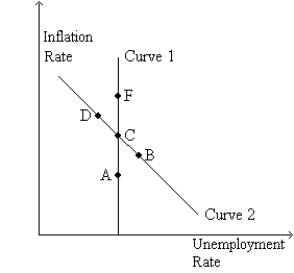 -Refer to Figure 35-6. If the economy starts at C and the money supply growth rate increases, then in the short run the economy moves to
 (Multiple Choice)
4.8/5 (95)
(95) If there is an adverse supply shock and the Federal Reserve responds by increasing the growth rate of the money supply, then in the short run the Federal Reserve's action will raise inflation and lower unemployment.
(True/False)
4.9/5 (89)
(89) Suppose Congress decides to reduce government expenditures by reducing its purchases of weapons systems. Which of the following would you expect to occur as a result of this change?
(Multiple Choice)
4.8/5 (80)
(80) Some economists argue suddenly reducing money supply growth is a costly way to reduce inflation and that it may not work. For example, if a government cuts money growth but makes no real fiscal reforms, people will expect the government will eventually need to expand the money supply to pay for its expenditures. Thus, the promise to fight inflation will not be credible. Explain why credibility is important to a reduction in the inflation rate.
(Essay)
4.9/5 (83)
(83) What evidence does the Volcker disinflation provide concerning the importance of inflation expectations to the costs of disinflation?
(Essay)
4.9/5 (75)
(75) If the central bank increases the money supply, in the short run, output
(Multiple Choice)
4.8/5 (81)
(81) The logic behind the tradeoff between inflation and unemployment is that high aggregate demand puts upward pressure on wages and prices while raising output.
(True/False)
4.7/5 (65)
(65) In the long run, the natural rate of unemployment depends primarily on the growth rate of the money supply.
(True/False)
4.8/5 (80)
(80) A central bank pledges to reduce the inflation rate from 20% to 5%. People reduce their inflation expectations to 10%, but the central bank only reduces inflation to 15%. What happens to the unemployment rate?
(Short Answer)
4.9/5 (82)
(82) If inflation expectations rise, the short-run Phillips curve shifts
(Multiple Choice)
5.0/5 (77)
(77) Just as the aggregate-supply curve slopes upward only in the short run, the trade-off between inflation and unemployment holds only in the short run.
(True/False)
4.9/5 (68)
(68) The short-run relationship between inflation and unemployment is often called
(Multiple Choice)
4.8/5 (74)
(74) 
Filters
- Essay(0)
- Multiple Choice(0)
- Short Answer(0)
- True False(0)
- Matching(0)