



 Chat with AI
Exam 12: Intermolecular Forces: Liquids, Solids, and Phase Changes

Exam 1: Keys to the Study of Chemistry68 Questions
Exam 2: The Components of Matter104 Questions
Exam 3: Stoichiometry of Formulas and Equations96 Questions
Exam 4: Three Major Classes of Chemical Reactions105 Questions
Exam 5: Gases and the Kinetic-Molecular Theory103 Questions
Exam 6: Thermochemistry: Energy Flow and Chemical Change79 Questions
Exam 7: Quantum Theory and Atomic Structure74 Questions
Exam 8: Electron Configuration and Chemical Periodicity81 Questions
Exam 9: Models of Chemical Bonding73 Questions
Exam 10: The Shapes of Molecules108 Questions
Exam 11: Theories of Covalent Bonding56 Questions
Exam 12: Intermolecular Forces: Liquids, Solids, and Phase Changes97 Questions
Exam 13: The Properties of Mixtures: Solutions and Colloids98 Questions
Exam 14: Periodic Patterns in the Main-Group Elements111 Questions
Exam 15: Organic Compounds and the Atomic Properties of Carbon113 Questions
Exam 16: Kinetics: Rates and Mechanisms of Chemical Reactions89 Questions
Exam 17: Equilibrium: the Extent of Chemical Reactions102 Questions
Exam 18: Acid-Base Equilibria106 Questions
Exam 19: Ionic Equilibria in Aqueous Systems115 Questions
Exam 20: Thermodynamics: Entropy, Free Energy, and the Direction of Chemical Reactions85 Questions
Exam 21: Electrochemistry: Chemical Change and Electrical Work102 Questions
Exam 22: The Elements in Nature and Industry56 Questions
Exam 23: The Transition Elements and Their Coordination Compounds92 Questions
Exam 24: Nuclear Reactions and Their Applications90 Questions
Select questions type


A 5.00 g sample of water vapor, initially at 155 C is cooled at atmospheric pressure, producing ice at -55 C. Calculate the amount of heat energy lost by the water sample in this process, in kJ. Use the following data: specific heat capacity of ice is 2.09 J/g ? K; specific heat capacity of liquid water is 4.18 J/g ? K; specific heat capacity of water vapor is 1.84 J/g ? K; heat of fusion of ice is 336 J/g; heat of vaporization of water is 2260 J/g.
(Multiple Choice)
4.9/5  (82)
(82) Which of the following statements about ceramics is incorrect?
(Multiple Choice)
4.8/5 (63)
(63) A metal such with a face-centered cubic lattice will have ________________ atom(s) per unit cell.
(Multiple Choice)
4.9/5 (88)
(88) Which of the following statements about the packing of monatomic solids with different unit cells is incorrect?
(Multiple Choice)
5.0/5 (73)
(73) What word best describes the type of liquid crystal represented in this figure? 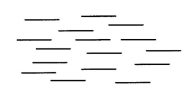
(Multiple Choice)
4.9/5 (89)
(89) Liquid ammonia (boiling point = -33.4 C) can be used as a refrigerant and heat transfer fluid. How much energy is needed to heat 25.0 g of NH3(l) from -65.0 C to -12.0 C?
Specific heat capacity, NH3(l) : 4.7 J/(g ? K)
Specific heat capacity, NH3(g): 2.2 J/(g ? K)
Heat of vaporization: 23.5 kJ/mol
Molar mass, ?: 17.0 g/mol
(Multiple Choice)
4.8/5 (80)
(80) In which of the following compounds will the molecules not form hydrogen bonds with each other?
(Multiple Choice)
4.7/5 (90)
(90) Diethyl ether, used as a solvent for extraction of organic compounds from aqueous solutions, has a high vapor pressure which makes it a potential fire hazard in laboratories in which it is used. How much energy is released when 100.0 g is cooled from 53.0 C to 10.0 C?
Boiling point: 34.5 C
Heat of vaporization: 351 J/g
Specific heat capacity, (CH3)2O(l): 3.74 J/(g ? K)
Specific heat capacity, (CH3)2O(g): 2.35 J/(g ? K)
(Multiple Choice)
4.7/5 (85)
(85) The strongest intermolecular interactions between hydrogen sulfide (H2S) molecules arise from
(Multiple Choice)
4.7/5 (76)
(76) A) State the essential requirements for hydrogen bonding to be important in a compound.
B) List four properties of water which are significantly influenced by the presence of hydrogen bonding.
(Essay)
4.8/5 (75)
(75) Which of the following is true about kinetic energy, Ek, and potential energy, Ep, when ethyl alcohol at 40 C is compared with ethyl alcohol at 20 C?
(Multiple Choice)
4.9/5 (72)
(72) Which one of the following substances will have hydrogen bonds between molecules?
(Multiple Choice)
4.8/5 (75)
(75) Some of the information obtained from the heating or cooling curve of a substance can also be found on a phase diagram of that substance.
(True/False)
4.9/5 (69)
(69) Which of the following atoms should have the smallest polarizability?
(Multiple Choice)
4.8/5 (88)
(88) Use molecular orbital band diagrams to explain why metals are good conductors but semiconductors are not.
(Essay)
4.8/5 (88)
(88) Hexagonal close packing of identical atoms occurs when close-packed layers are stacked in an abcabc.... arrangement.
(True/False)
4.9/5 (98)
(98) Polonium crystallizes in the simple cubic lattice. What is the coordination number for Po?
(Multiple Choice)
5.0/5 (79)
(79) The phase diagram for xenon has a solid-liquid curve with a positive slope. Which of the following is true?
(Multiple Choice)
4.8/5 (87)
(87) 
Filters
- Essay(0)
- Multiple Choice(0)
- Short Answer(0)
- True False(0)
- Matching(0)