



 Chat with AI
Exam 5: Gases and the Kinetic-Molecular Theory

Exam 1: Keys to the Study of Chemistry68 Questions
Exam 2: The Components of Matter104 Questions
Exam 3: Stoichiometry of Formulas and Equations96 Questions
Exam 4: Three Major Classes of Chemical Reactions105 Questions
Exam 5: Gases and the Kinetic-Molecular Theory103 Questions
Exam 6: Thermochemistry: Energy Flow and Chemical Change79 Questions
Exam 7: Quantum Theory and Atomic Structure74 Questions
Exam 8: Electron Configuration and Chemical Periodicity81 Questions
Exam 9: Models of Chemical Bonding73 Questions
Exam 10: The Shapes of Molecules108 Questions
Exam 11: Theories of Covalent Bonding56 Questions
Exam 12: Intermolecular Forces: Liquids, Solids, and Phase Changes97 Questions
Exam 13: The Properties of Mixtures: Solutions and Colloids98 Questions
Exam 14: Periodic Patterns in the Main-Group Elements111 Questions
Exam 15: Organic Compounds and the Atomic Properties of Carbon113 Questions
Exam 16: Kinetics: Rates and Mechanisms of Chemical Reactions89 Questions
Exam 17: Equilibrium: the Extent of Chemical Reactions102 Questions
Exam 18: Acid-Base Equilibria106 Questions
Exam 19: Ionic Equilibria in Aqueous Systems115 Questions
Exam 20: Thermodynamics: Entropy, Free Energy, and the Direction of Chemical Reactions85 Questions
Exam 21: Electrochemistry: Chemical Change and Electrical Work102 Questions
Exam 22: The Elements in Nature and Industry56 Questions
Exam 23: The Transition Elements and Their Coordination Compounds92 Questions
Exam 24: Nuclear Reactions and Their Applications90 Questions
Select questions type


State Amontons's Law and illustrate it with a graph, using standard x-y coordinate axes. Be sure to label the axes unambiguously with the correct gas variables.
(Essay)
4.7/5  (75)
(75) Small quantities of hydrogen can be prepared by the addition of hydrochloric acid to zinc. A sample of 195 mL of hydrogen was collected over water at 25 C and 753 torr. What mass of hydrogen was collected? (Pwater = 24 torr at 25 C)
(Multiple Choice)
4.8/5 (82)
(82) A flask containing argon gas is connected to an closed-ended mercury manometer. The closed end is under vacuum. If the mercury level in the closed arm is 230. mm above that in the arm connected to the flask, what is the argon pressure, in torr?
(Multiple Choice)
4.9/5 (81)
(81) The rate of diffusion of a gas is inversely proportional to its molar mass.
(True/False)
4.7/5 (76)
(76) A sample of oxygen gas has its absolute temperature halved while the pressure of the gas remained constant. If the initial volume is 400 mL, what is the final volume?
(Multiple Choice)
4.8/5 (76)
(76) A gas consists of 85.7 % carbon and 14.3% hydrogen, by weight. A sample of this gas weighing 0.673 g occupies 729 mL at a pressure of 720.0 mmHg and a temperature of 77 C. Calculate its empirical and molecular formulas.
(Multiple Choice)
4.9/5 (79)
(79) According to the postulates of kinetic-molecular theory, the molecules of all gases at a given temperature have the same average kinetic energy.
(True/False)
4.9/5 (79)
(79) "The rate of effusion of a gas is inversely proportional to the square root of its molar mass" is a statement of ______________________ Law.
(Multiple Choice)
4.9/5 (85)
(85) For a gas obeying Charles's Law, a plot of V versus 1/T will give a straight line passing through the origin.
(True/False)
4.8/5 (82)
(82) A compound composed of carbon, hydrogen, and chlorine effuses through a pinhole 0.411 times as fast as neon. Select the correct molecular formula for the compound.
(Multiple Choice)
4.9/5 (86)
(86) . If the partial pressure of argon is 200. torr, what is the pressure of methane, in torr?
(Multiple Choice)
4.8/5 (95)
(95) "The total pressure in a mixture of unreacting gases is equal to the sum of the partial pressures of the individual gases" is a statement of __________________ Law.
(Multiple Choice)
4.9/5 (81)
(81) Select the gas with the highest average kinetic energy per mole at 298 K.
(Multiple Choice)
5.0/5 (84)
(84) Use the van der Waals equation for real gases to calculate the pressure exerted by 1.00 mole of ammonia at 27 C in a 750-mL container. (a = 4.17 L2*atm/mol2, b = 0.0371 L/mol)
(Multiple Choice)
4.8/5 (85)
(85) Which of the lines on the figure below is the best representation of the relationship between the volume of a gas and its pressure, other factors remaining constant? 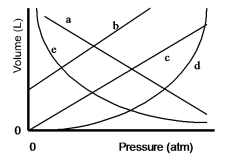
(Multiple Choice)
4.8/5 (94)
(94) A flask with a volume of 3.16 L contains 9.33 grams of an unknown gas at 32.0 C and 1.00 atm. What is the molar mass of the gas?
(Multiple Choice)
4.8/5 (78)
(78) A carbon dioxide sample weighing 44.0 g occupies 32.68 L at 65 C and 645 torr. What is its volume at STP?
(Multiple Choice)
4.9/5 (87)
(87) 
Filters
- Essay(0)
- Multiple Choice(0)
- Short Answer(0)
- True False(0)
- Matching(0)