



 Chat with AI
Exam 9: Models of Chemical Bonding

Exam 1: Keys to the Study of Chemistry68 Questions
Exam 2: The Components of Matter104 Questions
Exam 3: Stoichiometry of Formulas and Equations96 Questions
Exam 4: Three Major Classes of Chemical Reactions105 Questions
Exam 5: Gases and the Kinetic-Molecular Theory103 Questions
Exam 6: Thermochemistry: Energy Flow and Chemical Change79 Questions
Exam 7: Quantum Theory and Atomic Structure74 Questions
Exam 8: Electron Configuration and Chemical Periodicity81 Questions
Exam 9: Models of Chemical Bonding73 Questions
Exam 10: The Shapes of Molecules108 Questions
Exam 11: Theories of Covalent Bonding56 Questions
Exam 12: Intermolecular Forces: Liquids, Solids, and Phase Changes97 Questions
Exam 13: The Properties of Mixtures: Solutions and Colloids98 Questions
Exam 14: Periodic Patterns in the Main-Group Elements111 Questions
Exam 15: Organic Compounds and the Atomic Properties of Carbon113 Questions
Exam 16: Kinetics: Rates and Mechanisms of Chemical Reactions89 Questions
Exam 17: Equilibrium: the Extent of Chemical Reactions102 Questions
Exam 18: Acid-Base Equilibria106 Questions
Exam 19: Ionic Equilibria in Aqueous Systems115 Questions
Exam 20: Thermodynamics: Entropy, Free Energy, and the Direction of Chemical Reactions85 Questions
Exam 21: Electrochemistry: Chemical Change and Electrical Work102 Questions
Exam 22: The Elements in Nature and Industry56 Questions
Exam 23: The Transition Elements and Their Coordination Compounds92 Questions
Exam 24: Nuclear Reactions and Their Applications90 Questions
Select questions type


Hydrogenation of double and triple bonds is an important industrial process. Calculate (in kJ) the standard enthalpy change ?H for the hydrogenation of ethyne (acetylene) to ethane. 

(Multiple Choice)
4.8/5  (89)
(89) Select the correct formula for a compound formed from calcium and chlorine.
(Multiple Choice)
4.8/5 (83)
(83) For which of the following elements (in their normal, stable, forms) would it be correct to describe the bonding as involving "electron pooling"?
(Multiple Choice)
4.8/5 (77)
(77) Most of the copper sold in major metal markets is highly purified, typically to 99.99%. Why is this?
(Essay)
5.0/5 (79)
(79) Ionic bonding typically occurs when a ______________ bonds with a ______________.
(Short Answer)
4.8/5 (81)
(81) Acetone can be easily converted to isopropyl alcohol by addition of hydrogen to the carbon-oxygen double bond. Calculate the enthalpy of reaction using the bond energies given. 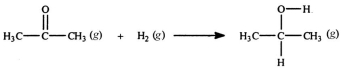

(Multiple Choice)
4.8/5 (73)
(73) Which one of the following properties is least characteristic of typical ionic compounds?
(Multiple Choice)
4.9/5 (75)
(75) The stronger the bonds in a fuel, the more energy it will yield.
(True/False)
4.9/5 (69)
(69) The lattice energy of large ions is greater in magnitude than that of small ions of the same charge.
(True/False)
4.9/5 (78)
(78) In not more than three sentences, describe the electron arrangement responsible for bonding in Cl2 molecules.
(Essay)
4.8/5 (70)
(70) Using appropriate, real examples to illustrate your answer, describe the correlation between bond energy and bond length for a series of single bonds.
(Essay)
4.8/5 (72)
(72) Arrange oxygen, sulfur, calcium, rubidium and potassium in order of decreasing electronegativity.
(Multiple Choice)
5.0/5 (68)
(68) 
Filters
- Essay(0)
- Multiple Choice(0)
- Short Answer(0)
- True False(0)
- Matching(0)