



 Chat with AI
Exam 1: Accounting in Action

Exam 1: Accounting in Action220 Questions
Exam 2: The Recording Process192 Questions
Exam 3: Adjusting the Accounts216 Questions
Exam 4: Completing the Accounting Cycle203 Questions
Exam 5: Accounting for Merchandising Operations221 Questions
Exam 6: Inventories204 Questions
Exam 7: Accounting Information Systems139 Questions
Exam 8: Fraud, Internal Control, and Cash212 Questions
Exam 9: Accounting for Receivables220 Questions
Exam 10: Plant Assets, Natural Resources, and Intangible Assets293 Questions
Exam 11: Current Liabilities and Payroll Accounting207 Questions
Exam 12: Accounting for Partnerships210 Questions
Exam 13: Corporations: Organization and Capital Stock Transactions195 Questions
Exam 14: Corporations: Dividends, Retained Earnings, and Income Reporting176 Questions
Exam 15: Long-Term Liabilities215 Questions
Exam 16: Investments178 Questions
Exam 17: Statement of Cash Flows203 Questions
Exam 18: Financial Analysis: the Big Picture225 Questions
Exam 19: Managerial Accounting197 Questions
Exam 20: Job Order Costing199 Questions
Exam 21: Process Costing198 Questions
Exam 22: Cost-Volume-Profit217 Questions
Exam 23: Incremental Analysis208 Questions
Exam 24: Budgetary Planning207 Questions
Exam 25: Budgetary Control and Responsibility Accounting207 Questions
Exam 26: Standard Costs and Balanced Scorecard221 Questions
Select questions type


A basic assumption of accounting assumes that the dollar is
(Multiple Choice)
4.7/5  (83)
(83) Presented below are balance sheet items for Wilson Company at December 31, 2009.  Compute each of the following:
1. Total assets.
2. Total liabilities.
Compute each of the following:
1. Total assets.
2. Total liabilities. (Essay)
4.9/5 (71)
(71) At October 1, Smithson Enterprises reported owner's equity of $35,000. During October, the owner made additional investments of $5,000 and the company posted a net loss of $3,000. If owner's equity at October 31 totals $35,000, what amount of owner drawings were made during the month?
(Multiple Choice)
4.8/5 (76)
(76) The Securities and Exchange Commission oversees U.S. financial markets and accounting standard-setting bodies.
(True/False)
4.9/5 (88)
(88) Listed below in alphabetical order are the balance sheet items of Pieter Company at December 31, 2009. Prepare a balance sheet and include a complete heading. 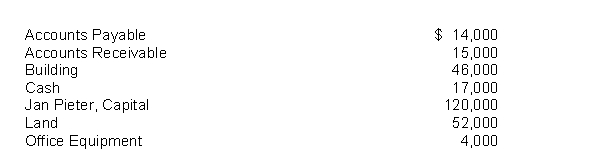
(Essay)
4.8/5 (80)
(80) 
Identify whether the following items would be reported on the income statement (IS) or balance sheet (BS).
1. Cash
2. Service Revenue
3. Notes Payable
4. Interest Expense
5. Accounts Receivable
(Essay)
4.9/5 (82)
(82) On June 1, 2009, Bush Company prepared a balance sheet that shows the following:  Shortly thereafter, all of the assets were sold for cash. How would the balance sheet appear immediately after the sale of the assets for cash for each of the following cases?
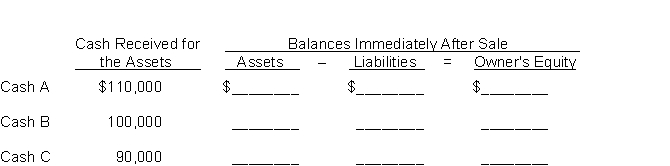
Shortly thereafter, all of the assets were sold for cash. How would the balance sheet appear immediately after the sale of the assets for cash for each of the following cases? (Essay)
4.8/5 (82)
(82) The SEC and FASB are two organizations that are primarily responsible for establishing generally accepted accounting principles. It is true that
(Multiple Choice)
4.8/5 (94)
(94) The primary purpose of the statement of cash flows is to report
(Multiple Choice)
4.8/5 (77)
(77) One item is omitted in each of the following summaries of balance sheet and income statement data for three different sole proprietorships, X, Y, and Z. Determine the amounts of the missing items, identifying each proprietorship by letter. 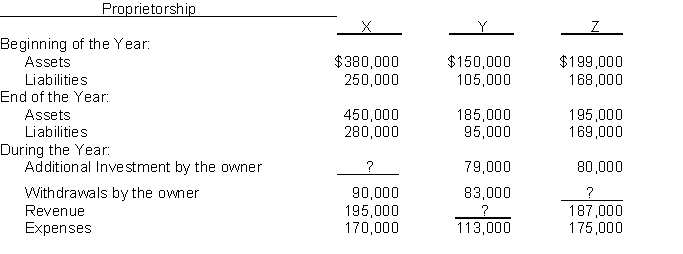
(Essay)
4.8/5 (95)
(95) The three major services rendered by a certified public accountant are ______________, ________________, and management ________________.
(Short Answer)
4.8/5 (67)
(67) The _________________ assumption requires that the activities of an entity be kept separate from the activities of its owner.
(Short Answer)
4.8/5 (92)
(92) The Financial Accounting Standards Board is a part of the Securities and Exchange Commission.
(True/False)
4.7/5 (80)
(80) 
Filters
- Essay(0)
- Multiple Choice(0)
- Short Answer(0)
- True False(0)
- Matching(0)