



 Chat with AI
Exam 1: Accounting in Action

Exam 1: Accounting in Action220 Questions
Exam 2: The Recording Process192 Questions
Exam 3: Adjusting the Accounts216 Questions
Exam 4: Completing the Accounting Cycle203 Questions
Exam 5: Accounting for Merchandising Operations221 Questions
Exam 6: Inventories204 Questions
Exam 7: Accounting Information Systems139 Questions
Exam 8: Fraud, Internal Control, and Cash212 Questions
Exam 9: Accounting for Receivables220 Questions
Exam 10: Plant Assets, Natural Resources, and Intangible Assets293 Questions
Exam 11: Current Liabilities and Payroll Accounting207 Questions
Exam 12: Accounting for Partnerships210 Questions
Exam 13: Corporations: Organization and Capital Stock Transactions195 Questions
Exam 14: Corporations: Dividends, Retained Earnings, and Income Reporting176 Questions
Exam 15: Long-Term Liabilities215 Questions
Exam 16: Investments178 Questions
Exam 17: Statement of Cash Flows203 Questions
Exam 18: Financial Analysis: the Big Picture225 Questions
Exam 19: Managerial Accounting197 Questions
Exam 20: Job Order Costing199 Questions
Exam 21: Process Costing198 Questions
Exam 22: Cost-Volume-Profit217 Questions
Exam 23: Incremental Analysis208 Questions
Exam 24: Budgetary Planning207 Questions
Exam 25: Budgetary Control and Responsibility Accounting207 Questions
Exam 26: Standard Costs and Balanced Scorecard221 Questions
Select questions type


A service proprietorship shows five transactions summarized below. The effect of each transaction on the accounting equation is shown, and also the new balance of each item in the equation. For each transaction (a) to (e) write an explanation of the nature of the transaction. 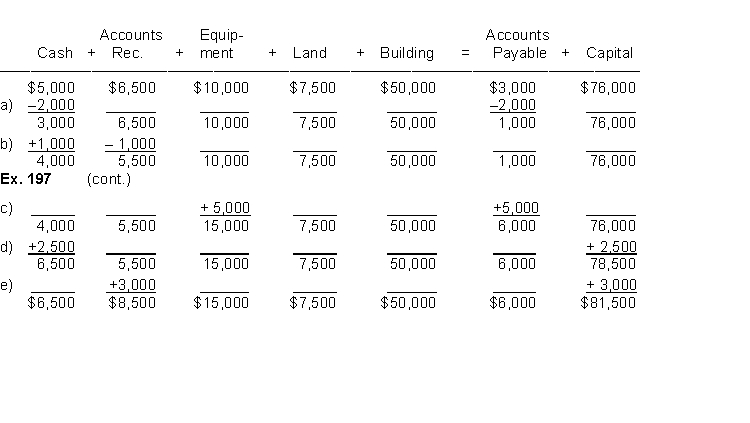
(Essay)
4.9/5  (75)
(75) As of December 31, 2009, Sievers Company has assets of $35,000 and owner's equity of $20,000. What are the liabilities for Sievers Company as of December 31, 2009?
(Multiple Choice)
4.8/5 (84)
(84) All of the following are advantages cost has over other valuations except that it
(Multiple Choice)
4.9/5 (81)
(81) At September 1, the balance sheet accounts for Stanley's Restaurant were as follows:  The following transactions occurred during the next two days:
Stanley invested an additional $22,000 cash in the business. The accounts payable were paid in full. (No payment was made on the notes payable.)
Instructions
Prepare a balance sheet at September 3, 2009.
The following transactions occurred during the next two days:
Stanley invested an additional $22,000 cash in the business. The accounts payable were paid in full. (No payment was made on the notes payable.)
Instructions
Prepare a balance sheet at September 3, 2009. (Essay)
4.8/5 (76)
(76) The monetary unit assumption states that transactions that can be measured in terms of money should be recorded in the accounting records.
(True/False)
4.8/5 (90)
(90) Owners' claims to total business assets take precedence over the claims of creditors because owners invest assets in the business and are liable for losses.
(True/False)
4.8/5 (57)
(57) If total liabilities increased by $14,000 during a period of time and owner's equity decreased by $6,000 during the same period, then the amount and direction (increase or decrease) of the period's change in total assets is a(n)
(Multiple Choice)
4.8/5 (87)
(87) At October 1, Smithson Enterprises reported owner's equity of $35,000. During October, the owner made additional investments of $2,000 and the company earned net income of $6,000. If owner's equity at October 31 totals $40,000, what amount of owner drawings were made during the month?
(Multiple Choice)
4.8/5 (83)
(83) Owner's equity is decreased by all of the following except
(Multiple Choice)
4.8/5 (79)
(79) External transactions involve economic events between the company and some other enterprise or party.
(True/False)
4.9/5 (91)
(91) Use the following information for questions 144-146.
Stahl Consulting started the year with total assets of $20,000 and total liabilities of $5,000. During the year, the business recorded $16,000 in catering revenues and $8,000 in expenses. Stahl made an additional investment of $3,000 and withdrew cash of $5,000 during the year.
-The net income reported by Stahl Consulting for the year was
(Multiple Choice)
4.7/5 (84)
(84) Compute the missing amount in each category of the accounting equation. 
(Essay)
4.9/5 (82)
(82) Selected transactions for Parton Company are listed below. List the number of the transaction and then describe the effect of each transaction on assets, liabilities, and owner's equity.
Sample: Made initial cash investment in the business.
The answer would be-Increase in assets and increase in owner's equity.
1. Paid monthly utility bill.
2. Purchased new display case for cash.
3. Paid cash for repair work on security system.
4. Billed customers for services performed.
5. Received cash from customers billed in 4.
6. Withdrew cash for owner's personal use.
7. Incurred advertising expenses on account.
8. Paid monthly rent.
9. Received cash from customers when service was rendered.
(Essay)
4.9/5 (73)
(73) 
All of the financial statements are for a period of time except the
(Multiple Choice)
4.8/5 (81)
(81) 
Filters
- Essay(0)
- Multiple Choice(0)
- Short Answer(0)
- True False(0)
- Matching(0)