



 Chat with AI
Exam 15: Long-Term Liabilities

Exam 1: Accounting in Action220 Questions
Exam 2: The Recording Process192 Questions
Exam 3: Adjusting the Accounts216 Questions
Exam 4: Completing the Accounting Cycle203 Questions
Exam 5: Accounting for Merchandising Operations221 Questions
Exam 6: Inventories204 Questions
Exam 7: Accounting Information Systems139 Questions
Exam 8: Fraud, Internal Control, and Cash212 Questions
Exam 9: Accounting for Receivables220 Questions
Exam 10: Plant Assets, Natural Resources, and Intangible Assets293 Questions
Exam 11: Current Liabilities and Payroll Accounting207 Questions
Exam 12: Accounting for Partnerships210 Questions
Exam 13: Corporations: Organization and Capital Stock Transactions195 Questions
Exam 14: Corporations: Dividends, Retained Earnings, and Income Reporting176 Questions
Exam 15: Long-Term Liabilities215 Questions
Exam 16: Investments178 Questions
Exam 17: Statement of Cash Flows203 Questions
Exam 18: Financial Analysis: the Big Picture225 Questions
Exam 19: Managerial Accounting197 Questions
Exam 20: Job Order Costing199 Questions
Exam 21: Process Costing198 Questions
Exam 22: Cost-Volume-Profit217 Questions
Exam 23: Incremental Analysis208 Questions
Exam 24: Budgetary Planning207 Questions
Exam 25: Budgetary Control and Responsibility Accounting207 Questions
Exam 26: Standard Costs and Balanced Scorecard221 Questions
Select questions type


Bryce Company has $1,500,000 of bonds outstanding. The unamortized premium is $21,600. If the company redeemed the bonds at 101, what would be the gain or loss on the redemption?
(Multiple Choice)
4.8/5  (84)
(84) Each of the following accounts is reported as long-term liabilities except
(Multiple Choice)
4.7/5 (84)
(84) Franco Corporation reports the following selected financial statement information at December 31, 2010:  Instructions
Calculate the debt to total assets and times interest earned ratios.
Instructions
Calculate the debt to total assets and times interest earned ratios. (Essay)
4.9/5 (74)
(74) In the balance sheet, mortgage notes payable are reported as
(Multiple Choice)
4.8/5 (85)
(85) Taylor Corporation issued $2 million, 10-year, 6% bonds on January 1, 2010.
Instructions
Prepare the entry to record the sale of these bonds, assuming they were issued at
(a) 98.
(b) 103.
(Essay)
4.8/5 (73)
(73) The carrying value of bonds is calculated by adding the balance of the Discount on Bonds Payable account to the balance in the Bonds Payable account.
(True/False)
4.8/5 (95)
(95) If the market interest rate is greater than the contractual interest rate, bonds will sell at a discount.
(True/False)
4.8/5 (93)
(93) Herman Company received proceeds of $188,500 on 10-year, 8% bonds issued on January 1, 2009. The bonds had a face value of $200,000, pay interest semi-annually on June 30 and December 31, and have a call price of 101. Herman uses the straight-line method of amortization.
Herman Company decided to redeem the bonds on January 1, 2011. What amount of gain or loss would Herman report on its 2011 income statement?
(Multiple Choice)
4.9/5 (81)
(81) Which of the following is not a condition under which the lessee must record the lease of an asset?
(Multiple Choice)
5.0/5 (83)
(83) The present value of a $10,000, 5-year bond, will be less than $10,000 if the
(Multiple Choice)
4.9/5 (81)
(81) Presented below are three different aircraft lease transactions that occurred for Midwest Airways in 2010. All the leases start on January 1, 2010. In no case does Midwest receive title to the aircraft during or at the end of the lease period; nor is there a bargain purchase option. 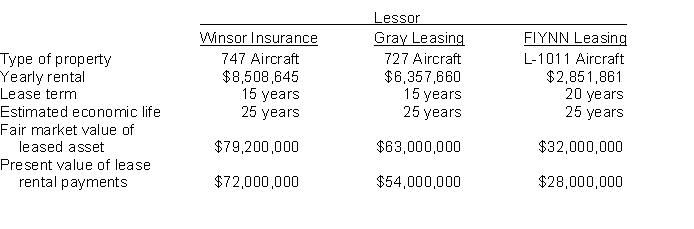 Instructions
(a) Which of the above leases are operating leases and which are capital leases? Explain your answer.
(b) How should the lease transaction with Winsor Insurance be recorded in 2010?
(c) How should the lease transaction with Gray Leasing be recorded in 2010?
Instructions
(a) Which of the above leases are operating leases and which are capital leases? Explain your answer.
(b) How should the lease transaction with Winsor Insurance be recorded in 2010?
(c) How should the lease transaction with Gray Leasing be recorded in 2010? (Essay)
4.9/5 (77)
(77) Which one of the following amounts increases each period when accounting for long-term notes payable?
(Multiple Choice)
4.8/5 (79)
(79) A mortgage note payable with a fixed interest rate requires the borrower to make installment payments over the term of the loan. Each installment payment includes interest on the unpaid balance of the loan and a payment on the principal. With each installment payment, indicate the effect on the portion allocated to interest expense and the portion allocated to principal. 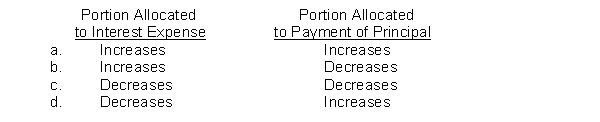
(Short Answer)
4.7/5 (80)
(80) On January 1, 2010, $3,000,000, 5-year, 10% bonds, were issued for $2,910,000. Interest is paid semiannually on January 1 and July 1. If the issuing corporation uses the straight-line method to amortize discount on bonds payable, the monthly amortization amount is
(Multiple Choice)
5.0/5 (81)
(81) The statement that "Bond prices vary inversely with changes in the market interest rate" means that if the
(Multiple Choice)
4.7/5 (88)
(88) A method of amortizing bond discount or premium that allocates an equal amount each period is the ________________ method.
(Short Answer)
4.9/5 (77)
(77) If a $1 million, 10%, 10-year bond issue was sold at 97, the cash proceeds from the issuance of the bonds amounted to $________________.
(Short Answer)
4.8/5 (79)
(79) On January 1, Porter Corporation issued $600,000, 6%, 5-year bonds at face value. Interest is payable semiannually on July 1 and January 1.
Instructions
Prepare journal entries to record the
(a) Issuance of the bonds.
(b) Payment of interest on July 1, assuming no previous accrual of interest.
(c) Accrual of interest on December 31.
(Essay)
4.8/5 (71)
(71) 
Filters
- Essay(0)
- Multiple Choice(0)
- Short Answer(0)
- True False(0)
- Matching(0)