



 Chat with AI
Exam 4: Chemical Quantities and Chemical Reactions

Exam 1: Measuring Matter and Energy99 Questions
Exam 2: Atomic Structure and Nuclear Radiation135 Questions
Exam 3: Compounds and Molecules164 Questions
Exam 4: Chemical Quantities and Chemical Reactions135 Questions
Exam 5: Changes of State and the Gas Laws85 Questions
Exam 6: Organic Chemistry: Hydrocarbons95 Questions
Exam 7: Organic Chemistry and Biomolecules101 Questions
Exam 8: Solutions, Colloids and Membranes93 Questions
Exam 9: Acids and Bases112 Questions
Exam 10: The Reactions of Organic Functional Groups in Biochemistry87 Questions
Exam 11: Carbohydrates: Structure and Function78 Questions
Exam 12: Lipids: Structure and Function108 Questions
Exam 13: Proteins: Structure and Function122 Questions
Exam 14: Nucleotides and Nucleic Acids107 Questions
Exam 15: Energy and Metabolism117 Questions
Select questions type


Hydrogen peroxide loses its potency when it is stored for extended periods of time because it spontaneously breaks down. The following figure illustrates this breakdown, but it is missing a product molecule. Which of the following symbols represents the missing product in this reaction? 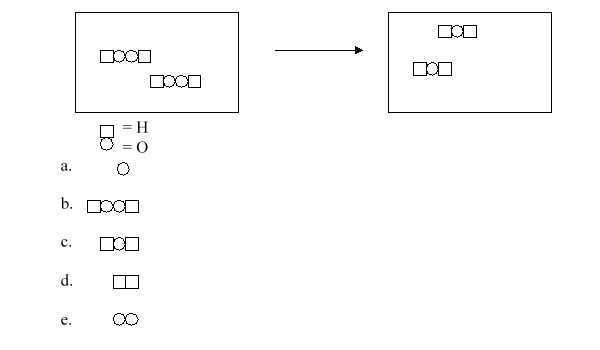
(Multiple Choice)
4.7/5  (90)
(90) Pentane (C5H12) reacts with oxygen gas (O2) to form carbon dioxide (CO2) and water (H2O) according to the following reaction. What is the coefficient for oxygen in the balanced equation? C5H12 + _?_ O2 → _?_ CO2 + _?_ H2O
(Multiple Choice)
4.9/5 (86)
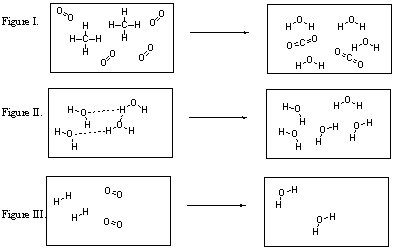
(86) 
Calculate the mass of one mole of dopamine, a neurotransmitter with the molecular formula C8H11NO2.
(Multiple Choice)
4.9/5 (77)
(77) What is the meaning of the arrow in the following chemical equation? 
(Multiple Choice)
4.9/5 (72)
(72) Which of the following transformations is illustrated in Figure II? 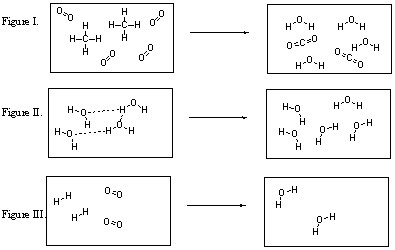
(Multiple Choice)
4.8/5 (86)
(86) Jane Doe has a cholesterol (C27H46O) count of 178 mg/dL. You would like to calculate the number of cholesterol molecules that Jane Doe has in each deciliter of blood. Which of the following calculations is used to solve this problem?
(Multiple Choice)
4.7/5 (84)
(84) During metabolism, table sugar (sucrose) is broken down into monosaccharides. According to the following chemical equation, how many moles of monosaccharides will be produced when 6 moles of sucrose react with 6 moles of water? C12H22O11 + H2O → 2 C6H12O6
Sucrose monosaccharides
(Multiple Choice)
4.7/5 (85)
(85) Atwater and Rosa built the first human calorimeter in the 1890s. After measuring the energy expenditure and food and oxygen intake of humans, they made a key discovery about the transformation of matter and energy in the human body. What discovery did they make?
(Multiple Choice)
5.0/5 (76)
(76) The industrial nitrogen fixing reaction used in the preparation of fertilizers and other nitrogen containing compounds is called the Haber process. The chemical equation for this process is shown below. According to this reaction, how many moles of ammonia would you produce if you reacted one mole of N2 with three moles of H2? N2 + 3 H2 → 2 NH3
(Multiple Choice)
4.8/5 (83)
(83) Below are several chemical equations, each labeled with the names of parts of a chemical equation. Which has the parts labeled correctly. 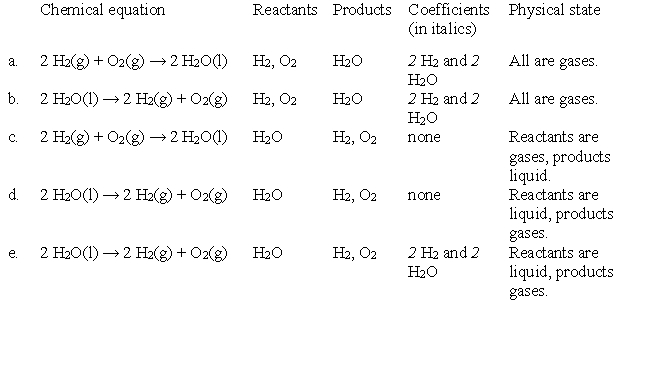
(Multiple Choice)
4.9/5 (75)
(75) 
Filters
- Essay(0)
- Multiple Choice(0)
- Short Answer(0)
- True False(0)
- Matching(0)