



 Chat with AI
Exam 4: Chemical Quantities and Chemical Reactions

Exam 1: Measuring Matter and Energy99 Questions
Exam 2: Atomic Structure and Nuclear Radiation135 Questions
Exam 3: Compounds and Molecules164 Questions
Exam 4: Chemical Quantities and Chemical Reactions135 Questions
Exam 5: Changes of State and the Gas Laws85 Questions
Exam 6: Organic Chemistry: Hydrocarbons95 Questions
Exam 7: Organic Chemistry and Biomolecules101 Questions
Exam 8: Solutions, Colloids and Membranes93 Questions
Exam 9: Acids and Bases112 Questions
Exam 10: The Reactions of Organic Functional Groups in Biochemistry87 Questions
Exam 11: Carbohydrates: Structure and Function78 Questions
Exam 12: Lipids: Structure and Function108 Questions
Exam 13: Proteins: Structure and Function122 Questions
Exam 14: Nucleotides and Nucleic Acids107 Questions
Exam 15: Energy and Metabolism117 Questions
Select questions type


During metabolism, table sugar (sucrose) is broken down into monosaccharides. Which of the following equations could you use to determine the moles of monosaccharides produced when 3 moles of sucrose react with 3 moles of water? 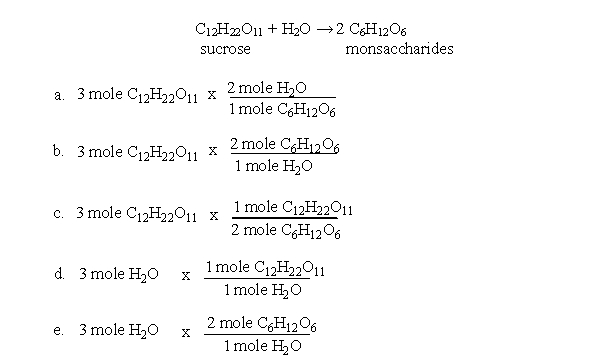
(Multiple Choice)
4.8/5  (86)
(86) Which of the following statements is the best definition of chemical equilibrium?
(Multiple Choice)
5.0/5 (83)
(83) Your friend combines vinegar (which contains acetic acid, CH3COOH) and baking soda (NaHCO3) and ends up with a runny foam. Your friend is pretty sure that the reaction produces water and carbon dioxide, which he can see just by looking at the foam, but he is unsure of what else the reaction produces. Given the partial reaction below, what do you tell your friend? NaHCO3 + CH3COOH → H2O + CO2 + ?
(Multiple Choice)
4.8/5 (68)
(68) By moving, breathing, and living, you do work every day. Work requires energy. Where does this energy come from?
(Multiple Choice)
4.8/5 (72)
(72) The reaction of water with ammonia is shown above. Which of the following substances are present at equilibrium?
(Multiple Choice)
4.8/5 (94)
(94) How many atoms of hydrogen are present in the products of this chemical equation? Mg(OH)2 + 2 HCl → MgCl2 + 2 H2O
(Multiple Choice)
4.9/5 (84)
(84) Which of the following processes that occur over the course of the reaction above gives off heat? 2 H2 + O2 → 2 H2O
(Multiple Choice)
4.9/5 (79)
(79) During anabolism, heat is absorbed. What does the absorption of heat tell us about the relative energies of the starting small molecules and products of anabolism?
(Multiple Choice)
4.9/5 (68)
(68) What is the primary relationship between a chemical reaction and a chemical equation?
(Multiple Choice)
4.9/5 (74)
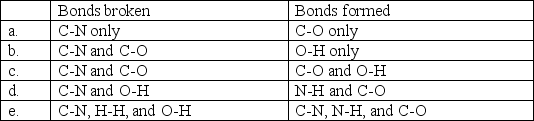
(74) An important part of metabolism is the breakdown of proteins into smaller parts called amino acids. During the course of this reaction, some bonds are broken and others are formed. Select the choice that correctly lists the bonds that are broken and those that are formed. 
(Multiple Choice)
5.0/5 (85)
(85) Which of the following statements describes how formula mass and molecular mass differ?
(Multiple Choice)
4.8/5 (78)
(78) Does one mole of the antibiotic penicillin G (C16H18N2O4S) weigh more or less than one mole of the antibiotic streptomycin (C21H39N7O12)?
(Multiple Choice)
4.8/5 (86)
(86) The reaction between acetic acid (CH3COOH) and methanol (CH3OH) is given below, followed by a list of changes that could be made to the reaction. Which of these changes will result in the equilibrium shifting to the left? 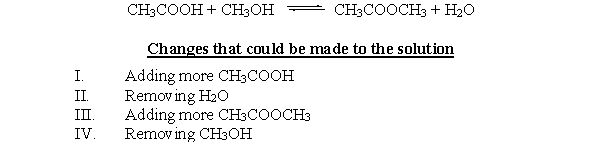
(Multiple Choice)
4.9/5 (86)
(86) Which of the following do you expect would decrease the rate of a reaction?
(Multiple Choice)
4.8/5 (90)
(90) Arsenic poisoning is a serious problem in Bangladesh, China, and Chile, resulting from contaminated well water. When arsenic poisoning occurs, arsenic binds to proteins and eventually causes cellular damage. This leads to a variety of symptoms in humans including exhaustion, muscle weakness, organ failure, and cancer. Arsenic poisoning is commonly treated with a drug called dimercaprol (or BAL) that binds arsenic. This process sets up a competing equilibrium within the body. Once arsenic reacts to form a complex with BAL, it can be excreted from the body. How does excretion of the arsenic-BAL complex affect the equilibrium shown below? Arsenic-protein complex  Arsenic + proteins + BAL
 Arsenic-BAL
Arsenic + proteins + BAL Arsenic-BAL (Multiple Choice)
4.8/5 (73)
(73) How does increasing the temperature of a reaction affect the rate?
(Multiple Choice)
4.8/5 (82)
(82) 

Filters
- Essay(0)
- Multiple Choice(0)
- Short Answer(0)
- True False(0)
- Matching(0)