



 Chat with AI
Exam 4: Chemical Quantities and Chemical Reactions

Exam 1: Measuring Matter and Energy99 Questions
Exam 2: Atomic Structure and Nuclear Radiation135 Questions
Exam 3: Compounds and Molecules164 Questions
Exam 4: Chemical Quantities and Chemical Reactions135 Questions
Exam 5: Changes of State and the Gas Laws85 Questions
Exam 6: Organic Chemistry: Hydrocarbons95 Questions
Exam 7: Organic Chemistry and Biomolecules101 Questions
Exam 8: Solutions, Colloids and Membranes93 Questions
Exam 9: Acids and Bases112 Questions
Exam 10: The Reactions of Organic Functional Groups in Biochemistry87 Questions
Exam 11: Carbohydrates: Structure and Function78 Questions
Exam 12: Lipids: Structure and Function108 Questions
Exam 13: Proteins: Structure and Function122 Questions
Exam 14: Nucleotides and Nucleic Acids107 Questions
Exam 15: Energy and Metabolism117 Questions
Select questions type


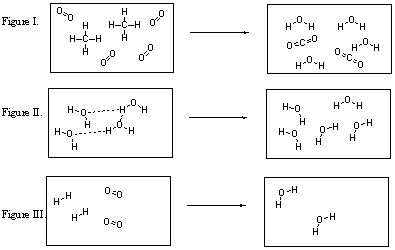

Bond breaking is always endothermic and yet catabolism, the breakdown of nutrients, is an overall exothermic process. How can you reconcile these two statements?
(Multiple Choice)
4.8/5  (86)
(86) Which of the following transformations is a chemical reaction?
(Multiple Choice)
4.9/5 (71)
(71) Below are several statements. Which of these statements apply to chemical reactions?
I. A chemical reaction always involves two reactants.
II. Physical changes are a type of chemical reaction.
III. Energy changes are involved in chemical reactions.
IV. Atoms are gained and lost during a chemical reaction.
V. Bonds are broken and new bonds formed during a chemical reaction.
(Multiple Choice)
4.9/5 (85)
(85) Arsenic poisoning is a serious problem in Bangladesh, China, and Chile, resulting from contaminated well water. When arsenic poisoning occurs, arsenic binds to proteins and eventually causes cellular damage. This leads to a variety of symptoms in humans including exhaustion, muscle weakness, organ failure, and cancer. Arsenic poisoning is commonly treated with a drug called dimercaprol (or BAL) that binds arsenic. This process sets up a competing equilibrium within the body. Once arsenic reacts to form a complex with BAL, it can be excreted from the body. How does treatment with BAL affect the equilibrium shown below? Arsenic-protein complex  Arsenic + proteins + BAL
 Arsenic-BAL complex
Arsenic + proteins + BAL Arsenic-BAL complex (Multiple Choice)
4.8/5 (92)
(92) The enthalpy for the reaction described by the energy diagram below is 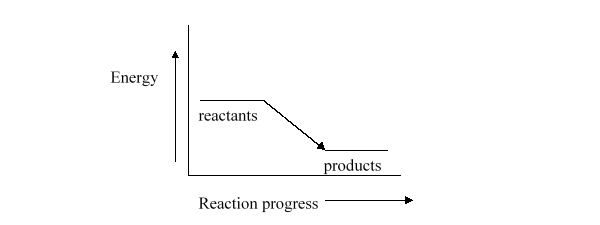
(Multiple Choice)
4.8/5 (72)
(72) If Jane Doe has a blood carbon dioxide concentration of 0.022 mol/L, how many carbon dioxide molecules are in each liter of her blood?
(Multiple Choice)
4.7/5 (72)
(72) The following chemical equation, the decomposition of hydrogen peroxide to water, is not balanced. What must be done to the equation to make it balanced? 2 H2O2 (l) → 2 H2O (l)
(Multiple Choice)
4.8/5 (82)
(82) The reaction of water with ammonia is shown below. Which of the following statements best describes the concentration of ammonia and ammonium at equilibrium? 
(Multiple Choice)
4.9/5 (85)
(85) Which of the following equations best describes how to calculate the molar mass of Mg(OH)2?
(Multiple Choice)
4.8/5 (92)
(92) Which of the following reactions could be described by the energy diagram below? 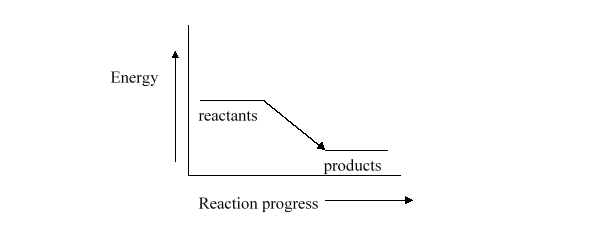
(Multiple Choice)
4.8/5 (78)
(78) Which part of the following energy diagram is changed when a catalyst is added, and how is it changed? 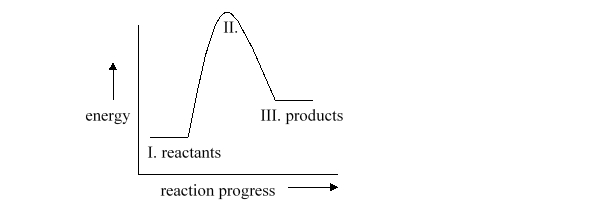
(Multiple Choice)
4.8/5 (89)
(89) Coefficients are important components of chemical equations. What is the significance of coefficients in a chemical equation? I. Coefficients indicate the ratio of masses of molecules.
II) Coefficients indicate the ratio of numbers of atoms and molecules.
III) Coefficients indicate the ratio of numbers of moles of molecules and atoms.
(Multiple Choice)
4.8/5 (86)
(86) Is this chemical equation balanced? Mg(OH)2 + 2 HCl → MgCl2 + 2 H2O
(Multiple Choice)
4.8/5 (81)
(81) 
Filters
- Essay(0)
- Multiple Choice(0)
- Short Answer(0)
- True False(0)
- Matching(0)