



 Chat with AI
Exam 4: Chemical Quantities and Chemical Reactions

Exam 1: Measuring Matter and Energy99 Questions
Exam 2: Atomic Structure and Nuclear Radiation135 Questions
Exam 3: Compounds and Molecules164 Questions
Exam 4: Chemical Quantities and Chemical Reactions135 Questions
Exam 5: Changes of State and the Gas Laws85 Questions
Exam 6: Organic Chemistry: Hydrocarbons95 Questions
Exam 7: Organic Chemistry and Biomolecules101 Questions
Exam 8: Solutions, Colloids and Membranes93 Questions
Exam 9: Acids and Bases112 Questions
Exam 10: The Reactions of Organic Functional Groups in Biochemistry87 Questions
Exam 11: Carbohydrates: Structure and Function78 Questions
Exam 12: Lipids: Structure and Function108 Questions
Exam 13: Proteins: Structure and Function122 Questions
Exam 14: Nucleotides and Nucleic Acids107 Questions
Exam 15: Energy and Metabolism117 Questions
Select questions type


According to the balanced chemical equation below, if you react 3.0 mole of butene with 3.0 mole of hydrogen, how many moles of butane would you expect to get? 
(Multiple Choice)
4.9/5  (69)
(69) A calorimeter is used to measure the energy content of foods because the energy measurement obtained using a calorimeter is the same as the energy we obtain by eating. Which of the following statements explains why this is the case?
(Multiple Choice)
4.9/5 (77)
(77) During anabolism, heat is absorbed. What does the absorption of heat tell us about how these reactions occur?
(Multiple Choice)
4.8/5 (86)
(86) Which of the following statements describe how oxygen intake relates to caloric requirements? I. Oxygen reacts with food to produce energy.
II) The larger the oxygen intake, the higher the energy output.
III) Oxygen is a product of food metabolism.
(Multiple Choice)
4.9/5 (68)
(68) According to the balanced chemical equation below, if, you react 28 grams of butene with excess hydrogen, how many grams of butane would you expect to get? 
(Multiple Choice)
4.8/5 (75)
(75) Which statement best describes how the temperature of the surroundings change as a result of the reaction represented by energy diagram below? 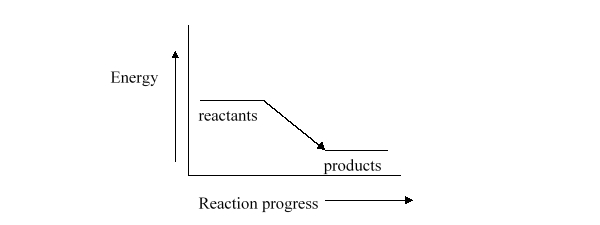
(Multiple Choice)
4.9/5 (75)
(75) The name for the heat energy released or absorbed in a chemical reaction is
(Multiple Choice)
4.8/5 (74)
(74) Which of the following must occur for there to be a chemical reaction?
(Multiple Choice)
4.9/5 (85)
(85) How is a nuclear reaction different from a chemical reaction?
(Multiple Choice)
4.8/5 (74)
(74) Which of the following statements best describes how calorimetry is used in medicine?
(Multiple Choice)
4.8/5 (90)
(90) A normal blood oxygen (O2) level is 8.0 mmol/L. What is the normal mass of oxygen per liter of blood?
(Multiple Choice)
4.9/5 (72)
(72) A reaction occurs between the large black spheres and the small grey spheres. Each of the boxes below represents different reaction conditions for that reaction. Which of the given boxes contains the reaction conditions that lead to the fastest reaction?
(Multiple Choice)
4.7/5 (89)
(89) A molecule of oxygen, O2, has a molar mass of 32.00 g/mole. What is the mass of 4.52 1023 O2 molecules?
(Multiple Choice)
4.9/5 (89)
(89) According to the balanced chemical equation below, if you react 3.0 mole of butene with 3.0 mole of hydrogen, how many grams of butane would you expect to get? 
(Multiple Choice)
4.9/5 (83)
(83) In the body, glucose is broken down in the presence of oxygen into carbon dioxide and water. The balanced chemical equation for this reaction is shown below. According to this equation, how many molecules of carbon dioxide are produced when three molecules of glucose are metabolized in the presence of 18 moles of oxygen? C6H12O6 + 6 O2 → 6 CO2 + 6 H2O
(Multiple Choice)
5.0/5 (82)
(82) Jane Doe has her cholesterol measured and the resulting lab report gives a value of 0.548 10-3 mol/dL. You know that the normal range of cholesterol (C27H46O) is 0.100 - 0.240 g/dL. Is Jane Doe's cholesterol within the normal range?
(Multiple Choice)
4.8/5 (61)
(61) 
Filters
- Essay(0)
- Multiple Choice(0)
- Short Answer(0)
- True False(0)
- Matching(0)