



 Chat with AI
Exam 12: Lipids: Structure and Function

Exam 1: Measuring Matter and Energy99 Questions
Exam 2: Atomic Structure and Nuclear Radiation135 Questions
Exam 3: Compounds and Molecules164 Questions
Exam 4: Chemical Quantities and Chemical Reactions135 Questions
Exam 5: Changes of State and the Gas Laws85 Questions
Exam 6: Organic Chemistry: Hydrocarbons95 Questions
Exam 7: Organic Chemistry and Biomolecules101 Questions
Exam 8: Solutions, Colloids and Membranes93 Questions
Exam 9: Acids and Bases112 Questions
Exam 10: The Reactions of Organic Functional Groups in Biochemistry87 Questions
Exam 11: Carbohydrates: Structure and Function78 Questions
Exam 12: Lipids: Structure and Function108 Questions
Exam 13: Proteins: Structure and Function122 Questions
Exam 14: Nucleotides and Nucleic Acids107 Questions
Exam 15: Energy and Metabolism117 Questions
Select questions type


Which of the following type of molecule is not a lipid?

Free
(Multiple Choice)
4.9/5  (77)
(77) Correct Answer: Verified
A
The melting point of a fatty acid is determined by _________in the fatty acid.
Free
(Multiple Choice)
4.8/5 (84)
(84) Correct Answer:Verified
VerifiedD
Which of the following choices best describes the structure and function of a chylomicron, illustrated below? 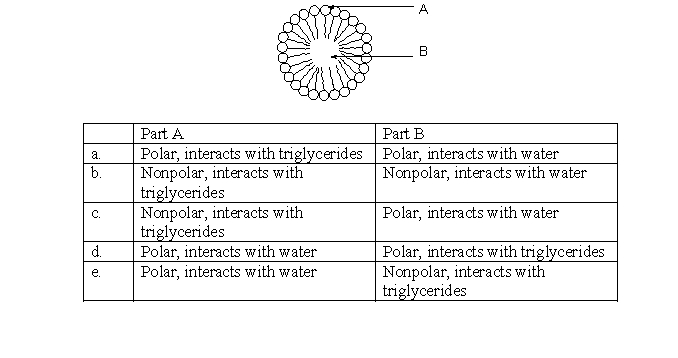
Free
(Multiple Choice)
4.8/5 (90)
(90) Correct Answer:Verified
VerifiedE
Why do unsaturated fatty acids have lower melting points than saturated fatty acids?
(Multiple Choice)
4.9/5 (80)
(80) Which of the following types of lipids are derived from fatty acids and are involved in the body's inflammatory response?
(Multiple Choice)
4.9/5 (81)
(81) Which of the following statements about cholesterol is NOT true?
(Multiple Choice)
4.7/5 (85)
(85) The type of molecules that make up the majority of the cell membrane are
(Multiple Choice)
4.9/5 (69)
(69) Cholesterol is shown below, on the left. To the right are two derivatives of cholesterol: cholic acid and vitamin D3. Which of the statements below best describe how cholesterol must be modified to become cholic acid and vitamin D3? 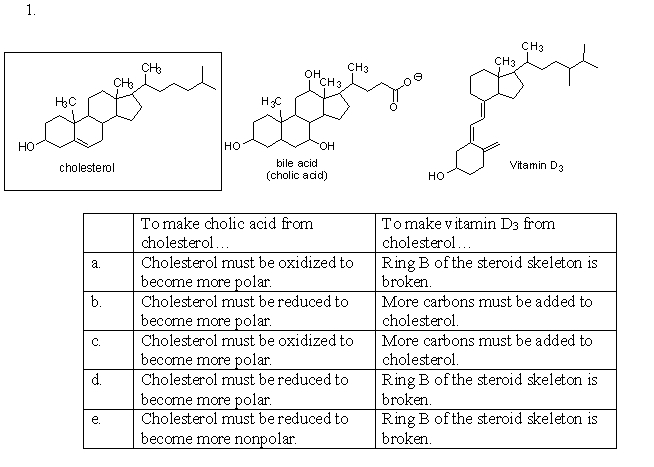
(Multiple Choice)
4.9/5 (70)
(70) 
Which of the following choices correctly numbers linolenic acid (shown below) using the omega system? 
(Multiple Choice)
4.9/5 (79)
(79) Which of the following choices correctly numbers pinolenic acid (shown below) using the omega system? 

(Multiple Choice)
4.9/5 (70)
(70) In which of the following choices are the three molecules below correctly identified as polar, nonpolar or amphipathic? 

(Multiple Choice)
4.8/5 (82)
(82) 
In the following illustration of a cell membrane, the molecule that acts as a receptor, communicating with molecules such as steroids, is represented by the letter 
(Multiple Choice)
4.8/5 (85)
(85) 
Filters
- Essay(0)
- Multiple Choice(0)
- Short Answer(0)
- True False(0)
- Matching(0)