



 Chat with AI
Exam 7: The Road to Revolution 1763-1775

Exam 1: New World Beginnings53 Questions
Exam 2: The Planting of English America 1500-173353 Questions
Exam 3: Settling the Northern Colonies 1619-170053 Questions
Exam 4: American Life in the 17th Century 1607-169253 Questions
Exam 5: Colonial Society on the Eve of Revolution 1700-177552 Questions
Exam 6: The Duel for North America 1608-176352 Questions
Exam 7: The Road to Revolution 1763-177552 Questions
Exam 8: America Secedes from the Empire 1775-178352 Questions
Exam 9: The Confederation and the Constitution 1776-179051 Questions
Select questions type


The following questions refer to the excerpt below.
"As a group,workers faced severe limitations on their political influence. The conservative nature of the major parties,institutional discrimination against third parties,and ethnic divisions that made some workingmen Democrats and others Republicans all placed obstacles in front of even those most empowered workers,the white men possessing citizenship. Far more striking was the way America's political system victimized female…and African-American workers through disenfranchisement… These barriers extinguished any possibility that American workers could become a united political force during the Gilded Age."
Julie Green,Pure and Simple Politics: The American Federation of Labor and Political Activism,
1881-1917,1998
-Despite the problems highlighted by the author,which of the following characteristics of the twentieth century helped to unite the groups described in the passage?
(Multiple Choice)
4.9/5  (88)
(88) The following questions refer to the graph below.
Index of Common Stock Prices (1926=100)
 -"The periods of World War I [and World War II] coincided with significant migration north from Mexico… [as] many Mexicans moved to the border…[and] easily found work in the United States since domestic mobilization for the war…greatly stimulated business… Although Mexican emigrants did not consider the United States a perfect destination,the economic boom of the 1920s at least presented the possibility of steady employment… However,consequences of the depression in 1929 and 1930 were immediate and unfortunate for the Mexican community living in the United States… The forced repatriations of the Great Depression,very close in time to World War II,painfully showed the Mexican government the truly precarious position of Mexican workers,legal and undocumented alike,in the U.S.economy."
Barbara A.Driscoll,The Tracks North: The Railroad Bracero Program of World War II,1999
Using the excerpt above,answer parts a,b,and c.
a)Briefly explain a cause OR effect of the migration described in the passage during the 1930s using ONE piece of evidence not directly mentioned in the excerpt.
b)Briefly explain a cause OR effect of the migration described in the passage during the 1940s using ONE piece of evidence not directly mentioned in the excerpt.
c)Briefly explain ONE government policy related to the migration described in the passage using ONE piece of evidence not directly mentioned in the excerpt.
-"The periods of World War I [and World War II] coincided with significant migration north from Mexico… [as] many Mexicans moved to the border…[and] easily found work in the United States since domestic mobilization for the war…greatly stimulated business… Although Mexican emigrants did not consider the United States a perfect destination,the economic boom of the 1920s at least presented the possibility of steady employment… However,consequences of the depression in 1929 and 1930 were immediate and unfortunate for the Mexican community living in the United States… The forced repatriations of the Great Depression,very close in time to World War II,painfully showed the Mexican government the truly precarious position of Mexican workers,legal and undocumented alike,in the U.S.economy."
Barbara A.Driscoll,The Tracks North: The Railroad Bracero Program of World War II,1999
Using the excerpt above,answer parts a,b,and c.
a)Briefly explain a cause OR effect of the migration described in the passage during the 1930s using ONE piece of evidence not directly mentioned in the excerpt.
b)Briefly explain a cause OR effect of the migration described in the passage during the 1940s using ONE piece of evidence not directly mentioned in the excerpt.
c)Briefly explain ONE government policy related to the migration described in the passage using ONE piece of evidence not directly mentioned in the excerpt. (Essay)
4.7/5 (86)
(86) The following questions refer to the cartoon below.
 MPI/Getty Images
"The Only Way to Handle It",1921
-The influx of immigrants in the early 20th century
MPI/Getty Images
"The Only Way to Handle It",1921
-The influx of immigrants in the early 20th century (Multiple Choice)
4.8/5 (77)
(77) The following questions refer to the excerpt below.
"The United States will,indeed,undertake under Article X to 'respect and preserve as against external aggression the territorial integrity and existing political independence of all members of the League [of Nations]' and that engagement constitutes a very grave and solemn moral obligation. But it is a moral,not a legal,obligation,and leaves our Congress absolutely free to put its own interpretation upon it in all cases that call for action."
Woodrow Wilson,Testimony before the Senate over Article X of the Treaty of Versailles,1919
-Opponents of this treaty would echo
(Multiple Choice)
4.8/5 (77)
(77) The following questions refer to the excerpt below.
"Conservatives,liberals,radicals of all shades and intensity,are agreed in denouncing the criminal indifference that is shown to the murderous conditions in which men,women,girls and mere children are compelled to earn their bread.The Triangle disaster has revealed an appalling state of affairs that exists though the factory district of New York City,and that presumably exists in varying degrees of badness in other cities.From the standpoint of safety of the workers everything was wrong.And yet it is hard to single out one person or institution and say that there belongs the blame.The proprietors of the Triangle Company were violating no law,and were but following the instincts and practices common among manufacturers in their trade…The ultimate blame must be traced back to…an indifference or unawakened public."
Miriam Finn Scott,"The Factory Girl's Danger," The Outlook,April 15,1911
-A member of which of the following groups would most likely agree with the tone taken in this excerpt?
(Multiple Choice)
4.8/5 (80)
(80) The following questions refer to the graph below.
Index of Common Stock Prices (1926=100)
-The trend shown between 1933 and 1937 would contribute to
-The trend shown between 1933 and 1937 would contribute to (Multiple Choice)
4.8/5 (77)
(77) The following questions refer to the graph below.
Index of Common Stock Prices (1926=100)
-Answer parts a,b,and c.
a)The United States mobilized its armed forces to join the conflict in both World War I and World War II.Briefly explain ONE important similarity in the home front impact of these two conflicts.
b)Briefly explain ONE important difference in the home front impact of these two conflicts.
c)Briefly explain the long-term impact of ONE of these two conflicts,making sure to include at least ONE piece of evidence to support your explanation.
-Answer parts a,b,and c.
a)The United States mobilized its armed forces to join the conflict in both World War I and World War II.Briefly explain ONE important similarity in the home front impact of these two conflicts.
b)Briefly explain ONE important difference in the home front impact of these two conflicts.
c)Briefly explain the long-term impact of ONE of these two conflicts,making sure to include at least ONE piece of evidence to support your explanation. (Essay)
4.8/5 (82)
(82) The following questions refer to the excerpt below.
"It is not alone members of Congress that the war party in this country has sought to intimidate. The mandate seems to have gone forth to the sovereign people of this country that they must be silent while those things are being done by their government which most vitally concern their well-being… It appears to be the purpose of those conducting this campaign to throw the country into a state of terror,to coerce public opinion,to stifle criticism,and suppress discussion of the great issues involved in this war. I think all men recognize that in time of war the citizen must surrender some rights for the common good which he is entitled to enjoy in time of peace. But…more than all,the citizen and his representative in Congress in time of war must maintain his right of free speech…to discuss in an orderly way frankly and publicly and without fear…every important phase of this war;its causes,the manner in which it should be conducted,and the terms upon which peace should be made."
Senator Robert M.LaFollette,speech before the Senate,"Free Speech in Wartime",October 6,1917
-The passage reveals a strong tension in the United States between the ideals of
(Multiple Choice)
4.8/5 (91)
(91) DOCUMENT BASED
DBQ Directions
Directions: These questions are based on the accompanying documents.The documents have been edited for the purpose of this exercise.
In your response you should do the following:
•State a relevant thesis that directly addresses all parts of the question.
•Support the thesis or a relevant argument with evidence from all,or all but one,of the documents.
•Incorporate analysis of all,or all but one,of the documents into your argument.
•Focus your analysis of each document on at least one of the following: intended audience,purpose,historical context,and/or point of view.
•Support your argument with analysis of historical examples outside the documents.
•Connect historical phenomena relevant to your argument to broader events or processes.
•Synthesize the elements above into a persuasive essay that extends your argument,connects it to a different historical context,or accounts for contradictory evidence on the topic.
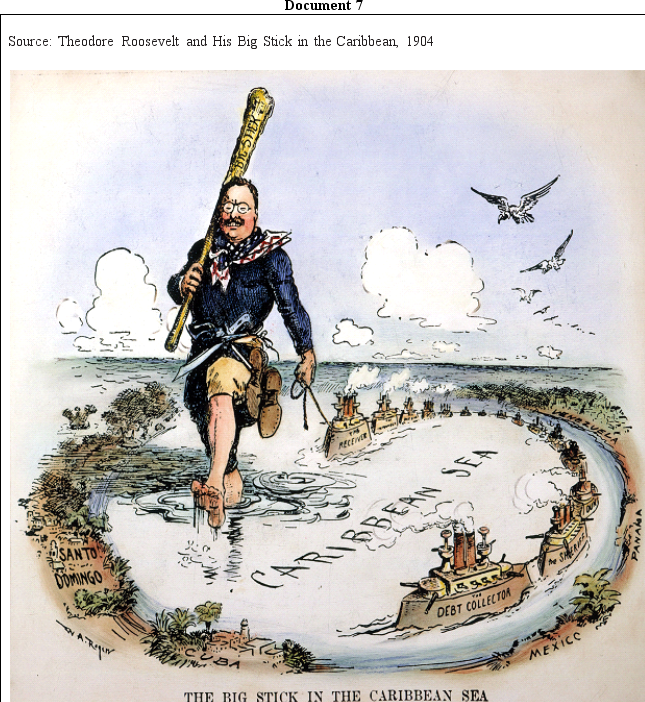
-Analyze the motivations of the United States in its foreign-policy decisions in the period from 1898 to 1908.To what extent did the nation build consensus for its actions?
Document 1
Source: Alfred Thayer Mahan, The Influence of Sea Power Upon History, 1890
The government by its policy can favor the natural growth of a people's industries and its tendencies to seek adventure and gain by way of the sea…
Colonies attached to the mother-country afford, therefore, the surest means of supporting abroad the sea power of a country… Such colonies the United States has not… Having therefore no foreign establishments, either colonial or military, the ships of war of the United States, in war, will be like land birds, unable to fly far from their own shores. To provide resting-places for them, where they can coal and repair, would be one of the first duties of a government proposing to itself the development of the power of the nation.
Document 2
Source: William M. Springer, “The Hawaiian Situation: Our Present Duty,” North American Review, December 1893
Whether the government of Hawaii is a good government or a just government is a matter for the people of that island to determine for themselves. There is no divine right of republicanism in this world, any more than there is a divine right of kings. The divinity in all these matters is in the right of the people to govern themselves... The so-called provisional government did not emanate from [the people of Hawaii], and does not have their sanction. It is a usurpation, which could not have had any de facto existence, to say nothing of a rightful existence, except for the presence of the overpowering armed forces of the United States… We must restore to the queen her own armed forces and we must disarm the forces of the provisional government which were armed and equipped by the aid and under the protection of our navies. Anything short of this is a mockery of justice, a disgrace to our diplomacy, is unworthy of a Christian nation, and a travesty upon our devotion to the principles of local self-government.
Documents 3
Source: Treaty of Paris, 1898
Article I.
Spain relinquishes all clain of sovereignty over and title to Cuba
Article II.
Spain cedes to the Urited States the island of Porto Rico... and the island af Guam..
Article III.
Spain cedes to the United States the archipelago known as the Philippine Islands...The United States will pay to Spain the sum of twenty million dollars ($20,000,000) within three months after the exchange of the ratifications of the present treaty.
Document 4
Source: Statement attributed to President William McKinley, describing to a church delegation the decision to acquire the Philippines, 1899
When next I realized that the Philippines had dropped into our laps, I confess I did not know what to do with them… I walked the floor of the White House night after night until midnight; …I went down on my knees and prayed to Almighty God for light and guidance… And one night late it came to me:
…(1) That we could not give them back to Spain-that would be cowardly and dishonorable;
(2) That we could not turn them over to France or Germany, our commercial rivals in the Orient-that would be bad business and discreditable;
(3) That we could not leave them to themselves-they were unfit for self-government, and they would soon have anarchy and misrule worse than Spain's was; and
(4) That there was nothing left for us to do but to take them all, and to educate the Filipinos, and uplift and civilize and Christianize them and by God's grace do the very best we could by them, as our fellow men for whom Christ also died.
Document 5
Source: Andrew Carnegie, “Americanism v. Imperialism,” The North American Review, March 1899
There remains today, as the one vital element of imperialism, the contention that Providence has opened of the American people a new and larger destiny, which imposes heavy burdens indeed upon them, but from which they cannot shrink without evading holy duty; that it has become their sacred task to undertake the civilization of a backward people committed to their charge… These potent cries which brought us to the drawing of the sword for oppressed Cuba are now calling us to a more difficult task, and hence to a greater “duty.”…Imperialism can become a “holy duty” only if we can by forcible interference confer blessings upon the subject races, otherwise it remains what the President once said it was, “criminal aggression.” … Has the influence of the superior race upon the inferior ever proved beneficial to either? I know of no case in which it has been or is.
Document 6
Source: John Hay to Andrew D. White, U.S. Department of State, 1899
Earnestly desirous to remove any cause of irritation and to insure at the same time to the commerce of all nations in China the undoubted benefits which should accrue from a formal recognition by the various powers claiming "spheres of interest" that they shall enjoy perfect equality of treatment for their commerce and navigation within such "spheres," the Government of the United States would be pleased to see His German Majesty's Government give formal assurances, and lend its cooperation in securing like assurances from the other interested powers, that each, within its respective sphere of whatever influence—… That the Chinese treaty tariff of the time being shall apply to all merchandise landed or shipped to all such ports…no matter to what nationality it may belong, and that duties so leviable shall be collected by the Chinese Government….[and] That it will levy no higher harbor dues on vessels of another nationality frequenting any port in such "sphere" than shall be levied on vessels of its own nationality.
 The Granger Collection, NYC
 (Essay)
4.9/5 (63)
(63) The following questions refer to the image below.
 Library of Congress Prints and Photographs Division[LC-USZ62-70774]
Interior of a Shoe Factory,circa 1908
-What impact did factories like the one pictured above have on women in the United States?
Library of Congress Prints and Photographs Division[LC-USZ62-70774]
Interior of a Shoe Factory,circa 1908
-What impact did factories like the one pictured above have on women in the United States? (Multiple Choice)
5.0/5 (73)
(73) The following questions refer to the excerpt below.
"Something new has come to confront American democracy… This is our proudest boast: 'The American citizen has more comforts and conveniences than kings had two hundred years ago.' It is a fact and this fact is the outward evidence of the new force which has crossed the path of American democracy. The increasing stream of automobiles and radios,buildings and bathrooms,furs and furniture,liners,hotels,bridges,vacuum cleaners…these are the signs… Consumptionism is bringing it about that the American citizen's first importance to his country is no longer that of citizen but that of consumer."
Samuel Strauss,"Things Are in the Saddle," Atlantic Monthly,1924
-The scenario described in the passage is most similar to cultural developments of
(Multiple Choice)
4.8/5 (87)
(87) The following questions refer to the excerpt below.
"Give us a business man [to] introduce business methods into politics and government"… yet politics remains corrupt… The commercial spirit is the spirit of profit,not patriotism;of credit,not honor;of individual gain,not national prosperity;of trade and dickering,not principle… "Business is business" is not a political sentiment,but our politician has caught it. He takes essentially the same view of the bribe… But there is hope…in the commercialism of our politics. If our political leaders are to be always a lot of political merchants,they will supply any demand we may create. All we have to do is to establish a steady demand for good government."
Lincoln Steffens,The Shame of the Cities,1904
-Which of the following best describes the cause of the problems that Steffens identifies,as seen by reformers like him?
(Multiple Choice)
4.8/5 (70)
(70) The following questions refer to the cartoon below.
 Library of congress Prints and photographic Division[ LC-USZ62-85742]
John Bull,representing Great Britain,asks Uncle Sam for a 'new army'
-Internal divisions over the issue depicted here would most directly be called into question
Library of congress Prints and photographic Division[ LC-USZ62-85742]
John Bull,representing Great Britain,asks Uncle Sam for a 'new army'
-Internal divisions over the issue depicted here would most directly be called into question (Multiple Choice)
4.9/5 (68)
(68) The following questions refer to the image below.
Library of Congress Prints and Photographs Division[LC-USZ62-70774]
Interior of a Shoe Factory,circa 1908
-The presence of factories such as this one would
Library of Congress Prints and Photographs Division[LC-USZ62-70774]
Interior of a Shoe Factory,circa 1908
-The presence of factories such as this one would (Multiple Choice)
4.9/5 (82)
(82) The following questions refer to the excerpt below.
"Give us a business man [to] introduce business methods into politics and government"… yet politics remains corrupt… The commercial spirit is the spirit of profit,not patriotism;of credit,not honor;of individual gain,not national prosperity;of trade and dickering,not principle… "Business is business" is not a political sentiment,but our politician has caught it. He takes essentially the same view of the bribe… But there is hope…in the commercialism of our politics. If our political leaders are to be always a lot of political merchants,they will supply any demand we may create. All we have to do is to establish a steady demand for good government."
Lincoln Steffens,The Shame of the Cities,1904
-Which of the following best explains the response of reformers to the political conditions described in the passage?
(Multiple Choice)
4.9/5 (76)
(76) The following questions refer to the cartoon below.
MPI/Getty Images
"The Only Way to Handle It",1921
-What had contributed most directly to the growth of immigration in the 1920s?
MPI/Getty Images
"The Only Way to Handle It",1921
-What had contributed most directly to the growth of immigration in the 1920s? (Multiple Choice)
4.9/5 (79)
(79) The following questions refer to the image below.
Library of Congress Prints and Photographs Division[LC-USZ62-70774]
Interior of a Shoe Factory,circa 1908
-Which of the following best explains the large numbers of women pictured above?
Library of Congress Prints and Photographs Division[LC-USZ62-70774]
Interior of a Shoe Factory,circa 1908
-Which of the following best explains the large numbers of women pictured above? (Multiple Choice)
4.7/5 (82)
(82) The following questions refer to the excerpt below.
"Something new has come to confront American democracy… This is our proudest boast: 'The American citizen has more comforts and conveniences than kings had two hundred years ago.' It is a fact and this fact is the outward evidence of the new force which has crossed the path of American democracy. The increasing stream of automobiles and radios,buildings and bathrooms,furs and furniture,liners,hotels,bridges,vacuum cleaners…these are the signs… Consumptionism is bringing it about that the American citizen's first importance to his country is no longer that of citizen but that of consumer."
Samuel Strauss,"Things Are in the Saddle," Atlantic Monthly,1924
-Disagreements over the implications of the situation described in the passage served to increase
(Multiple Choice)
4.8/5 (88)
(88) DOCUMENT BASED
DBQ Directions
Directions: These questions are based on the accompanying documents.The documents have been edited for the purpose of this exercise.
In your response you should do the following:
•State a relevant thesis that directly addresses all parts of the question.
•Support the thesis or a relevant argument with evidence from all,or all but one,of the documents.
•Incorporate analysis of all,or all but one,of the documents into your argument.
•Focus your analysis of each document on at least one of the following: intended audience,purpose,historical context,and/or point of view.
•Support your argument with analysis of historical examples outside the documents.
•Connect historical phenomena relevant to your argument to broader events or processes.
•Synthesize the elements above into a persuasive essay that extends your argument,connects it to a different historical context,or accounts for contradictory evidence on the topic.
-Evaluate the role of the New Deal in shaping political alignments and party systems in the United States during the period from 1932 to 1940.
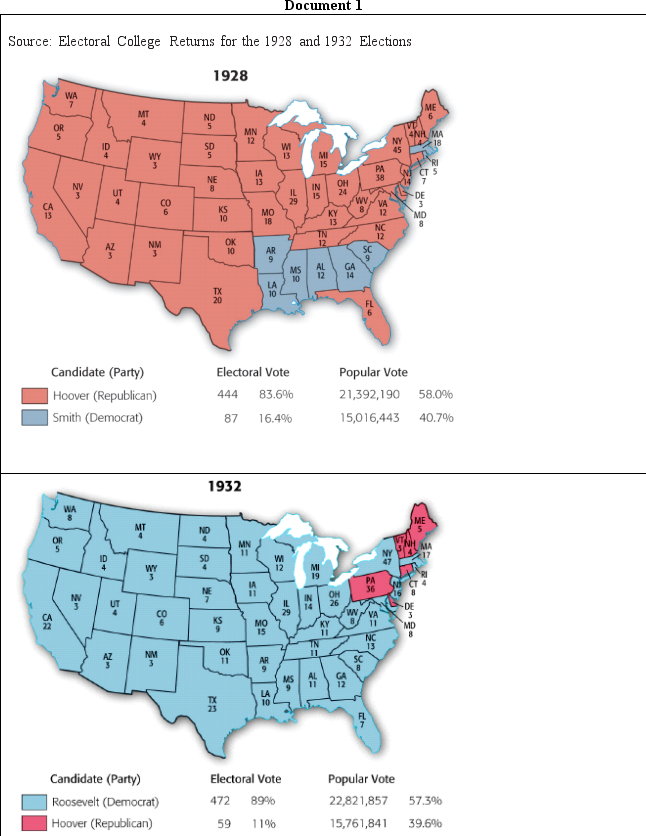 Document 2
Source: Speech by Franklin D. Roosevelt, April 1932
Although I understand that I am talking under the auspices of the Democratic National Committee, I do not want to limit myself to politics… The present condition of our national affairs is too serious to be viewed through partisan eyes for partisan purposes…
[Our] objectives [include] restoring farmers' buying power, relief to the small banks and homeowners and a reconstructed tariff policy [as] a part of ten or a dozen vital factors. But they seem to be beyond the concern of a national administration which can think in terms only of the top of the social and economic structure… It is high time to admit with courage that we are in the midst of an emergency at least equal to that of war. Let us mobilize to meet it.
Document 3
Source: National Labor Relations Act (Wagner Act), 1935
SEC. 7. Employees shall have the right of self-organization, to form, join, or assist labor organizations, to bargain collectively through representatives of their own choosing, and to engage in concerted activities, for the purpose of collective bargaining or other mutual aid or protection.
SEC. 8. It shall be an unfair labor practice for an employer-
(1)To interfere with, restrain, or coerce employees in the exercise of the rights guaranteed in section 7…
(2)By discrimination in regard to hire or tenure of employment or any term or condition of employment to encourage or discourage membership in any labor organization
Document 4
Source: Letter from Secretary of the Interior Harold Ickes to Robert Fechner, Director of Emergency Conservation Work, 1935
My Dear Mr. Fechner:
I have your letter of September 24 in which you express doubt as to the advisability of appointing Negro supervisory personnel in Negro CCC camps. For my part, I am quite certain that Negroes can function in supervisory capacities just as efficiently as can white men and I do not think that they should be discriminated against merely on account of their color. I can see no menace to the program that you are so efficiently carrying out in giving just and proper recognition to members of the Negro race.
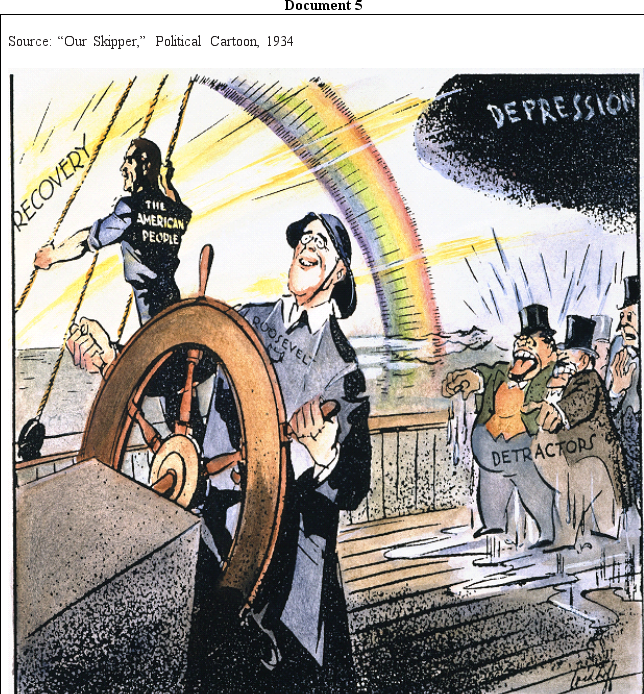 Granger, NYC €” All rights reserved.
Document 6
Source: Address delivered by Mrs. Ellen S. Woodward, Assistant Administrator in charge of Women's Activities, at the Democratic Women's Regional Conference for Southeastern States, held at Tampa, FL, March 19, 1936
I wonder whether the women in this country, and men too, realize just what the creation of the Women's Division in [the Works Progress Administration] signifies. It means the Administration is determined that women shall receive their fair share of work and that it has made special provision for the enforcement of that policy. When the President said that no able-bodied citizens were to be allowed to deteriorate on relief but must be given jobs, he meant women as well as men… We have learned to design projects which not only give women employment, but which increase their skill and keep them employable—so they will be ready to take advantage of the first opportunities for jobs in private industry.
Document 7
Source: Editorial, “Farmers and the Administration,” Fort Wayne Journal-Gazette, October 1, 1937
The enthusiastic warm reception accorded President Roosevelt by the people of the west, from the state of Iowa to the state of Washington, would today be duplicated in any section through which the chief executive should chance to past… And nowhere would it be more real than in the great agricultural community of the nation… For the American farmer is well aware that the agricultural program of Franklin D. Roosevelt, dating back to the early days of 1933, is the first and only broad-range programs designed to help the farmer which really worked… Every farmer… knows that the prosperity returned to America when the A.A.A. began to work, then and only then.
Document 2
Source: Speech by Franklin D. Roosevelt, April 1932
Although I understand that I am talking under the auspices of the Democratic National Committee, I do not want to limit myself to politics… The present condition of our national affairs is too serious to be viewed through partisan eyes for partisan purposes…
[Our] objectives [include] restoring farmers' buying power, relief to the small banks and homeowners and a reconstructed tariff policy [as] a part of ten or a dozen vital factors. But they seem to be beyond the concern of a national administration which can think in terms only of the top of the social and economic structure… It is high time to admit with courage that we are in the midst of an emergency at least equal to that of war. Let us mobilize to meet it.
Document 3
Source: National Labor Relations Act (Wagner Act), 1935
SEC. 7. Employees shall have the right of self-organization, to form, join, or assist labor organizations, to bargain collectively through representatives of their own choosing, and to engage in concerted activities, for the purpose of collective bargaining or other mutual aid or protection.
SEC. 8. It shall be an unfair labor practice for an employer-
(1)To interfere with, restrain, or coerce employees in the exercise of the rights guaranteed in section 7…
(2)By discrimination in regard to hire or tenure of employment or any term or condition of employment to encourage or discourage membership in any labor organization
Document 4
Source: Letter from Secretary of the Interior Harold Ickes to Robert Fechner, Director of Emergency Conservation Work, 1935
My Dear Mr. Fechner:
I have your letter of September 24 in which you express doubt as to the advisability of appointing Negro supervisory personnel in Negro CCC camps. For my part, I am quite certain that Negroes can function in supervisory capacities just as efficiently as can white men and I do not think that they should be discriminated against merely on account of their color. I can see no menace to the program that you are so efficiently carrying out in giving just and proper recognition to members of the Negro race.
Granger, NYC €” All rights reserved.
Document 6
Source: Address delivered by Mrs. Ellen S. Woodward, Assistant Administrator in charge of Women's Activities, at the Democratic Women's Regional Conference for Southeastern States, held at Tampa, FL, March 19, 1936
I wonder whether the women in this country, and men too, realize just what the creation of the Women's Division in [the Works Progress Administration] signifies. It means the Administration is determined that women shall receive their fair share of work and that it has made special provision for the enforcement of that policy. When the President said that no able-bodied citizens were to be allowed to deteriorate on relief but must be given jobs, he meant women as well as men… We have learned to design projects which not only give women employment, but which increase their skill and keep them employable—so they will be ready to take advantage of the first opportunities for jobs in private industry.
Document 7
Source: Editorial, “Farmers and the Administration,” Fort Wayne Journal-Gazette, October 1, 1937
The enthusiastic warm reception accorded President Roosevelt by the people of the west, from the state of Iowa to the state of Washington, would today be duplicated in any section through which the chief executive should chance to past… And nowhere would it be more real than in the great agricultural community of the nation… For the American farmer is well aware that the agricultural program of Franklin D. Roosevelt, dating back to the early days of 1933, is the first and only broad-range programs designed to help the farmer which really worked… Every farmer… knows that the prosperity returned to America when the A.A.A. began to work, then and only then. (Essay)
4.9/5 (77)
(77) The following questions refer to the excerpt below.
"As a group,workers faced severe limitations on their political influence. The conservative nature of the major parties,institutional discrimination against third parties,and ethnic divisions that made some workingmen Democrats and others Republicans all placed obstacles in front of even those most empowered workers,the white men possessing citizenship. Far more striking was the way America's political system victimized female…and African-American workers through disenfranchisement… These barriers extinguished any possibility that American workers could become a united political force during the Gilded Age."
Julie Green,Pure and Simple Politics: The American Federation of Labor and Political Activism,
1881-1917,1998
-The nation's labor force would be made increasingly diverse in the early twentieth century as a result of
(Multiple Choice)
4.9/5 (72)
(72) 
Filters
- Essay(0)
- Multiple Choice(0)
- Short Answer(0)
- True False(0)
- Matching(0)