



 Chat with AI
Exam 2: The Planting of English America 1500-1733

Exam 1: New World Beginnings53 Questions
Exam 2: The Planting of English America 1500-173353 Questions
Exam 3: Settling the Northern Colonies 1619-170053 Questions
Exam 4: American Life in the 17th Century 1607-169253 Questions
Exam 5: Colonial Society on the Eve of Revolution 1700-177552 Questions
Exam 6: The Duel for North America 1608-176352 Questions
Exam 7: The Road to Revolution 1763-177552 Questions
Exam 8: America Secedes from the Empire 1775-178352 Questions
Exam 9: The Confederation and the Constitution 1776-179051 Questions
Select questions type


The following questions refer to the excerpt below.
"Whereas some doubts have arisen whether children got by any Englishman upon a Negro woman should be slave or free,be it therefore enacted and declared by this present Grand Assembly,that all children born in this country shall be held bond or free only according to the condition of the mother;and that if any Christian shall commit fornication with a Negro man or woman,he or she so offending shall pay double the fines imposed by the former act."
Virginia slave law,December 1662
-The British system of slavery was different from the Spanish and French systems because

Free
(Multiple Choice)
4.8/5  (76)
(76) Correct Answer: Verified
B
The following questions refer to the excerpt below.
"Wee must be knitt together in this worke as one man,wee must entertaine each other in brotherly Affeccion… wee must delight in eache other,make others Condicions our owne rejoyce together,mourne together,labour,and suffer together… soe that wee shall see much more of his wisdome power goodnes and truthe then formerly wee have beene acquainted with,wee shall finde that the God of Israell is among us,when tenn of us shall be able to resist a thousand of our enemies,when hee shall make us a prayse and glory,that men shall say of succeeding plantacions: the lord make it like that of New England: for wee must Consider that wee shall be as a Citty upon a Hill,the eies of all people are uppon us;soe that if wee shall deale falsely with our god in this worke wee have undertaken and soe cause him to withdrawe his present help from us,wee shall be made a story and a byword through the world,wee shall open the mouthes of enemies to speake evill of the wayes of god and all professours for Gods sake."
John Winthrop,A Model of Christian Charity,1630
-Which of the following represents a later example of the ideas highlighted in the passage?
Free
(Multiple Choice)
4.8/5 (81)
(81) Correct Answer:Verified
VerifiedD
The following questions refer to the excerpt below.
"Wee must be knitt together in this worke as one man,wee must entertaine each other in brotherly Affeccion… wee must delight in eache other,make others Condicions our owne rejoyce together,mourne together,labour,and suffer together… soe that wee shall see much more of his wisdome power goodnes and truthe then formerly wee have beene acquainted with,wee shall finde that the God of Israell is among us,when tenn of us shall be able to resist a thousand of our enemies,when hee shall make us a prayse and glory,that men shall say of succeeding plantacions: the lord make it like that of New England: for wee must Consider that wee shall be as a Citty upon a Hill,the eies of all people are uppon us;soe that if wee shall deale falsely with our god in this worke wee have undertaken and soe cause him to withdrawe his present help from us,wee shall be made a story and a byword through the world,wee shall open the mouthes of enemies to speake evill of the wayes of god and all professours for Gods sake."
John Winthrop,A Model of Christian Charity,1630
-Winthrop's ideas on Puritan settlement were largely based on which of the following?
Free
(Multiple Choice)
4.8/5 (79)
(79) Correct Answer:Verified
VerifiedC
The following questions refer to the excerpt below.
"Run away from the Subscriber,the First of January,twelve Months past,a Negro Man,named Cato,who has since his Elopement changed his Name several times: Had on when he went away,a Pair of Buckskin Breeches,fine brown Linen Shirt…Underneath his right shoulder Blade he was branded in Jamaica when a Boy with the letters BC,which are plain to be seen…It is supposed he has a forged Pass."
Runaway slave notice,Pennsylvania Gazette,August 11,1757
-The excerpt most directly undermines which of the following assertions?
(Multiple Choice)
4.7/5 (83)
(83) The following questions refer to the excerpt below.
"Whereas some doubts have arisen whether children got by any Englishman upon a Negro woman should be slave or free,be it therefore enacted and declared by this present Grand Assembly,that all children born in this country shall be held bond or free only according to the condition of the mother;and that if any Christian shall commit fornication with a Negro man or woman,he or she so offending shall pay double the fines imposed by the former act."
Virginia slave law,December 1662
-The passage above reflects which of the following historical trends between 1607 and 1754?
(Multiple Choice)
4.9/5 (89)
(89) Directions: These questions are based on the accompanying documents.The documents have been edited for the purpose of this exercise.
In your response you should do the following:
•State a relevant thesis that directly addresses all parts of the question.
•Support the thesis or a relevant argument with evidence from all,or all but one,of the documents.
•Incorporate analysis of all,or all but one,of the documents into your argument.
•Focus your analysis of each document on at least one of the following: intended audience,purpose,historical context,and/or point of view.
•Support your argument with analysis of historical examples outside the documents.
•Connect historical phenomena relevant to your argument to broader events or processes.
•Synthesize the elements above into a persuasive essay that extends your argument,connects it to a different historical context,or accounts for contradictory evidence on the topic.
-In what ways,and to what extent,did religion shape American culture in the period from 1607-1754?
Document 1
his Bookes Two bibles
wooden boles platters dishes & pailes
5 platters 3 basons 5 plates 2 ale quarts worne
2 Iron potts 1 Iron Kettle
Three brass kettles 1 skillett
one Chest 2 Stooles 1 meal barrill 2 Spining wheels
1 dish 6 spoons 3 powdering Tubbs
old Cask 5 hogsheads 3 barrills & shaken Cask
Carpenters Tooles 3 Augers 2 Chisels 1 gouge
1 broad ax 1 hansaw 1 Ads 1 Coopers Ads
old sickles 1 drawing knife 1 Joynter 4 hamers
Three pick axes 1 dung fork 3 hoes 1 fro 2 betle Rings
half barrill mollases salt meat flax and Rope
salt and barrill grinding stone and harness
Sheeps Wooll, one shoe makers knife
one warming pan
Document 2
Source: Preacher Janathan Efwards, 1741
There are in the souls of wicked men those hellish principles reigning, that would presently kindle and flame out into hell fire, if it were not for God's restraints. There is laid in the very nature of carnal men, a foundation for the torments of hell. There are those corrupt principles, in reigning power in them, and in full possession of them, that are seeds of hell fire. These principles are active and powerful, exceeding violent in their nature, and if it were not for the restraining hand of God upon them, they would soon break out, they would flame out after the same manner as the same corruptions, the same enmity does in the hearts of damned souls, and would beget the same torments as they do in them. The souls of the wicked are in scripture compared to the troubled sea, Isa. 57:20. For the present, God restrains their wickedness by his mighty power, as he does the raging waves of the troubled sea, saying, "Hitherto shalt thou come, but no further;" but if God should withdraw that restraining power, it would soon carry all before it. Sin is the ruin and misery of the soul; it is destructive in its nature; and if God should leave it without restraint, there would need nothing else to make the soul perfectly miserable. The corruption of the heart of man is immoderate and boundless in its fury; and while wicked men live here, it is like fire pent up by God's restraints, whereas if it were let loose, it would set on fire the course of nature; and as the heart is now a sink of sin, so if sin was not restrained, it would immediately turn the soul into a fiery oven, or a furnace of fire and brimstone.
Document 3
Source: Benjarmin Franklin an meeting Gearee Whitefield a preacher, 1739
The Multitudes of all Sects and Denominations that attended his Sermons were enormous and it was [a] matter of Speculation to me who was one of the Number, to observe the extraordinary Influence of his Oratory on his Hearers, and how much they admir’d and respected him, notwithstanding his common Abuse of them, by assuring them they were naturally half Beasts and half Devils. It was wonderful to see the Change soon made in the Manners [behavior] of our Inhabitants; from being thoughtless or indifferent about Religion, it seem’d as if all the World were growing Religious; so that one could not walk thro’ the Town in an Evening without Hearing Psalms sung in different Families of every Street.
Document 4
Source: Historian Frark Lambert on the First Great Awakering
The Great Awakening was as much a movement of the printed as the spoken word. One of the central premises of the revivalists was that many Protestants, especially Anglicans, had substituted human reason for divine revelation as a sure guide for human conduct. Evangelicals insisted that Christians needed to return to the Bible and works of the "good old Puritans" of the seventeenth century. They themselves published extensively. For two years before his arrival in 1739 triggered the revival's intercolonial phase, Whitefield circulated about a hundred publications throughout the Atlantic world, including the American colonies. Then in 1740 colonial presses alone printed thirty-three Whitefield imprints. The eleven colonial newspapers from Boston to Charleston gave frequent and extensive coverage to the revivals, serving as advance publicity to mass outdoor services. Rather than relying solely on preaching, Whitefield and others employed the press to reach thousands who never heard them preach.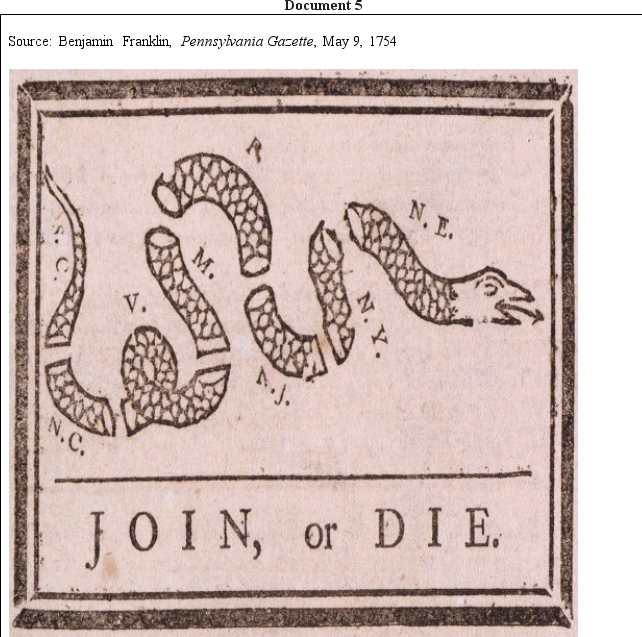 Document 6
Saurce: Histarian Pauline Maier an the Boston Bread Riot af 1710
This role of the mob as extralegal arm of the community's interest emerged, too, in repeated uprisings that occurred within the more densely settled coastal areas. The history of Boston, where by the mid-eighteenth century "public order . . . prevailed to a greater degree than anywhere else in England or America," is full of such incidents. During the food shortage of 1710, after the governor rejected a petition from the Boston selectmen calling for a temporary embargo on the exportation of foodstuffs one heavily laden ship found its rudder cut away, and fifty men sought to haul another outward bound vessel back to shore. Under similar circumstances Boston mobs again intervened to keep foodstuffs in the colony in 1713 and 1729.
Document 7
Source: Historian Antonio Bly on runaway slaves in the early 18th century
The colonies’ role in the traffic of slaves and within the Atlantic system itself was small during the seventeenth century, but after 1720 it grew significantly, linking Massachusetts, Rhode Island, New Hampshire, and Connecticut to a thriving economic network involving several African nations and the British West Indies……In order to reclaim their escaped property, masters turned to the press and public notices…To judge from the notices that appear in print, many slaveholders thought their servants both artful and crafty, unheralded masters of stealth and guile. Privately, they might have respected their servants’ bids for freedom or even taken a modicum of pride from their bondmen’s efforts.
Document 6
Saurce: Histarian Pauline Maier an the Boston Bread Riot af 1710
This role of the mob as extralegal arm of the community's interest emerged, too, in repeated uprisings that occurred within the more densely settled coastal areas. The history of Boston, where by the mid-eighteenth century "public order . . . prevailed to a greater degree than anywhere else in England or America," is full of such incidents. During the food shortage of 1710, after the governor rejected a petition from the Boston selectmen calling for a temporary embargo on the exportation of foodstuffs one heavily laden ship found its rudder cut away, and fifty men sought to haul another outward bound vessel back to shore. Under similar circumstances Boston mobs again intervened to keep foodstuffs in the colony in 1713 and 1729.
Document 7
Source: Historian Antonio Bly on runaway slaves in the early 18th century
The colonies’ role in the traffic of slaves and within the Atlantic system itself was small during the seventeenth century, but after 1720 it grew significantly, linking Massachusetts, Rhode Island, New Hampshire, and Connecticut to a thriving economic network involving several African nations and the British West Indies……In order to reclaim their escaped property, masters turned to the press and public notices…To judge from the notices that appear in print, many slaveholders thought their servants both artful and crafty, unheralded masters of stealth and guile. Privately, they might have respected their servants’ bids for freedom or even taken a modicum of pride from their bondmen’s efforts. (Essay)
4.8/5 (72)
(72) The following questions refer to the excerpt below.
"Be it enacted…That from and after [December 25,1733] there shall be raised,levied,collected and paid,unto and for the use of his Majesty…upon all rum or spirits of the produce or manufacture of any of the colonies or plantations in America…the sum of nine pence,money of Great Britain…for every gallon thereof,and after that for any greater or lesser quantity: and upon all molasses or syrups of such foreign produce or manufacture…"
The Molasses Act,May 17,1733
-The excerpt reflects which of the following historical trends from the period 1607-1754?
(Multiple Choice)
4.9/5 (76)
(76) The following questions refer to the image below.
 Library of Congress Prints & Photographs Division,[LC-USZC4-5315]
Benjamin Franklin,Pennsylvania Gazette,May 9,1754
-Which of the following represents a later example of the ideas highlighted in the drawing?
Library of Congress Prints & Photographs Division,[LC-USZC4-5315]
Benjamin Franklin,Pennsylvania Gazette,May 9,1754
-Which of the following represents a later example of the ideas highlighted in the drawing? (Multiple Choice)
4.7/5 (85)
(85) The following questions refer to the excerpt below.
"Friday Night last a Sloop from St.Anguilla,came to Anchor in Nantasket Road . . .The said Master further informs us,that while he lay at Anguilla a Bermudas Sloop arrived there from St.John's,the Master of which informed him,that the Number of Whites destroyed by the Negroes of that Island did not exceed 60,some having found Means to escape their Fury.That they kill'd all the Men and aged Women,that they could lay their Hands on,and debauched the young Women,and that they kept Possession of the Island and Fort for 8 Days,when a Number of Whites and Negroes came from St.Thomas's and attack'd the Fort,which they took after a stout Resistance;and among the rest,had the good Luck to take the Ringleader or Captain of the Black Gentry,whom they flea'd alive,and tortured several others of them to Death.Upon this Defeat,most of the Negroes that were scattered about upon the Island,took all the Canoes and other small Craft they could find,and quitted the Place,and 'tis thought they are gone to Cape Fransway,&c.This Rising of the Negroes at St.John's,has so alarmed our Islands,that they keep 30 or 40 Men every Night upon the Watch upon each Island,to prevent a Surprize.'Tis further said,that all the Islands in the West Indies are under Apprehensions of a War. . ."
John P.Zenger,New-York Weekly Journal,March 11,1733
-The excerpt reflects which of the following historical patterns from 1607-1754?
(Multiple Choice)
5.0/5 (83)
(83) The following questions refer to the excerpt below.
"Therefore…enacted…that noe person or persons whatsoever within this Province,or the Islands,Ports,Harbors,Creekes,or havens thereunto belonging professing to believe in Jesus Christ,shall from henceforth bee any waies troubled,Molested or discountenanced for or in respect of his or her religion nor in the free exercise thereof within this Province or the Islands thereunto belonging nor any way compelled to the belief or exercise of any other religion against his or her consent…"
Maryland Toleration Act,April 21,1649
-Which of the following was most likely a causal factor in the development of the kind of legislation seen in the excerpt?
(Multiple Choice)
4.9/5 (89)
(89) The following questions refer to the excerpt below.
"We thought it our duty ...to set forth in this our Declaration,the true state and condition of this country in general and our particular ...disabilit[y] to ...[engage in] war at the time of this invasion [by the Dutch]....[We] therefore do most humbly beseech your majesty and your most honorable council to consider that Virginia is intersected by so many vast rivers as makes more miles to defend than we have men of trust to defend them.For by our nearest computation we leave at our backs as many servants (besides Negroes).as there are freemen to defend the shores and all our frontiers [against the Indians]....This gives men fearful apprehensions of the danger they leave their estates and families in,while they are drawn from their houses to defend the borders.Also at least one third [of the freemen available for defense] are single freemen (whose labor will hardly maintain them)or men in such debt,...[Whom] we may reasonably expect upon any small advantage the enemy may gain upon us,...[to defect] to them in hopes of bettering their condition by sharing the plunder of the country with them."
Governor Berkeley and His Council,Report on their Inability to Defend Virginia Against a Dutch Attack,December 1673
-Which of the following pieces of evidence would best support the claims made in the passage?
(Multiple Choice)
4.9/5 (73)
(73) The following questions refer to the excerpt below.
"Therefore…enacted…that noe person or persons whatsoever within this Province,or the Islands,Ports,Harbors,Creekes,or havens thereunto belonging professing to believe in Jesus Christ,shall from henceforth bee any waies troubled,Molested or discountenanced for or in respect of his or her religion nor in the free exercise thereof within this Province or the Islands thereunto belonging nor any way compelled to the belief or exercise of any other religion against his or her consent…"
Maryland Toleration Act,April 21,1649
-All of the following statements are true of the period in which the legislation was enacted except:
(Multiple Choice)
4.9/5 (80)
(80) The following questions refer to the excerpt below.
"We thought it our duty ...to set forth in this our Declaration,the true state and condition of this country in general and our particular ...disabilit[y] to ...[engage in] war at the time of this invasion [by the Dutch]....[We] therefore do most humbly beseech your majesty and your most honorable council to consider that Virginia is intersected by so many vast rivers as makes more miles to defend than we have men of trust to defend them.For by our nearest computation we leave at our backs as many servants (besides Negroes).as there are freemen to defend the shores and all our frontiers [against the Indians]....This gives men fearful apprehensions of the danger they leave their estates and families in,while they are drawn from their houses to defend the borders.Also at least one third [of the freemen available for defense] are single freemen (whose labor will hardly maintain them)or men in such debt,...[Whom] we may reasonably expect upon any small advantage the enemy may gain upon us,...[to defect] to them in hopes of bettering their condition by sharing the plunder of the country with them."
Governor Berkeley and His Council,Report on their Inability to Defend Virginia Against a Dutch Attack,December 1673
-The passage reflects which of the following historical trends?
(Multiple Choice)
4.8/5 (69)
(69) The following questions refer to the excerpt below.
"For the increase of shipping and encouragement of the navigation of this nation wherein,under the good providence and protection of God,the wealth,safety,and strength of this kingdom is so much concerned;(2)be it enacted by the king's most excellent Majesty,and by the Lords and Commons in this present Parliament assembled,and by the authority thereof,that from and after the first day of December,one thousand six hundred and sixty,and from thence forward,no goods or commodities whatsoever shall be imported into or exported out of any lands,islands,plantations,or territories to his Majesty belonging or in his possession,or which may hereafter belong unto or be in the possession of his Majesty,his heirs,and successors,in Asia,Africa,or America,in any other ship or ships,vessel or vessels whatsoever,but in such ships or vessels as do truly and without fraud belong only to the people of England or Ireland,dominion of Wales or town of Berwick upon Tweed,or are of the built of and belonging to any the said lands,islands,plantations,or territories,as the proprietors and right owners thereof,and whereof the master and three fourths of the mariners at least are English."
The Navigation Act of September 13,1660
-Which of the following was an immediate result of the kind of legislation seen in the excerpt?
(Multiple Choice)
4.9/5 (88)
(88) The following questions refer to the excerpt below.
"The [Pueblo] uprising The 1680 uprising was no isolated event.The seventeenth-century history of modern New Mexico and northern Mexico is punctuated by unrest and rebellion.Many of the region's people had been conquered and none liked their situation,but they understood that though they greatly outnumbered the Spaniards,their foes were ruthless,organized,and determined.The Spanish possessed firearms and steel weapons superior to anything the Natives could muster.But despite all the odds against successful resistance,Spanish records show instance upon instance of plans and outbreaks among American Indians who supposedly had been "reduced" to Christianity and Spanish ways… If the purpose of the rebellion was simply to drive out Spanish ways,it failed,because the Spaniards came back and remained until Mexican independence in 1821.The Spanish were followed by two successor republics,Mexico and,ultimately,the United States.There could be no complete return to how Pueblo people had lived prior to the Spanish conquest.But if the rebels' purpose was to reassert their own ways in a new setting,their rebellion succeeded,because Acoma and places like it survive,on terms that their people set for themselves."
Historian Edward Countryman,"The Pueblo Revolt"
-As seen in the passage,which of the following was a similarity between Spanish and British colonizers?
(Multiple Choice)
4.9/5 (93)
(93) The following questions refer to the excerpt below.
"Then I took my children (and one of my sisters hers)to go forth and leave the house: but,as soon as we came to the door and appeared,the Indians shot so thick that the bullets rattled against the house as if one had taken a handful of stones and threw them,so that we were forced to give back.We had six stout dogs belonging to our garrison,but none of them would stir,though at another time if an Indian had come to the door,they were ready to fly upon him and tear him down.The Lord hereby would make us the more to acknowledge his hand,and to see that our help is always in him.But out we must go,the fire increasing,and coming along behind us roaring,and the Indians gaping before us with their guns,spears,and hatchets to devour us.No sooner were we out of the house,but my brother-in-law (being before wounded in defending the house,in or near the throat)fell down dead,whereat the Indians scornfully shouted and hallowed,and were presently upon him,stripping off his clothes.The bullets flying thick,one went through my side,and the same (as would seem)through the bowels and hand of my poor child in my arms.One of my elder sister's children (named William)had then his leg broke,which the Indians perceiving they knocked him on the head."
From the captivity narrative of Mary Rowlandson,1682
-Which of the following evidence would best explain the events Rowlandson describes?
(Multiple Choice)
4.9/5 (93)
(93) The following questions refer to the image below.
Library of Congress Prints & Photographs Division,[LC-USZC4-5315]
Benjamin Franklin,Pennsylvania Gazette,May 9,1754
-The ideas suggested by the drawing were largely the product of
Library of Congress Prints & Photographs Division,[LC-USZC4-5315]
Benjamin Franklin,Pennsylvania Gazette,May 9,1754
-The ideas suggested by the drawing were largely the product of (Multiple Choice)
4.9/5 (77)
(77) Answer parts a,b,and c.
a)The British and Spanish systems of slavery were in some ways similar and in some ways different.Briefly explain ONE important difference between the two systems in the period 1607-1754.
b)Briefly explain ONE important similarity of the two systems.
c)Briefly explain ONE way in which slavery changed in the period between 1607 and 1754.
(Essay)
4.9/5 (89)
(89) The following questions refer to the excerpt below.
"Whereas some doubts have arisen whether children got by any Englishman upon a Negro woman should be slave or free,be it therefore enacted and declared by this present Grand Assembly,that all children born in this country shall be held bond or free only according to the condition of the mother;and that if any Christian shall commit fornication with a Negro man or woman,he or she so offending shall pay double the fines imposed by the former act."
Virginia slave law,December 1662
-Which of the following was not a causal factor in the development of slavery in the British colonies?
(Multiple Choice)
4.7/5 (73)
(73) The following questions refer to the excerpt below.
"Then I took my children (and one of my sisters hers)to go forth and leave the house: but,as soon as we came to the door and appeared,the Indians shot so thick that the bullets rattled against the house as if one had taken a handful of stones and threw them,so that we were forced to give back.We had six stout dogs belonging to our garrison,but none of them would stir,though at another time if an Indian had come to the door,they were ready to fly upon him and tear him down.The Lord hereby would make us the more to acknowledge his hand,and to see that our help is always in him.But out we must go,the fire increasing,and coming along behind us roaring,and the Indians gaping before us with their guns,spears,and hatchets to devour us.No sooner were we out of the house,but my brother-in-law (being before wounded in defending the house,in or near the throat)fell down dead,whereat the Indians scornfully shouted and hallowed,and were presently upon him,stripping off his clothes.The bullets flying thick,one went through my side,and the same (as would seem)through the bowels and hand of my poor child in my arms.One of my elder sister's children (named William)had then his leg broke,which the Indians perceiving they knocked him on the head."
From the captivity narrative of Mary Rowlandson,1682
-As seen in the passage,Europeans and Native Americans fought for control of North America for all of the following reasons except
(Multiple Choice)
4.8/5 (83)
(83) 
Filters
- Essay(0)
- Multiple Choice(0)
- Short Answer(0)
- True False(0)
- Matching(0)