



 Chat with AI
Exam 3: Settling the Northern Colonies 1619-1700

Exam 1: New World Beginnings53 Questions
Exam 2: The Planting of English America 1500-173353 Questions
Exam 3: Settling the Northern Colonies 1619-170053 Questions
Exam 4: American Life in the 17th Century 1607-169253 Questions
Exam 5: Colonial Society on the Eve of Revolution 1700-177552 Questions
Exam 6: The Duel for North America 1608-176352 Questions
Exam 7: The Road to Revolution 1763-177552 Questions
Exam 8: America Secedes from the Empire 1775-178352 Questions
Exam 9: The Confederation and the Constitution 1776-179051 Questions
Select questions type


The following questions are based on the image below.
 Library of Congress Prints and Photographs Division [LC-USZC4-538]
-Acts of protest like the one pictured above occurred in response to
Library of Congress Prints and Photographs Division [LC-USZC4-538]
-Acts of protest like the one pictured above occurred in response to
Free
(Multiple Choice)
4.8/5  (74)
(74) Correct Answer: Verified
A
The following questions are based on the excerpt below.
"From decades of debate on the colonists' right to self-government,popular sovereignty had emerged as the basic principle of legitimate government. But how was this principle to be realized in practice? ...Whig social contract theory specified that sovereignty resided in the will of the majority of the participants in the contract,limited only by the individual member's right to life,liberty,and property. Applied to the colonies,the question was,who were the legitimate participants in the new polity based on contract?"
Willi Paul Adams,The First American Constitutions,1980
-Which of the following political features of American government is best explained by the description of founding principles in the passage above?
Free
(Multiple Choice)
4.9/5 (89)
(89) Correct Answer:Verified
VerifiedA
The following questions are based on the map below.
 2016 Cengage Learning
Western Land Cessions to the United States,1782-1802
-The national government's policies concerning the lands ceded by the states would most directly feed into
2016 Cengage Learning
Western Land Cessions to the United States,1782-1802
-The national government's policies concerning the lands ceded by the states would most directly feed intoFree
(Multiple Choice)
4.9/5 (82)
(82) Correct Answer:Verified
VerifiedB
The following questions are based on the image below.
 Library of Congress Prints and Photographs Division[LC-USZ62-44892]
Molly Pitcher,i.e.Molly McCauley,loading cannon at the Battle of Monmouth,1778
-The most significant job of a "republican mother" was to
Library of Congress Prints and Photographs Division[LC-USZ62-44892]
Molly Pitcher,i.e.Molly McCauley,loading cannon at the Battle of Monmouth,1778
-The most significant job of a "republican mother" was to (Multiple Choice)
4.9/5 (74)
(74) Answer parts a,b,and c.
a)Explain ONE principle presented in the Declaration of Independence.
b)Explain ONE principle presented in Thomas Paine's Common Sense.
c)Provide ONE piece of evidence that reveals the influence of these documents on the foundation of the United States government.
(Essay)
4.9/5 (85)
(85) The following questions are based on the image below.
Library of Congress Prints and Photographs Division [LC-USZC4-538]
-The British response to events like the one pictured here
Library of Congress Prints and Photographs Division [LC-USZC4-538]
-The British response to events like the one pictured here (Multiple Choice)
4.8/5 (88)
(88) The following questions are based on the image below.
Library of Congress Prints and Photographs Division[LC-USZ62-44892]
Molly Pitcher,i.e.Molly McCauley,loading cannon at the Battle of Monmouth,1778
-The nation's response to the wartime efforts of Revolutionary-era women would be most closely paralleled by the experiences of
Library of Congress Prints and Photographs Division[LC-USZ62-44892]
Molly Pitcher,i.e.Molly McCauley,loading cannon at the Battle of Monmouth,1778
-The nation's response to the wartime efforts of Revolutionary-era women would be most closely paralleled by the experiences of (Multiple Choice)
4.7/5 (87)
(87) The following questions refer to the excerpt below.
"With a good deal of surprise I have observed that little notice has been taken of an act of Parliament...If the Parliament may lawfully deprive New York of any of her rights,it may deprive any or all the other colonies of their rights;and nothing can possibly so much encourage such attempts as a mutual inattention to the interest of each other.To divide and thus to destroy is the first political maxim in attacking those who are powerful by their union.He certainly is not a wise man who folds his arms and reposes himself at home,seeing with unconcern the flames that have invaded his neighbor's house without using any endeavors to extinguish them."
Letter from a Pennsylvania Farmer,The Boston Chronicle,1767
-Which of the following best explains the colonists' eventual decision to declare independence from the British in the wake of publications like this one?
(Multiple Choice)
4.8/5 (78)
(78) The following questions are based on the excerpt below.
"In the history of revolutions around the world,the moderation of the American leaders is almost unique...American revolutionary leaders were...familiar with the political theories of the day.But in addition to those theories,they had also acquired experience in the give-and-take of ordinary politics ...The leaders of the French Revolution were also well schooled in political theory,but they had virtually no practical experience in politics to temper those theories… [as' the French people had been excluded from participation in government...The stage was set for the downfall of their revolution when the French rejected not only the self-restraint and moderation of the American leaders but also their insistence on due process and the inviolability of individual rights."
Susan Dunn,"Advice (Not Taken)for the French Revolution from America," History Now,2012
-America's reaction to the French Revolution marks the beginning of a period characterized by
(Multiple Choice)
4.8/5 (87)
(87) The following questions are based on the image below.
Library of Congress Prints and Photographs Division [LC-USZC4-538]
-Colonial protests were generally organized by
Library of Congress Prints and Photographs Division [LC-USZC4-538]
-Colonial protests were generally organized by (Multiple Choice)
4.9/5 (72)
(72) The following questions are based on the excerpt below.
"From decades of debate on the colonists' right to self-government,popular sovereignty had emerged as the basic principle of legitimate government. But how was this principle to be realized in practice? ...Whig social contract theory specified that sovereignty resided in the will of the majority of the participants in the contract,limited only by the individual member's right to life,liberty,and property. Applied to the colonies,the question was,who were the legitimate participants in the new polity based on contract?"
Willi Paul Adams,The First American Constitutions,1980
-During which of the following periods was the practical definition of legitimate participants as referenced in the passage expanded the most significantly?
(Multiple Choice)
4.9/5 (74)
(74) The following questions are based on the image below.
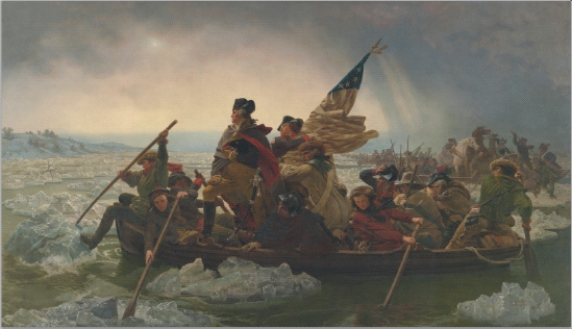 The Metropolitan Museum of Art/Art Resource,NY
Washington Crossing the Delaware,Emanuel Leutze,1851
-The troops mustered by the American Continental Army were generally motivated by a belief in
The Metropolitan Museum of Art/Art Resource,NY
Washington Crossing the Delaware,Emanuel Leutze,1851
-The troops mustered by the American Continental Army were generally motivated by a belief in (Multiple Choice)
5.0/5 (90)
(90) The following questions refer to the excerpt below.
"As the frontier of white settlement expanded westward and Iroquois war parties followed the warrior path to the southeastern tribes,the two forces inevitably clashed...But [the English] wanted the confederacy tied to the British interest exclusively…[and accepted that in the short term] an accommodation [treaty] would prove cheaper than a war… That summer of 1760 witnessed a high watermark in Indian affairs. Canada passed into English hands;the ancient regime ceased to rule New France… English traders no longer had French rivals… The Six Nations and their tributaries had fallen from the position of balancing power between rival nations."
William Nelson Fenton,The Great Law and the Longhouse: A Political History of the Iroquois Confederacy,1998
-Which of the following motivations best explains the Iroquois willingness to enter into agreements with the British?
(Multiple Choice)
4.8/5 (85)
(85) The following questions refer to the excerpt below.
"Whereas it is… essential to our Interest,and the Security of our Colonies,that the several Nations or Tribes of Indians ...who live under our Protection,should not be molested or disturbed ...--We do therefore,...declare it to be our Royal Will and Pleasure...for the use of the said Indians,[to be reserved] all the Lands and Territories ...lying to the Westward of the Sources of the Rivers [along the Appalachian Mountains] which fall into the Sea....And We do hereby strictly forbid… all our loving Subjects from… taking Possession of any of the Lands above reserved…"
The Royal Proclamation,King George III,October 1763
-The intent of the Proclamation above was to
(Multiple Choice)
4.9/5 (99)
(99) Directions: These questions are based on the accompanying documents.The documents have been edited for the purpose of this exercise.
In your response you should do the following:
•State a relevant thesis that directly addresses all parts of the question.
•Support the thesis or a relevant argument with evidence from all,or all but one,of the documents.
•Incorporate analysis of all,or all but one,of the documents into your argument.
•Focus your analysis of each document on at least one of the following: intended audience,purpose,historical context,and/or point of view.
•Support your argument with analysis of historical examples outside the documents.
•Connect historical phenomena relevant to your argument to broader events or processes.
•Synthesize the elements above into a persuasive essay that extends your argument,connects it to a different historical context,or accounts for contradictory evidence on the topic.
-To what extent did the newly created United States government uphold the Revolutionary principles on which it was founded in the period from 1776 to 1800?
Document 1
Source: John Locke, “Second Treatise on Government”, 1690
Why will [man] give up [the state of nature], and subject himself to the dominion and controul of any other power?...[T]hey enter into society, ...with [only] an intention in every one the better to preserve himself, his liberty and property…
For all the power the government has, being only for the good of the society, as it ought not to be arbitrary and at pleasure, so it ought to be exercised by established and promulgated laws; that both the people may know their duty, and be safe and secure within the limits of the law; and the rulers too kept within their bounds.
Document 2
Source: Thomas Jefferson, Declaration of Independence, 1776
We hold these truths to be self-evident, that all men are created equal, that they are endowed by their Creator with certain unalienable Rights, that among these are Life, Liberty and the pursuit of Happiness.—That to secure these rights, Governments are instituted among Men, deriving their just powers from the consent of the governed, —That whenever any Form of Government becomes destructive of these ends, it is the Right of the People to alter or to abolish it, and to institute new Government, laying its foundation on such principles and organizing its powers in such form, as to them shall seem most likely to effect their Safety and Happiness.
Document 3
Source: Thomas Paine, Common Sense, 1776
Where, say some, is the king of America? ...So far as we approve of monarchy. . . in America the law is king. . . .
A government of our own is our natural right. . . . Ye that oppose independence now, ye know not what ye do: ye are opening the door to eternal tyranny. . . .
O! ye that love mankind! Ye that dare oppose not only the tyranny but the tyrant, stand forth! Every spot of the old world is overrun with oppression. Freedom hath been hunted round the Globe. ...O [America]! receive the fugitive, and prepare in time an asylum for mankind
Document 4
Source: Portrait of a Revolutionary War Veteran, circa 1775
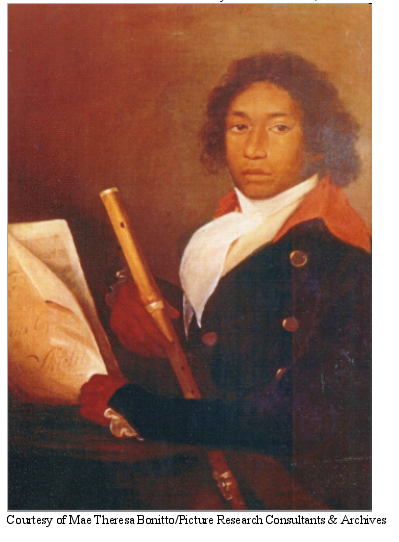 Document 5
Source: Quaker James Pemberton to British Abolitionist James Phillips, 1784
[T]he case of the oppressed blacks commands our attention to move in endeavors for their relief as opportunities are favorable; altho Congress has done as little in consequence of our address as your Parliament has in favor of your Petition…
The admission of [Black]members into our Religious Society is at all time a matter of weight, a base convincement of the rectitude of our principles and discipline,… while some friends are advocates for an unrestricted admission, others plead if no limitation is proscribed they must become entitled to the privilege of intermarriage, and I believe there are few who would freely consent to introduce such a union in their families which mixture some think would reverse the order of Divine Providence who in his wisdom inscrutable to us has been pleased to form distinction of Colour.
Document 6
Source: George Washington, Letter to the Hebrew Congregation at Newport, 1790
The citizens of the United States of America have a right to applaud themselves for having given to mankind examples of an enlarged and liberal policy—a policy worthy of imitation. All possess alike liberty of conscience and immunities of citizenship.
It is now no more that toleration is spoken of as if it were the indulgence of one class of people that another enjoyed the exercise of their inherent natural rights, for, happily, the Government of the United States, which gives to bigotry no sanction, to persecution no assistance, requires only that they who live under its protection should demean themselves as good citizens in giving it on all occasions their effectual support...
May the children of the stock of Abraham who dwell in this land continue to merit and enjoy the good will of the other inhabitants.
Document 7
Source: Judith Sargent Stevens Murray, "On the Equality of the Sexes", 1790
Are we deficient in reason? we can only reason from what we know, and if an opportunity of acquiring knowledge hath been denied us, the inferiority of our sex cannot fairly be deduced from thence....Will it be said that the judgment of a male of two years old, is more sage than that of a female of the same age? I believe the reverse is generally observed to be true.... At length arrived at womanhood,... united to a person whose soul nature made equal to her own, education hath set him so far above her, that in those entertainments which are productive of such rational felicity, she is not qualified to accompany him....
Yes, ye lordly, ye haughty sex, our souls are by nature equal to yours; the same breath of God animates, enlivens, and invigorates us....
Document 5
Source: Quaker James Pemberton to British Abolitionist James Phillips, 1784
[T]he case of the oppressed blacks commands our attention to move in endeavors for their relief as opportunities are favorable; altho Congress has done as little in consequence of our address as your Parliament has in favor of your Petition…
The admission of [Black]members into our Religious Society is at all time a matter of weight, a base convincement of the rectitude of our principles and discipline,… while some friends are advocates for an unrestricted admission, others plead if no limitation is proscribed they must become entitled to the privilege of intermarriage, and I believe there are few who would freely consent to introduce such a union in their families which mixture some think would reverse the order of Divine Providence who in his wisdom inscrutable to us has been pleased to form distinction of Colour.
Document 6
Source: George Washington, Letter to the Hebrew Congregation at Newport, 1790
The citizens of the United States of America have a right to applaud themselves for having given to mankind examples of an enlarged and liberal policy—a policy worthy of imitation. All possess alike liberty of conscience and immunities of citizenship.
It is now no more that toleration is spoken of as if it were the indulgence of one class of people that another enjoyed the exercise of their inherent natural rights, for, happily, the Government of the United States, which gives to bigotry no sanction, to persecution no assistance, requires only that they who live under its protection should demean themselves as good citizens in giving it on all occasions their effectual support...
May the children of the stock of Abraham who dwell in this land continue to merit and enjoy the good will of the other inhabitants.
Document 7
Source: Judith Sargent Stevens Murray, "On the Equality of the Sexes", 1790
Are we deficient in reason? we can only reason from what we know, and if an opportunity of acquiring knowledge hath been denied us, the inferiority of our sex cannot fairly be deduced from thence....Will it be said that the judgment of a male of two years old, is more sage than that of a female of the same age? I believe the reverse is generally observed to be true.... At length arrived at womanhood,... united to a person whose soul nature made equal to her own, education hath set him so far above her, that in those entertainments which are productive of such rational felicity, she is not qualified to accompany him....
Yes, ye lordly, ye haughty sex, our souls are by nature equal to yours; the same breath of God animates, enlivens, and invigorates us.... (Essay)
4.8/5 (65)
(65) "Those who are governed at the will of another,and whose property may be taken from them by taxes...without their own consent,and against their will,are in the miserable condition of slaves… the British subjects in America,have equal rights with those in Britain;...as an inherent indefeasible right… But it will be said,that the monies drawn from the colonies by duties...will be laid up and set apart to be used for their future defence.This will not at all alleviate the hardship,but serves only more strongly to mark the servile state of the people.Free people have ever thought,and always will think,that the money necessary for their defence lies safest in their own hands."
Stephen Hopkins,The Rights of the Colonists Examined,1764
"The several New England charters ascertain,define,and limit the respective rights and privileges of each colony,and I cannot conceive how it has come to pass that the colonies now claim any other or greater rights than are therein expressly granted to them… Hence it is plain to me that in denying [the jurisdiction of Parliament] we at the same time take leave of the common law and thereby,with equal temerity and folly,strip ourselves of every blessing we enjoy as Englishmen… Believe me,my friend,it gives me great pain to see so much ingratitude in the colonies to the mother country,whose arms and money so lately rescued them from a French government."
Martin Howard,A Letter from a Goodman at Halifax to his Friend in Rhode Island,1765
Using the excerpts above,answer parts a,b,and c.
a)Briefly explain the main point of Hopkins' passage.
b)Briefly explain the main point of Howard's passage.
c)Provide ONE piece of evidence from the era of the American Revolution,not included in the passages,and explain how it supports the viewpoint of one of the passages.
(Essay)
4.9/5 (74)
(74) The following questions refer to the excerpt below.
"As the frontier of white settlement expanded westward and Iroquois war parties followed the warrior path to the southeastern tribes,the two forces inevitably clashed...But [the English] wanted the confederacy tied to the British interest exclusively…[and accepted that in the short term] an accommodation [treaty] would prove cheaper than a war… That summer of 1760 witnessed a high watermark in Indian affairs. Canada passed into English hands;the ancient regime ceased to rule New France… English traders no longer had French rivals… The Six Nations and their tributaries had fallen from the position of balancing power between rival nations."
William Nelson Fenton,The Great Law and the Longhouse: A Political History of the Iroquois Confederacy,1998
-The presence of both the British and French in the territory of the Iroquois changed Native American society by
(Multiple Choice)
4.9/5 (89)
(89) The following questions refer to the excerpt below.
"With a good deal of surprise I have observed that little notice has been taken of an act of Parliament...If the Parliament may lawfully deprive New York of any of her rights,it may deprive any or all the other colonies of their rights;and nothing can possibly so much encourage such attempts as a mutual inattention to the interest of each other.To divide and thus to destroy is the first political maxim in attacking those who are powerful by their union.He certainly is not a wise man who folds his arms and reposes himself at home,seeing with unconcern the flames that have invaded his neighbor's house without using any endeavors to extinguish them."
Letter from a Pennsylvania Farmer,The Boston Chronicle,1767
-The Pennsylvania Farmer's complaint about the actions of the British can best be explained by the American belief in
(Multiple Choice)
4.9/5 (69)
(69) The following questions are based on the excerpt below.
"From decades of debate on the colonists' right to self-government,popular sovereignty had emerged as the basic principle of legitimate government. But how was this principle to be realized in practice? ...Whig social contract theory specified that sovereignty resided in the will of the majority of the participants in the contract,limited only by the individual member's right to life,liberty,and property. Applied to the colonies,the question was,who were the legitimate participants in the new polity based on contract?"
Willi Paul Adams,The First American Constitutions,1980
-What was generally accepted as a necessary qualification for the rights of citizenship in the first few decades of United States' government?
(Multiple Choice)
4.9/5 (82)
(82) The following questions refer to the passage below.
"...Is there one person of understanding & reflection among you who will not admit that every consideration of justice,humanity,and safety,forbids that any more Negroes should be brought into your state,and yet it is well known that the avarice of your citizens,and the rage for acquiring that property has broke through all legal restrictions,...Trust not on your Eastern friends for aid,if you do not enforce righteous measures for your own safety;...Already they begin to resist that principle in the Constitution which admits the Negroes of the Southern States to increase the number of Representatives in the Congress of the United States."
William Few,Letter to Georgia Governor Edward Telfair,1804
-Which of the following best explains the impact of the United States' Constitution on the issue addressed in the letter above?
(Multiple Choice)
4.7/5 (84)
(84) 
Filters
- Essay(0)
- Multiple Choice(0)
- Short Answer(0)
- True False(0)
- Matching(0)