



 Chat with AI
Exam 9: The Confederation and the Constitution 1776-1790


Directions: In your response you should do the following:
•State a relevant thesis that directly addresses all parts of the question.
•Support your argument with evidence,using specific examples.
•Apply historical thinking skills as directed by the question.
•Synthesize the elements above into a persuasive essay that extends your argument,connects it to a different historical context,or connects it to a different category of analysis.
-Some historians have argued that the War on Terror dramatically altered civil liberties for Americans.Support,modify,or refute this interpretation,providing specific evidence to justify your answer.

 (68)
 Verified
Sample Strong Response:
After the September 11,2001 attacks on New York City and the Pentagon (as well as a failed third attack which ended with a plane crash in Pennsylvania),the U.S.Congress and President George W.Bush responded by enacting legislation which altered civil liberties for American citizens. The legislation,known as the Patriot Act,sought to prevent further acts of terrorism by giving the federal government broad powers to investigate Americans for terroristic activity. Although the general idea of the law was to prevent terrorism,many Americans saw it as a violation of civil liberties. Freedom of speech and privacy,some argued,were among the primary targets of the legislation,as the government sought to protect the nation from internal and external threats. Although this alarmed many Americans,the suspension and restriction of civil liberties was similar to earlier restrictions of civil liberties during and after previous wars,including the Civil War,World War I,and World War II. In this sense,we must modify the original idea that the War on Terror dramatically altered civil liberties. Rather,the War on Terror revived restrictions and suspensions of civil liberties which had existed for decades but had been dormant.
Restricting civil liberties was not a novel idea during the War on Terror. Civil liberties have been suspended at other crucial times. Lincoln suspended the Writ of Habeas Corpus during the Civil to combat spying;suspected southern spies were arrested and held indefinitely without trial as a means to win the war.Although Lincoln understood the need to limit government's power,and though he thought this a dangerous idea,he also understood the need for such dramatic legislation during wartime. With spies in Washington,D.C.,he could not risk threatening the safety of the government. During World War I,Congress enacted legislation restricting free speech in an effort to rally the nation to war. When Congress passed the Espionage and Sedition laws,it made it legal to censor or punish virtually anyone who spoke out or criticized the federal government. Socialist Eugene Debs was the most prominent protester to be convicted under these statutes. The Supreme Court upheld the legality of these laws in the Schenck decision (1919). During World War II,President Franklin Roosevelt ordered the imprisonment of Japanese-Americans in internment camps to allay fears of an invasion of the west coast. Japanese-Americans were sent to internment camps without trial or charges being brought against them,and held there for the duration of the war. Again,the Supreme Court upheld this in its Korematsu decision (1945),arguing that,in times war,national security trumps individual civil liberties. In each case,the legality of the actions of the government was questioned,but the Supreme Court generally upheld each of the decisions as constitutional.
Thus,when Congress and President Bush passed the Patriot Act in the period after the 9/11 attacks,Americans were concerned about the constitutionality of the law. The Patriot Act gave the federal government broad powers to investigate terrorism. The FBI could investigate correspondence,review bank accounts,and eavesdrop on telephone calls-all without warrants. Bush and Congress both defended the necessity of the Patriot Act as a means to combat international and domestic terrorism. Eventually the courts upheld the law,and it was even renewed by Congress a second time. In addition,the President created a cabinet-level position and office,the Department of Homeland Security. This division of the federal government was tasked with such items as domestic travel security,and,in conjunction with the federal Transportation Safety Administration,created somewhat invasive travel policies: airlines passengers,for instance,were subjected to increasingly less private screenings in the name of security.
The events of 9/11 did cause the federal government to enact legislation,policies,and even cabinet-level positions to protect Americans. Many of these were seen by Americans as an invasion of privacy and a threat to basic civil liberties. But this was not,as historians have argued,a dramatic alteration of civil liberties when seen in the entire scope of U.S.history. Rather,it was a continuation of past practice of limiting or suspending civil liberties during time of war to protect the nation as a whole.
The following questions refer to the graph below.
 Source: Federal Bureau of Labor Statistics
Union Membership Rates
-Which of the following would most likely account for the trends seen in the graph?
Source: Federal Bureau of Labor Statistics
Union Membership Rates
-Which of the following would most likely account for the trends seen in the graph? (71) VerifiedC
The following questions refer to the cartoon below.
 -Which of the following was a causal factor in the trends depicted in the cartoon?
 (84) VerifiedC
The following questions refer to the excerpt below.
"The hope of reversing the trends of decay in our republic now lies with the Christian public in America.We cannot expect help from the liberals.They certainly are not going to call our nation back to righteousness and neither are the pornographers,the smut peddlers,and those who are corrupting our youth.Moral Americans must be willing to put their reputations,their fortunes,and their very lives on the line for this great nation of ours.Would that we had the courage of our forefathers who knew the great responsibility that freedom carries with it....Our Founding Fathers separated church and state in function,but never intended to establish a government void of God.As is evidenced by our Constitution,good people in America must exert an influence and provide a conscience and climate of morality in which it is difficult to go wrong,not difficult for people to go right in America."
Jerry Falwell on the Moral Majority,1980
-The rise of neoconservative thought,as expressed by Falwell,most directly supported
(69) The following questions refer to the excerpt below.
"For decades,the United States has not been in complete control of its borders.As a result,many who want to work in our economy have been able to sneak across our border and millions have stayed….We are a nation of laws,and we must enforce our laws.We're also a nation of immigrants,and we must uphold that tradition,which has strengthened our country in so many ways.These are not contradictory goals.America can be a lawful society and a welcoming society at the same time.We will fix the problems created by illegal immigration,and we will deliver a system that is secure,orderly,and fair.So I support comprehensive immigration reform that will accomplish…clear objectives. First,the United States must secure its borders.This is a basic responsibility of a sovereign nation.It is also an urgent requirement of our national security.Our objective is straightforward: The border should be open to trade and lawful immigration,and shut to illegal immigrants,as well as criminals,drug dealers,and terrorists."
President George W.Bush,Address to the Nation,May 15,2006
-One reason that maintaining reasonably open borders was so important was that
(75) The following questions refer to the cartoon below.
 Signe Wilkinson's/Cartoonist Group
-As expressed in the cartoon,government policies of this era were sometimes seen as
Signe Wilkinson's/Cartoonist Group
-As expressed in the cartoon,government policies of this era were sometimes seen as (72) The following questions refer to the excerpt below.
"The 1980's have been born in turmoil,strife,and change.This is a time of challenge to our interests and our values and it's a time that tests our wisdom and our skills.At this time in Iran,50 Americans are still held captive,innocent victims of terrorism and anarchy.Also at this moment,massive Soviet troops are attempting to subjugate the fiercely independent and deeply religious people of Afghanistan.These two acts-one of international terrorism and one of military aggression-present a serious challenge to the United States of America and indeed to all the nations of the world.Together,we will meet these threats to peace. I'm determined that the United States will remain the strongest of all nations,but our power will never be used to initiate a threat to the security of any nation or to the rights of any human being.We seek to be and to remain secure-a nation at peace in a stable world.But to be secure we must face the world as it is."
President Jimmy Carter,State of the Union Address,January 23,1980
-The ideas expressed by Carter in this speech were most similar to which of the following?
(78) The following questions refer to the cartoon below.
 -The message of the cartoon most nearly reflects twenty-first century debates over
 (83) Directions: These questions are based on the accompanying documents.The documents have been edited for the purpose of this exercise.
In your response you should do the following:
•State a relevant thesis that directly addresses all parts of the question.
•Support the thesis or a relevant argument with evidence from all,or all but one,of the documents.
•Incorporate analysis of all,or all but one,of the documents into your argument.
•Focus your analysis of each document on at least one of the following: intended audience,purpose,historical context,and/or point of view.
•Support your argument with analysis of historical examples outside the documents.
•Connect historical phenomena relevant to your argument to broader events or processes.
•Synthesize the elements above into a persuasive essay that extends your argument,connects it to a different historical context,or accounts for contradictory evidence on the topic.
-Analyze the major changes and continuities in U.S.foreign policy after 1980.
Document 1
Source: Cartoon by Signe Wilkinson, November 11, 2010
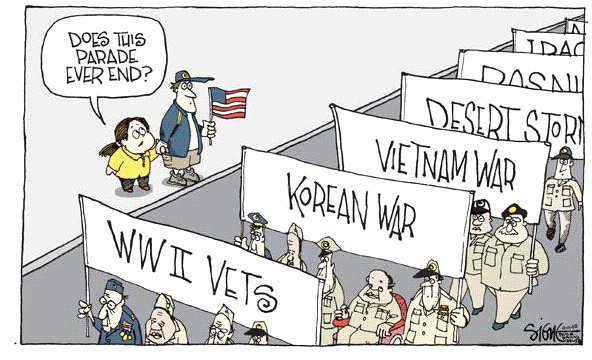 Document 2
Source: An assessment of President George H.W. Bush by the Miller Center
One example of Bush's conservative and pragmatic approach to foreign affairs occurred early in his administration. In June 1989, the Chinese military suppressed a pro-democracy movement demonstrating in Beijing's Tiananmen Square. Using tanks and armored cars, the military crushed the demonstrations and fired into the crowd, killing hundreds of protestors. Although Bush abhorred the Chinese government's violent crackdown in Tiananmen Square, he did not want to jettison improved U.S.-Sino relations by overreacting to events. Many in Congress cried out for a harsh, punitive response to the Chinese government's killing of peaceful protestors, but the Bush administration imposed only limited sanctions. Later in his administration, Bush sent Brent Scowcroft and Lawrence Eagleburger, deputy secretary of state, to China to try to repair the damaged, but not destroyed, relationship. In the end, U.S.-Sino relations, while always somewhat fragile, have generally thrived, particularly in the economic realm, where both nations have benefitted from a robust trading partnership.
Document 3
Source: President George W. Bush, address to the nation, September 20, 2001
Now, this war will not be like the war against Iraq a decade ago, with a decisive liberation of territory and a swift conclusion. It will not look like the air war above Kosovo two years ago, where no ground troops were used and not a single American was lost in combat. Our response involves far more than instant retaliation and isolated strikes. Americans should not expect one battle, but a lengthy campaign unlike any other we have ever seen. It may include dramatic strikes visible on TV and covert operations secret even in success.
We will starve terrorists of funding, turn them one against another, drive them from place to place until there is no refuge or no rest. And we will pursue nations that provide aid or safe haven to terrorism. Every nation in every region now has a decision to make: Either you are with us or you are with the terrorists. From this day forward, any nation that continues to harbor or support terrorism will be regarded by the United States as a hostile regime. Our nation has been put on notice, we're not immune from attack. We will take defensive measures against terrorism to protect Americans.
Document 4
Saurce: Lauisiana Governor Bobby Jindal an policies proposed by Presidential Candidate, Senator Jahn McCain
Because UN membership is open to any twa-bit despot, the argarization has become carrupt and dysfunctional. McCain has proposed creating a League af Democracies. Camprising anly
democracies, it wauld better reflect aur values and better protect US 5ecurity. Although a league wald present a valuable way to coordinate aus actions with aur allies, we also have to be prepared to go it alone. No ane-no persan, cauntry, ar international arganization -should have veto power aver American 5 ecurity.
Document 5
Source: New York Times, December 3, 1987
President Reagan, backing away from his own previous statements on what he called ''the Iran-contra so-called affair,'' said today that it was not a scandal, ''and never at any time did we view this as trading weapons for hostages.'' Mr. Reagan's remarks, in an interview with television news correspondents, ran counter to the findings of both the Tower Commission he appointed last December to examine the matter and the Congressional committees that investigated the Iran-contra affair for more than 10 months.
In a nationally broadcast speech last March 4, Mr. Reagan said he accepted the Tower Commission's findings and added, ''What began as a strategic opening to Iran deteriorated, in its implementation, into trading arms for hostages.'' At that time Mr. Reagan's aides said, informally, that he did not really believe that but felt compelled to appear contrite as a means of getting the scandal behind him. His remarks today seem to support that view. Everybody has misunderstood and ''misconstrued'' his actions, he said today. ''We weren't dealing at all with the Ayatollah'' but others in the Iranian Government who ''asked for that token shipment of arms to verify—and so forth—our credentials,'' he said.
Document 6
Source: New York Times, July 12, 1995
Saying the time was at hand to "bind up our own wounds," President Clinton today extended full diplomatic recognition to Vietnam 22 years after the American withdrawal from a bitterly divisive war that still scars the national psyche. Mr. Clinton, the one-time student protester who avoided serving in a war he once said he "opposed and despised," announced the normalization of relations in a brief ceremony in the East Room attended by military figures, the families of those still missing in action and members of Congress who were veterans of the war and prisoners of the Vietnamese.
"This moment offers us the opportunity to bind up our own wounds," the President said, evoking words used by Lincoln at the end of the Civil War. "They have resisted time for too long. We can now move onto common ground."
Document 7
Source: U.S. Troops in Iraq (toop levels and deaths by month as of October 17, 2011)
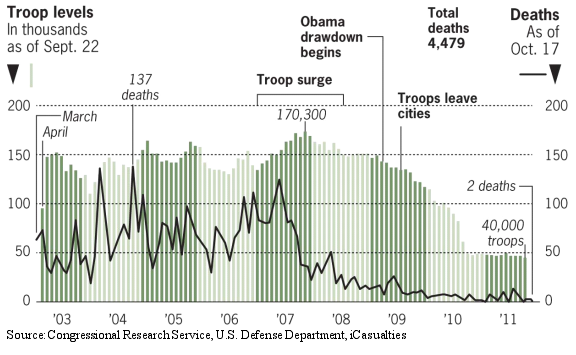
Document 2
Source: An assessment of President George H.W. Bush by the Miller Center
One example of Bush's conservative and pragmatic approach to foreign affairs occurred early in his administration. In June 1989, the Chinese military suppressed a pro-democracy movement demonstrating in Beijing's Tiananmen Square. Using tanks and armored cars, the military crushed the demonstrations and fired into the crowd, killing hundreds of protestors. Although Bush abhorred the Chinese government's violent crackdown in Tiananmen Square, he did not want to jettison improved U.S.-Sino relations by overreacting to events. Many in Congress cried out for a harsh, punitive response to the Chinese government's killing of peaceful protestors, but the Bush administration imposed only limited sanctions. Later in his administration, Bush sent Brent Scowcroft and Lawrence Eagleburger, deputy secretary of state, to China to try to repair the damaged, but not destroyed, relationship. In the end, U.S.-Sino relations, while always somewhat fragile, have generally thrived, particularly in the economic realm, where both nations have benefitted from a robust trading partnership.
Document 3
Source: President George W. Bush, address to the nation, September 20, 2001
Now, this war will not be like the war against Iraq a decade ago, with a decisive liberation of territory and a swift conclusion. It will not look like the air war above Kosovo two years ago, where no ground troops were used and not a single American was lost in combat. Our response involves far more than instant retaliation and isolated strikes. Americans should not expect one battle, but a lengthy campaign unlike any other we have ever seen. It may include dramatic strikes visible on TV and covert operations secret even in success.
We will starve terrorists of funding, turn them one against another, drive them from place to place until there is no refuge or no rest. And we will pursue nations that provide aid or safe haven to terrorism. Every nation in every region now has a decision to make: Either you are with us or you are with the terrorists. From this day forward, any nation that continues to harbor or support terrorism will be regarded by the United States as a hostile regime. Our nation has been put on notice, we're not immune from attack. We will take defensive measures against terrorism to protect Americans.
Document 4
Saurce: Lauisiana Governor Bobby Jindal an policies proposed by Presidential Candidate, Senator Jahn McCain
Because UN membership is open to any twa-bit despot, the argarization has become carrupt and dysfunctional. McCain has proposed creating a League af Democracies. Camprising anly
democracies, it wauld better reflect aur values and better protect US 5ecurity. Although a league wald present a valuable way to coordinate aus actions with aur allies, we also have to be prepared to go it alone. No ane-no persan, cauntry, ar international arganization -should have veto power aver American 5 ecurity.
Document 5
Source: New York Times, December 3, 1987
President Reagan, backing away from his own previous statements on what he called ''the Iran-contra so-called affair,'' said today that it was not a scandal, ''and never at any time did we view this as trading weapons for hostages.'' Mr. Reagan's remarks, in an interview with television news correspondents, ran counter to the findings of both the Tower Commission he appointed last December to examine the matter and the Congressional committees that investigated the Iran-contra affair for more than 10 months.
In a nationally broadcast speech last March 4, Mr. Reagan said he accepted the Tower Commission's findings and added, ''What began as a strategic opening to Iran deteriorated, in its implementation, into trading arms for hostages.'' At that time Mr. Reagan's aides said, informally, that he did not really believe that but felt compelled to appear contrite as a means of getting the scandal behind him. His remarks today seem to support that view. Everybody has misunderstood and ''misconstrued'' his actions, he said today. ''We weren't dealing at all with the Ayatollah'' but others in the Iranian Government who ''asked for that token shipment of arms to verify—and so forth—our credentials,'' he said.
Document 6
Source: New York Times, July 12, 1995
Saying the time was at hand to "bind up our own wounds," President Clinton today extended full diplomatic recognition to Vietnam 22 years after the American withdrawal from a bitterly divisive war that still scars the national psyche. Mr. Clinton, the one-time student protester who avoided serving in a war he once said he "opposed and despised," announced the normalization of relations in a brief ceremony in the East Room attended by military figures, the families of those still missing in action and members of Congress who were veterans of the war and prisoners of the Vietnamese.
"This moment offers us the opportunity to bind up our own wounds," the President said, evoking words used by Lincoln at the end of the Civil War. "They have resisted time for too long. We can now move onto common ground."
Document 7
Source: U.S. Troops in Iraq (toop levels and deaths by month as of October 17, 2011)
(75) The following questions refer to the excerpt below.
"The hope of reversing the trends of decay in our republic now lies with the Christian public in America.We cannot expect help from the liberals.They certainly are not going to call our nation back to righteousness and neither are the pornographers,the smut peddlers,and those who are corrupting our youth.Moral Americans must be willing to put their reputations,their fortunes,and their very lives on the line for this great nation of ours.Would that we had the courage of our forefathers who knew the great responsibility that freedom carries with it....Our Founding Fathers separated church and state in function,but never intended to establish a government void of God.As is evidenced by our Constitution,good people in America must exert an influence and provide a conscience and climate of morality in which it is difficult to go wrong,not difficult for people to go right in America."
Jerry Falwell on the Moral Majority,1980
-The popularity of Falwell's message contributed to which of the following developments of the 1980s and 1990s?
(65) Directions: Read each question carefully and write your responses using complete sentences; an outline or bulleted list alone is not acceptable.
-Answer parts a,b,and c.
a)Briefly explain why ONE of the following events best represents a turning point in the modern world:
-The election of Ronald Reagan in 1980
-The end of the Cold War
-The terrorist attacks on September 11,2001
b)Provide ONE piece of evidence from the period to support your explanation.
c)Briefly explain why ONE of the other options is not as persuasive as the one you chose.
(79) The following questions refer to the graph below.
Source: Federal Bureau of Labor Statistics
Union Membership Rates
-The graph reflects which of the following historical trends?
Source: Federal Bureau of Labor Statistics
Union Membership Rates
-The graph reflects which of the following historical trends? (63) The following questions refer to the cartoon below.
Signe Wilkinson's/Cartoonist Group
-Which of the following events was the most significant cause of the events depicted in the cartoon?
Signe Wilkinson's/Cartoonist Group
-Which of the following events was the most significant cause of the events depicted in the cartoon? (83) The following questions refer to the cartoon below.
-All of the following would have been likely to agree with the ideas depicted in the cartoon except
-All of the following would have been likely to agree with the ideas depicted in the cartoon except (70) The following questions refer to the excerpt below.
"For decades,the United States has not been in complete control of its borders.As a result,many who want to work in our economy have been able to sneak across our border and millions have stayed….We are a nation of laws,and we must enforce our laws.We're also a nation of immigrants,and we must uphold that tradition,which has strengthened our country in so many ways.These are not contradictory goals.America can be a lawful society and a welcoming society at the same time.We will fix the problems created by illegal immigration,and we will deliver a system that is secure,orderly,and fair.So I support comprehensive immigration reform that will accomplish…clear objectives. First,the United States must secure its borders.This is a basic responsibility of a sovereign nation.It is also an urgent requirement of our national security.Our objective is straightforward: The border should be open to trade and lawful immigration,and shut to illegal immigrants,as well as criminals,drug dealers,and terrorists."
President George W.Bush,Address to the Nation,May 15,2006
-All of the following statements are true of the period to which the excerpt refers,except?
(84) Directions: Read each question carefully and write your responses using complete sentences; an outline or bulleted list alone is not acceptable.
-Which of the following developments was most directly caused by the events described in the passage?
(85) The following questions refer to the excerpt below.
"The 1980's have been born in turmoil,strife,and change.This is a time of challenge to our interests and our values and it's a time that tests our wisdom and our skills.At this time in Iran,50 Americans are still held captive,innocent victims of terrorism and anarchy.Also at this moment,massive Soviet troops are attempting to subjugate the fiercely independent and deeply religious people of Afghanistan.These two acts-one of international terrorism and one of military aggression-present a serious challenge to the United States of America and indeed to all the nations of the world.Together,we will meet these threats to peace. I'm determined that the United States will remain the strongest of all nations,but our power will never be used to initiate a threat to the security of any nation or to the rights of any human being.We seek to be and to remain secure-a nation at peace in a stable world.But to be secure we must face the world as it is."
President Jimmy Carter,State of the Union Address,January 23,1980
-Enacting the policies that Carter suggests would require
(82) The following questions refer to the cartoon below.
-Which of the following was a causal factor in creating the patterns seen in the cartoon?
-Which of the following was a causal factor in creating the patterns seen in the cartoon? (77) Directions: Read each question carefully and write your responses using complete sentences; an outline or bulleted list alone is not acceptable.
-"During his two terms in the White House (1981-89),Reagan presided over a widening gap between the rich and everyone else,declining wages and living standards for working families,an assault on labor unions as a vehicle to lift Americans into the middle class,a dramatic increase in poverty and homelessness,and the consolidation and deregulation of the financial industry that led to the current mortgage meltdown,foreclosure epidemic and lingering recession."
Peter Dreir,"Reagan's Real Legacy"
"It is not difficult to identify the principal initiatives for which Ronald Reagan will be remembered.After a decade of national defeatism and doubt,he strode into office in 1981-confident of America's ideals and promise,and of the ability of his countrymen to conquer their malaise.He instituted startling tax-rate reductions and other measures that have produced (his supporters argue)the longest peacetime economic expansion in the history of the United States.In foreign policy he initiated a massive rearmament program to contain Soviet imperialism and expounded America's democratic faith without shame.In doing so he broke,without fully dispelling,the debilitating grip of the "post-Vietnam syndrome" and the mentality of "blame America first." In the realm of social issues,he set out deliberately to curb the "imperial judiciary" and reorient a left-leaning Supreme Court."
George H.Nash,"How Great Was Ronald Reagan?"
Using the excerpts above,answer parts a,b,and c.
a)Briefly explain ONE major difference between Dreier's and Nash's interpretation of the legacy of President Ronald Reagan.
b)Briefly explain how ONE specific event,development,or circumstance in the period after 1980 that is not specifically mentioned in the excerpts could be used to support Dreier's argument.
c)Briefly explain how ONE specific event,development,or circumstance in the period after 1980 that is not specifically mentioned in the excerpts could be used to support Nash's argument.
(68) The following questions refer to the cartoon below.
-The cartoonist would likely agree with which of the following statements?
-The cartoonist would likely agree with which of the following statements? (76) 
Filters
- Essay(0)
- Multiple Choice(0)
- Short Answer(0)
- True False(0)
- Matching(0)