



 Chat with AI
Exam 6: The Duel for North America 1608-1763

Exam 1: New World Beginnings53 Questions
Exam 2: The Planting of English America 1500-173353 Questions
Exam 3: Settling the Northern Colonies 1619-170053 Questions
Exam 4: American Life in the 17th Century 1607-169253 Questions
Exam 5: Colonial Society on the Eve of Revolution 1700-177552 Questions
Exam 6: The Duel for North America 1608-176352 Questions
Exam 7: The Road to Revolution 1763-177552 Questions
Exam 8: America Secedes from the Empire 1775-178352 Questions
Exam 9: The Confederation and the Constitution 1776-179051 Questions
Select questions type


DOCUMENT BASED
DBQ Directions
Directions: These questions are based on the accompanying documents.The documents have been edited for the purpose of this exercise.
In your response you should do the following:
•State a relevant thesis that directly addresses all parts of the question.
•Support the thesis or a relevant argument with evidence from all,or all but one,of the documents.
•Incorporate analysis of all,or all but one,of the documents into your argument.
•Focus your analysis of each document on at least one of the following: intended audience,purpose,historical context,and/or point of view.
•Support your argument with analysis of historical examples outside the documents.
•Connect historical phenomena relevant to your argument to broader events or processes.
•Synthesize the elements above into a persuasive essay that extends your argument,connects it to a different historical context,or accounts for contradictory evidence on the topic.
-The immigrants that came to the Unites States post-Civil War were both welcomed and unwelcome.Analyze the reasons for the continued and changing attitudes Americans had toward these immigrants from 1865 to 1898.
Document 1
Source: Burlingame Seward Treaty, 1868
ARTICLE II
The United States of America and his Majesty the Emperor of China, believing that the safety and prosperity of commerce will thereby best be promoted, agree that any privilege or immunity in respect to trade or navigation within the Chinese dominions which may not have been stipulated for by treaty, shall be subject to the discretion of the Chinese Government and may be regulated by it accordingly, but not in a manner or spirit incompatible with the treaty stipulations of the parties.
ARTICLE V
The United States of America and the Emperor of China cordially recognize the inherent and inalienable right of man to change his home and allegiance, and also the mutual advantage of the free migration and emigration of their citizens and subjects respectively from the one country to the other, for purposes of curiosity, of trade, or as permanent residents. The high contracting parties, therefore, join in reprobating any other than an entirely voluntary emigration for these purposes…
Document 2
Source: Immigration to U. S. 1880-1930
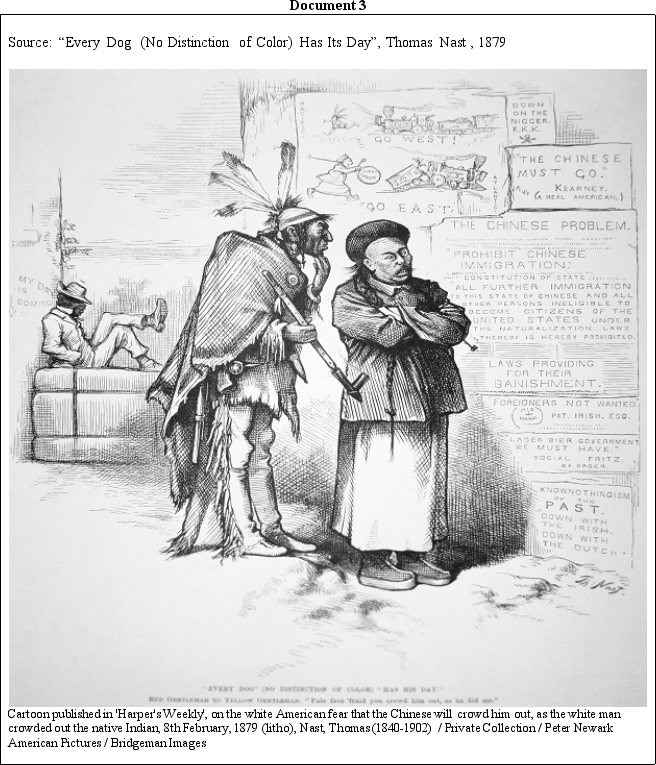
Italy 4,600,000 Austo-Hungarian Empire 4,000,000 Russian Empire 3,300,000 German Empire 2,800,000 Britain 2,300,000 Canada 2,300,000 Ireland 1,700,000 Sweden 1,100,000
 Document 4
Source: “The Secret Oath of the American Protective Association, October 31, 1893”
I do most solemnly promise and swear that I will always, to the utmost of my ability, labor, plead and wage a continuous warfare against ignorance and fanaticism; that I will use my utmost power to strike the shackles and chains of blind obedience to the Roman Catholic church from the hampered and bound consciences of a priest-ridden and church-oppressed people; that I will never allow any one, a member of the Roman Catholic church, to become a member of this order, I knowing him to be such; that I will use my influence to promote the interest of all Protestants everywhere in the world that I may be; that I will not employ a Roman Catholic in any capacity if I can procure the services of a Protestant. I furthermore promise and swear that I will not aid in building or maintaining, by my resources, any Roman Catholic church or institution of their sect or creed whatsoever, but will do all in my power to retard and break down the power of the Pope, in this country or any other; that I will not enter into any controversy with a Roman Catholic upon the subject of this order, nor will I enter into any agreement with a Roman Catholic to strike or create a disturbance whereby the Catholic employees may undermine and substitute their Protestant co-workers;…I furthermore promise and swear that I will not countenance the nomination, in any caucus or convention, of a Roman Catholic for any office in the gift of the American people, and that I will not vote for, or counsel others to vote for, any Roman Catholic, but will vote only for a Protestant, so far as may lie in my power…
 Picture History/Newscom
Document 6
Source: President Cleveland, Veto of Literacy Test, 1897
…The best reason that could be given for this radical restriction of immigration is the necessity of protecting our population against degeneration and saving our national peace and quiet from imported turbulence and disorder…Violence and disorder do not originate with illiterate laborers. They are, rather, the victims of the educated agitator…If any particular element of our illiterate immigration is to be feared for other causes than illiteracy, these causes should be dealt with directly, instead of making illiteracy the pretext for exclusion…
Document 7
Saurce: "There was Nathing to Arbitrate," The Fhiladelphia haquirer, August 12, 1899
The refusal of the United States Government to accede to the request of Austria-Hungary to submit to the arbitration of a claim for the payment of an indemnity on account of the killing of Hungarians in the memorable Lattimer riot is entirely justifiable, and it is indeed surprising that the request should have been made. The killing in question was the subject of judicial proceedings, the result of which was to vindicate its legality. It will be recalled that the rioting occurred in connection with a strike of coal-miners. In the course of that strike, and as a means of intimidating the employers, a number of men, among whom were the Hungarians on account of whose death the claims were made, had assembled and had begun to act in a threatening and disorderly manner. Called upon by the Sheriff of the county to disperse, they refused to do so and they suffered as a consequence of their refusal. The verdict of a jury confirmed the rightfulness of the Sheriff’s action and there is not the slightest basis upon which to found a claim against the United States. There is no parallel between this case and that of the Italians who were taken from a New Orleans jail and lynched, and for whom this country did pay a compensation. The Lattimer rioters had no one to blame but themselves, and as the facts are undisputed and undisputable, there is absolutely nothing to arbitrate. The Austro-Hungarian Government could hardly have been serious in its request.
Document 4
Source: “The Secret Oath of the American Protective Association, October 31, 1893”
I do most solemnly promise and swear that I will always, to the utmost of my ability, labor, plead and wage a continuous warfare against ignorance and fanaticism; that I will use my utmost power to strike the shackles and chains of blind obedience to the Roman Catholic church from the hampered and bound consciences of a priest-ridden and church-oppressed people; that I will never allow any one, a member of the Roman Catholic church, to become a member of this order, I knowing him to be such; that I will use my influence to promote the interest of all Protestants everywhere in the world that I may be; that I will not employ a Roman Catholic in any capacity if I can procure the services of a Protestant. I furthermore promise and swear that I will not aid in building or maintaining, by my resources, any Roman Catholic church or institution of their sect or creed whatsoever, but will do all in my power to retard and break down the power of the Pope, in this country or any other; that I will not enter into any controversy with a Roman Catholic upon the subject of this order, nor will I enter into any agreement with a Roman Catholic to strike or create a disturbance whereby the Catholic employees may undermine and substitute their Protestant co-workers;…I furthermore promise and swear that I will not countenance the nomination, in any caucus or convention, of a Roman Catholic for any office in the gift of the American people, and that I will not vote for, or counsel others to vote for, any Roman Catholic, but will vote only for a Protestant, so far as may lie in my power…
Picture History/Newscom
Document 6
Source: President Cleveland, Veto of Literacy Test, 1897
…The best reason that could be given for this radical restriction of immigration is the necessity of protecting our population against degeneration and saving our national peace and quiet from imported turbulence and disorder…Violence and disorder do not originate with illiterate laborers. They are, rather, the victims of the educated agitator…If any particular element of our illiterate immigration is to be feared for other causes than illiteracy, these causes should be dealt with directly, instead of making illiteracy the pretext for exclusion…
Document 7
Saurce: "There was Nathing to Arbitrate," The Fhiladelphia haquirer, August 12, 1899
The refusal of the United States Government to accede to the request of Austria-Hungary to submit to the arbitration of a claim for the payment of an indemnity on account of the killing of Hungarians in the memorable Lattimer riot is entirely justifiable, and it is indeed surprising that the request should have been made. The killing in question was the subject of judicial proceedings, the result of which was to vindicate its legality. It will be recalled that the rioting occurred in connection with a strike of coal-miners. In the course of that strike, and as a means of intimidating the employers, a number of men, among whom were the Hungarians on account of whose death the claims were made, had assembled and had begun to act in a threatening and disorderly manner. Called upon by the Sheriff of the county to disperse, they refused to do so and they suffered as a consequence of their refusal. The verdict of a jury confirmed the rightfulness of the Sheriff’s action and there is not the slightest basis upon which to found a claim against the United States. There is no parallel between this case and that of the Italians who were taken from a New Orleans jail and lynched, and for whom this country did pay a compensation. The Lattimer rioters had no one to blame but themselves, and as the facts are undisputed and undisputable, there is absolutely nothing to arbitrate. The Austro-Hungarian Government could hardly have been serious in its request. (Essay)
4.8/5  (96)
(96) The following questions refer to the excerpt below.
"…They buried him in the midst of a marble quarry-they cut through solid marble to make his grave-and yet a little tombstone they put above him was from Vermont.They buried him in the heart of a pine forest,and yet the pine coffin was imported from Cincinnati…the iron in the shovel that dug his grave was imported from Pittsburg.They buried him by the side of the best sheep-grazing country on earth…and the coffin bands were brought from the North.The South didn't furnish a thing on earth for that funeral but the corpse and the hole in the ground…"
Henry Grady,1889
-Which of the following is true concerning the economic condition of the South after the Civil War?
(Multiple Choice)
4.7/5 (73)
(73) Answer parts a,b,and c.
a)Briefly explain ONE significant cause of Westward migration during the period from 1845 to 1898.
b)Briefly explain ONE significant economic effect of Westward migration during the period from 1845 to 1898.
c)Briefly explain ONE significant social effect of Westward migration during the period from 1845 to 1898.
(Essay)
4.8/5 (69)
(69) The following questions refer to the excerpt below.
"… There is but one way to remove an evil-and that is,to remove its cause. Poverty deepens as wealth increases,and wages are forced down while productive power grows,because land,which is the source of all wealth and the field of all labor,is monopolized.To extirpate poverty,to make wages what justice commands they should be,the full earnings of the laborer,we must therefore substitute for the individual ownership of land a common ownership.Nothing else will go to the cause of the evil…This,then,is the remedy for the unjust and unequal distribution of wealth apparent in modern civilization,and for all the evils which flow from it…
Henry George,Progress and Poverty,1879
-Which of the following details most directly contributed to the frustrations expressed by Henry George in this excerpt?
(Multiple Choice)
4.9/5 (79)
(79) DOCUMENT BASED
DBQ Directions
Directions: These questions are based on the accompanying documents.The documents have been edited for the purpose of this exercise.
In your response you should do the following:
•State a relevant thesis that directly addresses all parts of the question.
•Support the thesis or a relevant argument with evidence from all,or all but one,of the documents.
•Incorporate analysis of all,or all but one,of the documents into your argument.
•Focus your analysis of each document on at least one of the following: intended audience,purpose,historical context,and/or point of view.
•Support your argument with analysis of historical examples outside the documents.
•Connect historical phenomena relevant to your argument to broader events or processes.
•Synthesize the elements above into a persuasive essay that extends your argument,connects it to a different historical context,or accounts for contradictory evidence on the topic.
-To what extent did new cultural trends lead to social change in America from 1870 to 1900?
Document 1
Source: Frederick Law Olmstead, 1871
Compare advantages in respect simply to schools, libraries, music, and the fine arts. People of the greatest wealth can hardly command as much of these in the country as the poorest work-girl is offered here in Boston at the mere cost of a walk for a short distance over a good firm, clean pathway, lighted at night and made interesting to her by shop fronts and the variety of people passing.
Document 2
Source : “An Essay about Kindergarten, Modernism, and the Value of Women’s Work,” Margaret Wertheim, 2003
Properly conducted, Froebel believed that education for the very young would enable the flowering of human potential, for kindergarten was literally the garden of children where growing buds might unfurl and bloom. “By education,” he declared, “the divine essence of man should be unfolded, brought out, lifted into consciousness.” For Froebel, the education of children was nothing less than a holy duty, “a necessary, universal requirement” that was beginning to assert itself as the birthright of all humanity.
 JT Vintage/ZUMA Press/Newscom
 Field Museum Library/Getty Images
Document 5
Source: The San Francisco Call, July 26, 1896
SAN FRANCISCO BICYCLE RIDERS AS DISCIPLES OF PROGRESS.
Enthusiastic Outpouring of Devotees of the Wheel Who Are Determined on Improving the City's Thoroughfares—Fully One Hundred Thousand Spectators Viewed the Parade.
BICYCLISTS of every age, race, sex and color—bicyclists from every stratum of cycledom, from the scorcher with his interrogation-point hump to the hoary-headed patriarch biker, sitting in military erectness on an antique 60-pounder wheels—in short, everybody who could claim any degree of proficiency in managing a wheel, turned out last night to take part in the great demonstration in favor of good streets. Such a parade as last night's has never before greeted the eyes of San Franciscans and it was estimated that at least 100,000 spectators lined the streets. The number of wheelmen who started with the procession is estimated to have been at least 5000. They came from every direction on wheels and every stage of decoration and thronged filled streets in the vicinity of Twenty-second and Folsom until even the pedestrians could scarcely move.
Document 6
Source: Scott Joplin, “Maple Leaf Rag,” 1898
Ragtime musician Scott Joplin completed his masterpiece, “The Maple Leaf Rag,” while in Sedalia in 1898, and a year later local music store owner John Stark published the spirited composition. Named after a local saloon, the “Maple Leaf Rag” is probably the most enduring melody from the ragtime era and sold over a half-million copies within a decade of its release. Joplin’s huge success with this piece led to his being named the “King of Ragtime,” and his music set the standard for the musical genre. Although it had yet to be named, ragtime was first introduced in 1893 at the World’s Colombian Exposition in Chicago. The music, first known as ”jig piano” and featuring jaunty melodies and syncopated rhythm, became widely known as ragtime by 1897. Many consider this style of piano playing to be the first uniquely type of American music.
 Stock Sales WGBH / Scala / Art Resource
JT Vintage/ZUMA Press/Newscom
Field Museum Library/Getty Images
Document 5
Source: The San Francisco Call, July 26, 1896
SAN FRANCISCO BICYCLE RIDERS AS DISCIPLES OF PROGRESS.
Enthusiastic Outpouring of Devotees of the Wheel Who Are Determined on Improving the City's Thoroughfares—Fully One Hundred Thousand Spectators Viewed the Parade.
BICYCLISTS of every age, race, sex and color—bicyclists from every stratum of cycledom, from the scorcher with his interrogation-point hump to the hoary-headed patriarch biker, sitting in military erectness on an antique 60-pounder wheels—in short, everybody who could claim any degree of proficiency in managing a wheel, turned out last night to take part in the great demonstration in favor of good streets. Such a parade as last night's has never before greeted the eyes of San Franciscans and it was estimated that at least 100,000 spectators lined the streets. The number of wheelmen who started with the procession is estimated to have been at least 5000. They came from every direction on wheels and every stage of decoration and thronged filled streets in the vicinity of Twenty-second and Folsom until even the pedestrians could scarcely move.
Document 6
Source: Scott Joplin, “Maple Leaf Rag,” 1898
Ragtime musician Scott Joplin completed his masterpiece, “The Maple Leaf Rag,” while in Sedalia in 1898, and a year later local music store owner John Stark published the spirited composition. Named after a local saloon, the “Maple Leaf Rag” is probably the most enduring melody from the ragtime era and sold over a half-million copies within a decade of its release. Joplin’s huge success with this piece led to his being named the “King of Ragtime,” and his music set the standard for the musical genre. Although it had yet to be named, ragtime was first introduced in 1893 at the World’s Colombian Exposition in Chicago. The music, first known as ”jig piano” and featuring jaunty melodies and syncopated rhythm, became widely known as ragtime by 1897. Many consider this style of piano playing to be the first uniquely type of American music.
Stock Sales WGBH / Scala / Art Resource (Essay)
4.9/5 (87)
(87) "The sod wall is about 2 feet thick at the ground,and slopes off on the outside to about 14 inches at the top.The roof is composed of a ridge pole and rafters of rough split logs… Occasionally a newcomer has a "bee," and the neighbors for miles around gather at his claim and put up his house in a day… tried a new dodge with the cornmeal.Mixed it with a little water and salt…My supper will be a slice of ham boiled with beans,and a slice of bread.How is that for high toned?..."
Howard Ruede,1877
-Which of the following earlier historical events was most similar to the post-Civil War westward migration?
(Multiple Choice)
4.9/5 (93)
(93) The following questions refer to the painting below.
 Library of Congress Prints and Photographs Division Washington,D.C[LC-USZC4-3246]
Thomas Moran,Tower Falls and Sulphur Mountain,Yellowstone,1875
-American expansion and settlement in the region depicted here was initially sparked by
Library of Congress Prints and Photographs Division Washington,D.C[LC-USZC4-3246]
Thomas Moran,Tower Falls and Sulphur Mountain,Yellowstone,1875
-American expansion and settlement in the region depicted here was initially sparked by (Multiple Choice)
4.7/5 (72)
(72) The following questions refer to the advertisement below.
 Image Courtesy of The Advertising Archives
-The point of view expressed in the advertisement emerged most directly from which of the following trends?
Image Courtesy of The Advertising Archives
-The point of view expressed in the advertisement emerged most directly from which of the following trends? (Multiple Choice)
4.8/5 (78)
(78) The following questions refer to the excerpt below.
"… Of all the races and varieties of men which have suffered from this feeling,the colored people of this country have endured most… The African origin can be instantly recognized,though they may be several removes from the typical African race…They are Negroes-and that is enough,in the eye of this unreasoning prejudice,to justify indignity and violence.In nearly every department of American life they are confronted by this insidious influence…It meets them at the workshop,and factory,when they apply for work.It meets them at the church,at the hotel,at the ballot box,and worst of all,it meets them in the jury box… Everything against the person with the hated color is promptly taken for granted;while everything in his favor is received with suspicion and doubt."
Frederick Douglass,The Color Line,1891
-Which other group of Americans in the period from 1865 to 1898 faced similar discrimination as blacks?
(Multiple Choice)
4.8/5 (64)
(64) The following questions refer to the excerpt below.
"The Cigar Manufacturers' Association had declared that under no circumstances would any leaders of the strike be employed for at least six months.As a consequence,for nearly four months I was out of employment.I had parted with anything of value in the house,and my wife and I were everyday expecting a newcomer in addition to the five children we already had.My family helped in every way possible…Blacklisted,I desperately sought employment…Once I was ready to commit murder. All the children were ill…"
Samuel Gompers,"Strike Baby",1878
-Which of the following was true for strikes around the time of the excerpt?
(Multiple Choice)
4.8/5 (79)
(79) The following questions refer to the advertisement below.
Image Courtesy of The Advertising Archives
-Which of the following caused the need for mass marketing techniques?
Image Courtesy of The Advertising Archives
-Which of the following caused the need for mass marketing techniques? (Multiple Choice)
4.8/5 (78)
(78) The following questions refer to the excerpt below.
Jany 31/89
5 West Fifty-First Street,New York
My Dear Mr.Hitchcock
Yours rec'd - We must begin at once if Hall is to be ready for next winter.
Please let it be understood between us that if upon my return from the South say February 15th you have not succeeded that we consider the idea given up.We have property in view & quite ready to go on & build the Hall Capital all ready-although we will wait on you until Feby 15??.
If we build it will be much farther up town-not below 56th.Would not build upon Madison Square if we have to invest beyond the last 50,000 ft I agreed to take [illegible].Perhaps if your people leased us ground & agreed that our investment for Hall should bear [crossed out: up to illegible] interest upon cost and first net receipts,before ground rent was payable We might consider it-in that case you would have to clear a part from Mortgage & lease to us: but [illegible] increase your investment.
Yours,Andrew Carnegie
Andrew Carnegie to Hiram Hitchcock on the construction of a new philanthropic venture,
January 31,1889
-Which of the following statements is true concerning how Carnegie believed he should spend his fortune?
(Multiple Choice)
4.9/5 (80)
(80) 
Filters
- Essay(0)
- Multiple Choice(0)
- Short Answer(0)
- True False(0)
- Matching(0)