



 Chat with AI
Exam 33: An Introduction to Invertebrates

Exam 1: Evolution, the Themes of Biology, and Scientific Inquiry51 Questions
Exam 2: The Chemical Context of Life61 Questions
Exam 3: Water and Life55 Questions
Exam 4: Carbon and the Molecular Diversity of Life58 Questions
Exam 5: The Structure and Function of Large Biological Molecules70 Questions
Exam 6: A Tour of the Cell66 Questions
Exam 7: Membrane Structure and Function68 Questions
Exam 8: An Introduction to Metabolism67 Questions
Exam 9: Cellular Respiration and Fermentation68 Questions
Exam 10: Photosynthesis65 Questions
Exam 11: Cell Communication65 Questions
Exam 12: The Cell Cycle66 Questions
Exam 13: Meiosis and Sexual Life Cycles64 Questions
Exam 14: Mendel and the Gene Idea62 Questions
Exam 15: The Chromosomal Basis of Inheritance58 Questions
Exam 16: The Molecular Basis of Inheritance65 Questions
Exam 17: Gene Expression: From Gene to Protein67 Questions
Exam 18: Regulation of Gene Expression66 Questions
Exam 19: Viruses54 Questions
Exam 20: DNA Tools and Biotechnology57 Questions
Exam 21: Genomes and Their Evolution44 Questions
Exam 22: Descent with Modification: A Darwinian View of Life60 Questions
Exam 23: The Evolution of Populations64 Questions
Exam 24: The Origin of Species67 Questions
Exam 25: The History of Life on Earth59 Questions
Exam 26: Phylogeny and the Tree of Life75 Questions
Exam 27: Bacteria and Archaea75 Questions
Exam 28: Protists79 Questions
Exam 29: Plant Diversity I: How Plants Colonized Land82 Questions
Exam 30: Plant Diversity II: The Evolution of Seed Plants80 Questions
Exam 31: Fungi75 Questions
Exam 32: An Overview of Animal Diversity67 Questions
Exam 33: An Introduction to Invertebrates83 Questions
Exam 34: The Origin and Evolution of Vertebrates82 Questions
Exam 35: Vascular Plant Structure, Growth, and Development65 Questions
Exam 36: Resource Acquisition and Transport in Vascular Plants74 Questions
Exam 37: Soil and Plant Nutrition52 Questions
Exam 38: Angiosperm Reproduction and Biotechnology60 Questions
Exam 39: Plant Responses to Internal and External Signals61 Questions
Exam 40: Basic Principles of Animal Form and Function68 Questions
Exam 41: Animal Nutrition64 Questions
Exam 42: Circulation and Gas Exchange67 Questions
Exam 43: The Immune System69 Questions
Exam 44: Osmoregulation and Excretion64 Questions
Exam 45: Hormones and the Endocrine System66 Questions
Exam 46: Animal Reproduction68 Questions
Exam 47: Animal Development70 Questions
Exam 48: Neurons, Synapses, and Signaling68 Questions
Exam 49: Nervous Systems65 Questions
Exam 50: Sensory and Motor Mechanisms67 Questions
Exam 51: Animal Behavior69 Questions
Exam 52: An Introduction to Ecology and the Biosphere68 Questions
Exam 53: Population Ecology69 Questions
Exam 54: Community Ecology71 Questions
Exam 55: Ecosystems and Restoration Ecology68 Questions
Exam 56: Conservation Biology and Global Change69 Questions
Select questions type


Use the information and figure to answer the following question.
The sea slug Pteraeolidia ianthina can harbor living dinoflagellates (photosynthetic protists) in its skin. These endosymbiotic dinoflagellates reproduce quickly enough to maintain their populations. Low populations do not affect the sea slugs very much, but high populations (> 5 × 10⁵ cells/mg of sea slug protein) can promote sea slug survival.
 Percent of sea slug respiratory carbon demand provided by indwelling dinoflagellates.
In the graph, the percent of the oxygen demand contributed by the dinoflagellates is greater than 100% during much of the year. What is the fate of this "excess" energy?
Percent of sea slug respiratory carbon demand provided by indwelling dinoflagellates.
In the graph, the percent of the oxygen demand contributed by the dinoflagellates is greater than 100% during much of the year. What is the fate of this "excess" energy? (Multiple Choice)
4.9/5  (81)
(81) Use the following information to answer the question.
The phylum Cycliophora was discovered in 1995. They are tiny organisms that live in large numbers on the outsides of the mouthparts and appendages of lobsters. The feeding stage permanently attaches to the lobster via an adhesive disk and collects scraps of food from its host's feeding by capturing the scraps in a current created by a ring of cilia. The body is saclike and has a U-shaped intestine that brings the anus close to the mouth. Cycliophorans are coelomates, do not molt (though their host does), and their embryos undergo spiral cleavage.
Which of these features is least useful in assigning the phylum Cycliophora to a clade of animals?
(Multiple Choice)
4.9/5 (66)
(66) Planarians lack dedicated respiratory and circulatory systems. This deficiency does not cause a problem because ________.
(Multiple Choice)
4.9/5 (82)
(82) Which of the following changes would lead to an increase in surface-area-to-volume ratios?
(Multiple Choice)
4.7/5 (59)
(59) The presence of a lophophore in a newly discovered species would suggest that the species ________.
(Multiple Choice)
5.0/5 (89)
(89) Which of the following combinations correctly matches a phylum to its description?
(Multiple Choice)
4.8/5 (71)
(71) Use the information and figure to answer the following question.
The sea slug Pteraeolidia ianthina can harbor living dinoflagellates (photosynthetic protists) in its skin. These endosymbiotic dinoflagellates reproduce quickly enough to maintain their populations. Low populations do not affect the sea slugs very much, but high populations (> 5 × 10⁵ cells/mg of sea slug protein) can promote sea slug survival.
 Percent of sea slug respiratory carbon demand provided by indwelling dinoflagellates.
According to the graph, during which season(s) of the year is the relationship between the sea slug and its dinoflagellates closest to being commensal?
Percent of sea slug respiratory carbon demand provided by indwelling dinoflagellates.
According to the graph, during which season(s) of the year is the relationship between the sea slug and its dinoflagellates closest to being commensal? (Multiple Choice)
4.7/5 (75)
(75) Without genetic variation, evolution cannot occur. Sexual reproduction leads to increased genetic variation, but male bdelloid rotifers have never been observed. Which of the following are correct statements with regard to evolution in bdelloid rotifers?
(Multiple Choice)
4.9/5 (80)
(80) 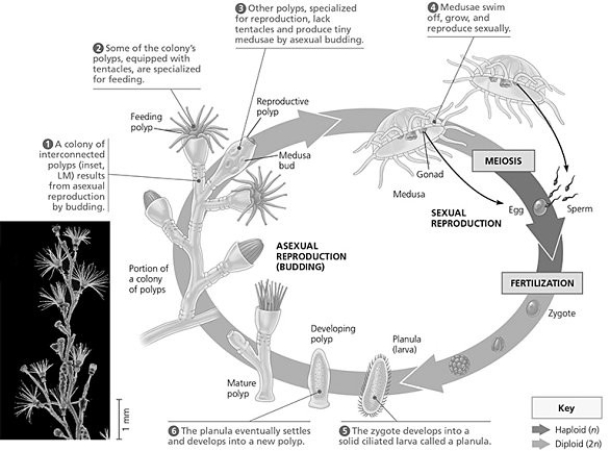 In Figure 33.8, assume that the two medusae shown at step 4 were produced by one polyp colony. Review Concept 12.1 and Concept 13.3, and then use your understanding of mitosis and meiosis to evaluate whether the following sentence is true or false; if false, select the answer that provides the correct reason. Although the two medusae are genetically identical, a sperm produced by one will differ genetically from an egg produced by the other.
 (Multiple Choice)
4.9/5 (74)
(74) What would be the most effective method of reducing the incidence of blood flukes in a human population?
(Multiple Choice)
5.0/5 (77)
(77) Use the following information to answer the question.
The phylum Cycliophora was discovered in 1995. They are tiny organisms that live in large numbers on the outsides of the mouthparts and appendages of lobsters. The feeding stage permanently attaches to the lobster via an adhesive disk and collects scraps of food from its host's feeding by capturing the scraps in a current created by a ring of cilia. The body is saclike and has a U-shaped intestine that brings the anus close to the mouth. Cycliophorans are coelomates, do not molt (though their host does), and their embryos undergo spiral cleavage.
Basing your inferences on information in the paragraph, to which clades should cycliophorans belong?
(Multiple Choice)
4.8/5 (69)
(69) Parasitism is one of the most widespread lifestyles ever to evolve. Which of the following is consistent with this finding?
(Multiple Choice)
4.8/5 (91)
(91) Imagine that you are a graduate student seeking an idea for a research project that will help us understand the evolution of a parasitic lifestyle from a free-living lifestyle. Which of the following outcomes would you expect if you compare the genes of parasitic species to relatives that are free living?
(Multiple Choice)
4.8/5 (78)
(78) Which phylum is characterized by animals that have a segmented body?
(Multiple Choice)
4.8/5 (77)
(77) Use the following information and figures to answer the question.
Many terrestrial arthropods exchange gases with their environments by using tracheae, tubes that lead from openings (called spiracles) in the animal's exoskeleton or cuticle directly to the animal's tissues. Some arthropods can control whether their spiracles are opened or closed; opening the spiracles allows the carbon dioxide produced in the tissues to travel down the tracheae and be released outside the animal. Klok et al. measured the carbon dioxide emitted over time (represented by ⱽCO₂) by several species of centipedes. The figures present graphs of their results for two species, Cormocephalus morsitans and Scutigerina weberi.
 Look at the graph for Scutigerina weberi (note the scale of the y-axis) in the figure. What is the best interpretation of these results?
 (Multiple Choice)
4.9/5 (84)
(84) Use the following information and figure to answer the question.
Aphids are Hemiptera that suck phloem liquid from plants. Ants are often seen tapping the posterior end of the aphid and collecting the liquid that is released from the aphid's digestive system. In an effort to understand this interaction, several researchers measure the survival rates of aphid populations when ants were present and when they were excluded. Their results are shown.
 Imagine that you wished to discover if the ants protect the aphids from flying predators. You would exclude ants from the plants and count aphid population size under two conditions. Which of the following experiments would best help answer this question?
 (Multiple Choice)
4.9/5 (80)
(80) Use the following information to answer the question.
A farm pond, usually dry during winter, has plenty of water and aquatic pond life during the summer. One summer, Sarah returns to the family farm from college. Observing the pond, she is fascinated by some six-legged organisms that can crawl about on submerged surfaces or, when disturbed, seemingly "jet" through the water. Watching further, she is able to conclude that the "mystery organisms" are ambush predators, and their prey includes everything from insects to small fish and tadpoles.
If the pond organisms are larvae, rather than adults, Sarah should expect them to have all of the following structures, except ________.
(Multiple Choice)
4.9/5 (76)
(76) Use the following information and figures to answer the question.
Many terrestrial arthropods exchange gases with their environments by using tracheae, tubes that lead from openings (called spiracles) in the animal's exoskeleton or cuticle directly to the animal's tissues. Some arthropods can control whether their spiracles are opened or closed; opening the spiracles allows the carbon dioxide produced in the tissues to travel down the tracheae and be released outside the animal. Klok et al. measured the carbon dioxide emitted over time (represented by ⱽCO₂) by several species of centipedes. The figures present graphs of their results for two species, Cormocephalus morsitans and Scutigerina weberi.
 Compare the graphs in the figure of carbon dioxide (CO₂) emission for Cormocephalus morsitans and Scutigerina weberi. What hypothesis can you make about each centipede's habitat?
 (Multiple Choice)
4.7/5 (74)
(74) Use the following information to answer the question.
The phylum Cycliophora was discovered in 1995. They are tiny organisms that live in large numbers on the outsides of the mouthparts and appendages of lobsters. The feeding stage permanently attaches to the lobster via an adhesive disk and collects scraps of food from its host's feeding by capturing the scraps in a current created by a ring of cilia. The body is saclike and has a U-shaped intestine that brings the anus close to the mouth. Cycliophorans are coelomates, do not molt (though their host does), and their embryos undergo spiral cleavage.
Which of these, if discovered among cycliophorans, would cause the most confusion concerning our current understanding of cycliophoran taxonomy?
(Multiple Choice)
4.9/5 (72)
(72) 
Filters
- Essay(0)
- Multiple Choice(0)
- Short Answer(0)
- True False(0)
- Matching(0)