



 Chat with AI
Exam 33: An Introduction to Invertebrates

Exam 1: Evolution, the Themes of Biology, and Scientific Inquiry51 Questions
Exam 2: The Chemical Context of Life61 Questions
Exam 3: Water and Life55 Questions
Exam 4: Carbon and the Molecular Diversity of Life58 Questions
Exam 5: The Structure and Function of Large Biological Molecules70 Questions
Exam 6: A Tour of the Cell66 Questions
Exam 7: Membrane Structure and Function68 Questions
Exam 8: An Introduction to Metabolism67 Questions
Exam 9: Cellular Respiration and Fermentation68 Questions
Exam 10: Photosynthesis65 Questions
Exam 11: Cell Communication65 Questions
Exam 12: The Cell Cycle66 Questions
Exam 13: Meiosis and Sexual Life Cycles64 Questions
Exam 14: Mendel and the Gene Idea62 Questions
Exam 15: The Chromosomal Basis of Inheritance58 Questions
Exam 16: The Molecular Basis of Inheritance65 Questions
Exam 17: Gene Expression: From Gene to Protein67 Questions
Exam 18: Regulation of Gene Expression66 Questions
Exam 19: Viruses54 Questions
Exam 20: DNA Tools and Biotechnology57 Questions
Exam 21: Genomes and Their Evolution44 Questions
Exam 22: Descent with Modification: A Darwinian View of Life60 Questions
Exam 23: The Evolution of Populations64 Questions
Exam 24: The Origin of Species67 Questions
Exam 25: The History of Life on Earth59 Questions
Exam 26: Phylogeny and the Tree of Life75 Questions
Exam 27: Bacteria and Archaea75 Questions
Exam 28: Protists79 Questions
Exam 29: Plant Diversity I: How Plants Colonized Land82 Questions
Exam 30: Plant Diversity II: The Evolution of Seed Plants80 Questions
Exam 31: Fungi75 Questions
Exam 32: An Overview of Animal Diversity67 Questions
Exam 33: An Introduction to Invertebrates83 Questions
Exam 34: The Origin and Evolution of Vertebrates82 Questions
Exam 35: Vascular Plant Structure, Growth, and Development65 Questions
Exam 36: Resource Acquisition and Transport in Vascular Plants74 Questions
Exam 37: Soil and Plant Nutrition52 Questions
Exam 38: Angiosperm Reproduction and Biotechnology60 Questions
Exam 39: Plant Responses to Internal and External Signals61 Questions
Exam 40: Basic Principles of Animal Form and Function68 Questions
Exam 41: Animal Nutrition64 Questions
Exam 42: Circulation and Gas Exchange67 Questions
Exam 43: The Immune System69 Questions
Exam 44: Osmoregulation and Excretion64 Questions
Exam 45: Hormones and the Endocrine System66 Questions
Exam 46: Animal Reproduction68 Questions
Exam 47: Animal Development70 Questions
Exam 48: Neurons, Synapses, and Signaling68 Questions
Exam 49: Nervous Systems65 Questions
Exam 50: Sensory and Motor Mechanisms67 Questions
Exam 51: Animal Behavior69 Questions
Exam 52: An Introduction to Ecology and the Biosphere68 Questions
Exam 53: Population Ecology69 Questions
Exam 54: Community Ecology71 Questions
Exam 55: Ecosystems and Restoration Ecology68 Questions
Exam 56: Conservation Biology and Global Change69 Questions
Select questions type


Use the information to answer the following question.
The nontaxonomic term sea slug encompasses a wide variety of marine gastropods. One feature they share as adults is the lack of a shell. One might think, therefore, that they represent defenseless morsels for predators. In fact, sea slugs have multiple defenses. Some sea slugs prey on sponges and concentrate sponge toxins in their tissues. Others feed on cnidarians, digesting everything except the nematocysts, which they then transfer to their own skins. Whereas the most brightly colored sea slugs are often highly toxic, others are nontoxic and mimic the coloration of the toxic species. Their colors are mostly derived from pigments in their prey. There are also sea slugs that use their coloration to blend into their environments.
This nudibranch, a type of sea slug, has many reddish cerata on its dorsal surface, as well as two white-tipped rhinophores located on the head.
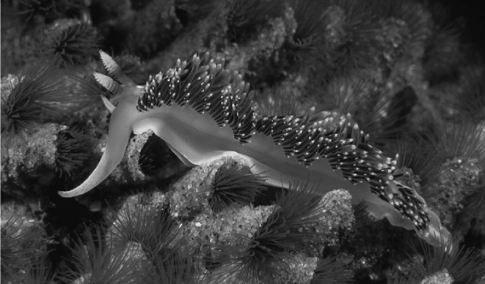 The nematocysts of sea slugs should be most effective at protecting individual sea slugs from predation if the predators ________.
 (Multiple Choice)
5.0/5  (87)
(87) Which of the following statements is correct with respect to the evolutionary relationship between chordates and invertebrates?
(Multiple Choice)
4.8/5 (82)
(82) Use the information to answer the following question.
The nontaxonomic term sea slug encompasses a wide variety of marine gastropods. One feature they share as adults is the lack of a shell. One might think, therefore, that they represent defenseless morsels for predators. In fact, sea slugs have multiple defenses. Some sea slugs prey on sponges and concentrate sponge toxins in their tissues. Others feed on cnidarians, digesting everything except the nematocysts, which they then transfer to their own skins. Whereas the most brightly colored sea slugs are often highly toxic, others are nontoxic and mimic the coloration of the toxic species. Their colors are mostly derived from pigments in their prey. There are also sea slugs that use their coloration to blend into their environments.
This nudibranch, a type of sea slug, has many reddish cerata on its dorsal surface, as well as two white-tipped rhinophores located on the head.
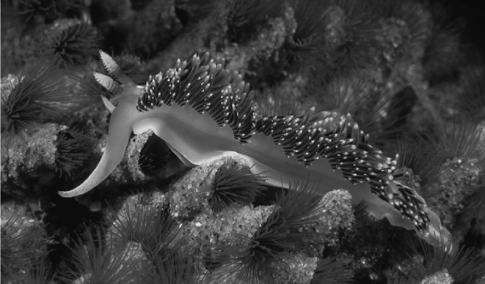 The nematocysts most likely reach the skin of sea slugs through branches of the ________.
 (Multiple Choice)
5.0/5 (77)
(77) Use the information and figure to answer the following question.
The sea slug Pteraeolidia ianthina can harbor living dinoflagellates (photosynthetic protists) in its skin. These endosymbiotic dinoflagellates reproduce quickly enough to maintain their populations. Low populations do not affect the sea slugs very much, but high populations (> 5 × 10⁵ cells/mg of sea slug protein) can promote sea slug survival.
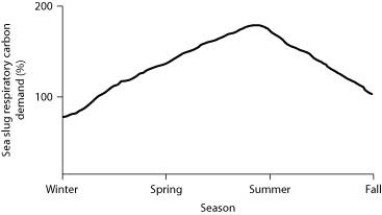 Percent of sea slug respiratory carbon demand provided by indwelling dinoflagellates.
If the dinoflagellate-containing sea slug P. ianthina preys on coral animals, then it would be most surprising to find that ________.
Percent of sea slug respiratory carbon demand provided by indwelling dinoflagellates.
If the dinoflagellate-containing sea slug P. ianthina preys on coral animals, then it would be most surprising to find that ________. (Multiple Choice)
4.8/5 (79)
(79) Use the following information and figure to answer the question.
Aphids are Hemiptera that suck phloem liquid from plants. Ants are often seen tapping the posterior end of the aphid and collecting the liquid that is released from the aphid's digestive system. In an effort to understand this interaction, several researchers measure the survival rates of aphid populations when ants were present and when they were excluded. Their results are shown.
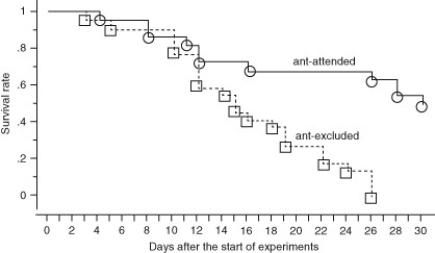 Which of the following conclusions is most likely correct?
 (Multiple Choice)
4.9/5 (78)
(78) The heartworms that can accumulate within the hearts of dogs and other mammals have a pseudocoelom, an alimentary canal, and an outer covering that is occasionally shed. To which phylum does the heartworm belong?
(Multiple Choice)
5.0/5 (86)
(86) Use the following information to answer the question.
Nudibranchs, a type of predatory sea slug, can have various protuberances (that is, extensions) on their dorsal surfaces. Rhinophores are paired structures, located close to the head, which bear many chemoreceptors. Dorsal plumules, usually located posteriorly, perform respiratory gas exchange. Cerata usually cover much of the dorsal surface and contain nematocysts at their tips.
The antennae of insects have a function most similar to that of ________.
(Multiple Choice)
4.7/5 (67)
(67) Which one of these mollusc groups can be classified as suspension feeders?
(Multiple Choice)
4.8/5 (72)
(72) Which of the following can be found in the mesohyl of a sponge?
(Multiple Choice)
4.8/5 (83)
(83) Use the following information to answer the question.
The phylum Cycliophora was discovered in 1995. They are tiny organisms that live in large numbers on the outsides of the mouthparts and appendages of lobsters. The feeding stage permanently attaches to the lobster via an adhesive disk and collects scraps of food from its host's feeding by capturing the scraps in a current created by a ring of cilia. The body is saclike and has a U-shaped intestine that brings the anus close to the mouth. Cycliophorans are coelomates, do not molt (though their host does), and their embryos undergo spiral cleavage.
The feeding stage of cycliophorans ________.
(Multiple Choice)
4.9/5 (72)
(72) Use the following information and figures to answer the question.
Many terrestrial arthropods exchange gases with their environments by using tracheae, tubes that lead from openings (called spiracles) in the animal's exoskeleton or cuticle directly to the animal's tissues. Some arthropods can control whether their spiracles are opened or closed; opening the spiracles allows the carbon dioxide produced in the tissues to travel down the tracheae and be released outside the animal. Klok et al. measured the carbon dioxide emitted over time (represented by ⱽCO₂) by several species of centipedes. The figures present graphs of their results for two species, Cormocephalus morsitans and Scutigerina weberi.
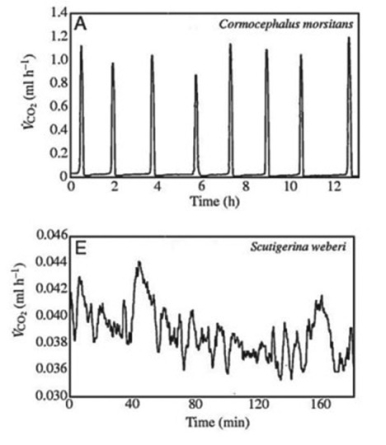 How would a terrestrial centipede most likely benefit from the ability to close its spiracles? Closing spiracles would ________.
 (Multiple Choice)
4.9/5 (82)
(82) Against which hard structure do the circular and longitudinal muscles of annelids work?
(Multiple Choice)
4.7/5 (76)
(76) In a tide pool, a student encounters an organism with a hard outer covering that contains much calcium carbonate, an open circulatory system, and gills. The organism could potentially be a crab, a shrimp, a barnacle, or a bivalve. The presence of which of the following structures would allow for the most certain identification of the organism?
(Multiple Choice)
4.9/5 (71)
(71) If a lung were to be found in a mollusc, where would it be located?
(Multiple Choice)
4.8/5 (86)
(86) The sea slug Elysia chorotica has no nematocysts or dinoflagellates but, rather, has "naked" chloroplasts in its skin. The chloroplasts are all that remain of the seaweed (Vaucheria sp.) that Elysia feeds upon. The chloroplasts are transferred to the skin; consequently, this slug is green. It spends most of its time basking in shallow water on the surface of seaweeds. How should we expect its chloroplasts to benefit the Elysia sea slug?
(Multiple Choice)
4.8/5 (82)
(82) Whiteflies are common pest insects found on cotton, tomato, poinsettia, and many other plants. Nymphs are translucent and mostly sessile, feeding on their host plant's phloem (sap) from the undersides of leaves. They undergo incomplete metamorphosis into winged adults. Because whitefly nymphs cannot escape predation by moving, you hypothesize that their translucent bodies make them hard to spot by predators. How could you directly test this hypothesis?
(Multiple Choice)
4.8/5 (86)
(86) 
Filters
- Essay(0)
- Multiple Choice(0)
- Short Answer(0)
- True False(0)
- Matching(0)