



 Chat with AI
Exam 41: Animal Nutrition

Exam 1: Evolution, the Themes of Biology, and Scientific Inquiry51 Questions
Exam 2: The Chemical Context of Life61 Questions
Exam 3: Water and Life55 Questions
Exam 4: Carbon and the Molecular Diversity of Life58 Questions
Exam 5: The Structure and Function of Large Biological Molecules70 Questions
Exam 6: A Tour of the Cell66 Questions
Exam 7: Membrane Structure and Function68 Questions
Exam 8: An Introduction to Metabolism67 Questions
Exam 9: Cellular Respiration and Fermentation68 Questions
Exam 10: Photosynthesis65 Questions
Exam 11: Cell Communication65 Questions
Exam 12: The Cell Cycle66 Questions
Exam 13: Meiosis and Sexual Life Cycles64 Questions
Exam 14: Mendel and the Gene Idea62 Questions
Exam 15: The Chromosomal Basis of Inheritance58 Questions
Exam 16: The Molecular Basis of Inheritance65 Questions
Exam 17: Gene Expression: From Gene to Protein67 Questions
Exam 18: Regulation of Gene Expression66 Questions
Exam 19: Viruses54 Questions
Exam 20: DNA Tools and Biotechnology57 Questions
Exam 21: Genomes and Their Evolution44 Questions
Exam 22: Descent with Modification: A Darwinian View of Life60 Questions
Exam 23: The Evolution of Populations64 Questions
Exam 24: The Origin of Species67 Questions
Exam 25: The History of Life on Earth59 Questions
Exam 26: Phylogeny and the Tree of Life75 Questions
Exam 27: Bacteria and Archaea75 Questions
Exam 28: Protists79 Questions
Exam 29: Plant Diversity I: How Plants Colonized Land82 Questions
Exam 30: Plant Diversity II: The Evolution of Seed Plants80 Questions
Exam 31: Fungi75 Questions
Exam 32: An Overview of Animal Diversity67 Questions
Exam 33: An Introduction to Invertebrates83 Questions
Exam 34: The Origin and Evolution of Vertebrates82 Questions
Exam 35: Vascular Plant Structure, Growth, and Development65 Questions
Exam 36: Resource Acquisition and Transport in Vascular Plants74 Questions
Exam 37: Soil and Plant Nutrition52 Questions
Exam 38: Angiosperm Reproduction and Biotechnology60 Questions
Exam 39: Plant Responses to Internal and External Signals61 Questions
Exam 40: Basic Principles of Animal Form and Function68 Questions
Exam 41: Animal Nutrition64 Questions
Exam 42: Circulation and Gas Exchange67 Questions
Exam 43: The Immune System69 Questions
Exam 44: Osmoregulation and Excretion64 Questions
Exam 45: Hormones and the Endocrine System66 Questions
Exam 46: Animal Reproduction68 Questions
Exam 47: Animal Development70 Questions
Exam 48: Neurons, Synapses, and Signaling68 Questions
Exam 49: Nervous Systems65 Questions
Exam 50: Sensory and Motor Mechanisms67 Questions
Exam 51: Animal Behavior69 Questions
Exam 52: An Introduction to Ecology and the Biosphere68 Questions
Exam 53: Population Ecology69 Questions
Exam 54: Community Ecology71 Questions
Exam 55: Ecosystems and Restoration Ecology68 Questions
Exam 56: Conservation Biology and Global Change69 Questions
Select questions type


Ticks are parasites that obtain nutrients by ingesting blood from a host animal. Ticks would be classified as ________.

Free
(Multiple Choice)
4.8/5  (90)
(90) Correct Answer: Verified
C
Over-the-counter medications for acid reflux or heartburn block the production of stomach acid. Which of the following cells are directly affected by this medication?
Free
(Multiple Choice)
4.9/5 (90)
(90) Correct Answer:Verified
VerifiedC
Which of the following is not a major activity of the stomach?
Free
(Multiple Choice)
4.8/5 (87)
(87) Correct Answer:Verified
VerifiedC
A relatively long cecum is characteristic of animals that are ________.
(Multiple Choice)
5.0/5 (77)
(77) What is the importance of the mucus that are released by salivary glands?
(Multiple Choice)
4.9/5 (87)
(87) Fat digestion yields fatty acids and glycerol. Protein digestion yields amino acids. Both digestive processes
(Multiple Choice)
4.8/5 (80)
(80) 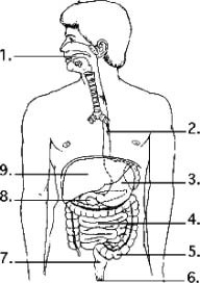 Examine the digestive system structures in the figure. Bacteria that produce vitamins are found in the greatest concentration in location ________.
 (Multiple Choice)
4.9/5 (87)
(87) Food being digested in the stomach is in a highly acidic environment. When the food is released from the stomach into the small intestine, why is the environment no longer acidic?
(Multiple Choice)
4.9/5 (79)
(79) Coprophagy is important for the nutritional balance of ________.
(Multiple Choice)
4.8/5 (72)
(72) In a healthy person, after a carbohydrate-rich meal, the production of ________ will increase, causing the uptake of ________ from the blood into liver cells.
(Multiple Choice)
4.8/5 (85)
(85) If a mammal did not obtain enough iodine in its diet, you might expect ________.
(Multiple Choice)
4.9/5 (83)
(83) After surgical removal of the gallbladder, a person might need to limit his or her dietary intake of
(Multiple Choice)
4.8/5 (87)
(87) Lysine is an essential amino acid for animals. If an animal did not consume lysine in its diet, you might expect that the animal ________.
(Multiple Choice)
4.8/5 (85)
(85) Because the foods eaten by animals are often composed largely of macromolecules, animals need to have mechanisms for ________.
(Multiple Choice)
4.8/5 (86)
(86) The absorption of fats differs from that of carbohydrates in that ________.
(Multiple Choice)
4.8/5 (90)
(90) 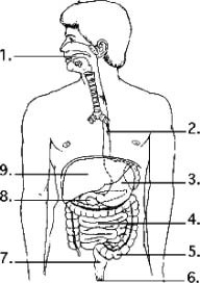 Examine the digestive system structures in the figure. The highest rate of nutrient absorption occurs at location ________.
 (Multiple Choice)
4.8/5 (76)
(76) Feelings of hunger can be stimulated by the hormone ________, but suppressed by the hormone ________.
(Multiple Choice)
4.8/5 (83)
(83) Which of the following is a difference between vitamins and minerals?
(Multiple Choice)
5.0/5 (86)
(86) If you put the following events in the order they occur in the human digestive system, the third event in the series would be:
(Multiple Choice)
4.9/5 (78)
(78) 
Filters
- Essay(0)
- Multiple Choice(0)
- Short Answer(0)
- True False(0)
- Matching(0)