



 Chat with AI
Exam 41: Animal Nutrition

Exam 1: Evolution, the Themes of Biology, and Scientific Inquiry51 Questions
Exam 2: The Chemical Context of Life61 Questions
Exam 3: Water and Life55 Questions
Exam 4: Carbon and the Molecular Diversity of Life58 Questions
Exam 5: The Structure and Function of Large Biological Molecules70 Questions
Exam 6: A Tour of the Cell66 Questions
Exam 7: Membrane Structure and Function68 Questions
Exam 8: An Introduction to Metabolism67 Questions
Exam 9: Cellular Respiration and Fermentation68 Questions
Exam 10: Photosynthesis65 Questions
Exam 11: Cell Communication65 Questions
Exam 12: The Cell Cycle66 Questions
Exam 13: Meiosis and Sexual Life Cycles64 Questions
Exam 14: Mendel and the Gene Idea62 Questions
Exam 15: The Chromosomal Basis of Inheritance58 Questions
Exam 16: The Molecular Basis of Inheritance65 Questions
Exam 17: Gene Expression: From Gene to Protein67 Questions
Exam 18: Regulation of Gene Expression66 Questions
Exam 19: Viruses54 Questions
Exam 20: DNA Tools and Biotechnology57 Questions
Exam 21: Genomes and Their Evolution44 Questions
Exam 22: Descent with Modification: A Darwinian View of Life60 Questions
Exam 23: The Evolution of Populations64 Questions
Exam 24: The Origin of Species67 Questions
Exam 25: The History of Life on Earth59 Questions
Exam 26: Phylogeny and the Tree of Life75 Questions
Exam 27: Bacteria and Archaea75 Questions
Exam 28: Protists79 Questions
Exam 29: Plant Diversity I: How Plants Colonized Land82 Questions
Exam 30: Plant Diversity II: The Evolution of Seed Plants80 Questions
Exam 31: Fungi75 Questions
Exam 32: An Overview of Animal Diversity67 Questions
Exam 33: An Introduction to Invertebrates83 Questions
Exam 34: The Origin and Evolution of Vertebrates82 Questions
Exam 35: Vascular Plant Structure, Growth, and Development65 Questions
Exam 36: Resource Acquisition and Transport in Vascular Plants74 Questions
Exam 37: Soil and Plant Nutrition52 Questions
Exam 38: Angiosperm Reproduction and Biotechnology60 Questions
Exam 39: Plant Responses to Internal and External Signals61 Questions
Exam 40: Basic Principles of Animal Form and Function68 Questions
Exam 41: Animal Nutrition64 Questions
Exam 42: Circulation and Gas Exchange67 Questions
Exam 43: The Immune System69 Questions
Exam 44: Osmoregulation and Excretion64 Questions
Exam 45: Hormones and the Endocrine System66 Questions
Exam 46: Animal Reproduction68 Questions
Exam 47: Animal Development70 Questions
Exam 48: Neurons, Synapses, and Signaling68 Questions
Exam 49: Nervous Systems65 Questions
Exam 50: Sensory and Motor Mechanisms67 Questions
Exam 51: Animal Behavior69 Questions
Exam 52: An Introduction to Ecology and the Biosphere68 Questions
Exam 53: Population Ecology69 Questions
Exam 54: Community Ecology71 Questions
Exam 55: Ecosystems and Restoration Ecology68 Questions
Exam 56: Conservation Biology and Global Change69 Questions
Select questions type


Jahasz-Pocsine and co-workers found a correlation between gastric bypass surgery and neurological complications. Surgeons performed gastric bypass surgery on 150 patients at the University of Arkansas for Medical Sciences Neurology Clinic. Of the 150 patients, 26 experienced neurological complications related to the surgery. What is the most likely cause for the neurological complications?
(Multiple Choice)
5.0/5  (83)
(83) The large surface area in the gut directly facilitates ________.
(Multiple Choice)
4.9/5 (72)
(72) If there is a strong genetic link for type II diabetes mellitus in your family, how might you minimize your risk of developing the disorder?
(Multiple Choice)
4.8/5 (72)
(72) If you found a vertebrate skull in the woods and the teeth were sharp and scissor-like, what type of food would you expect this animal to eat?
(Multiple Choice)
4.9/5 (83)
(83) Which of the following organs is correctly paired with its function?
(Multiple Choice)
4.8/5 (79)
(79) 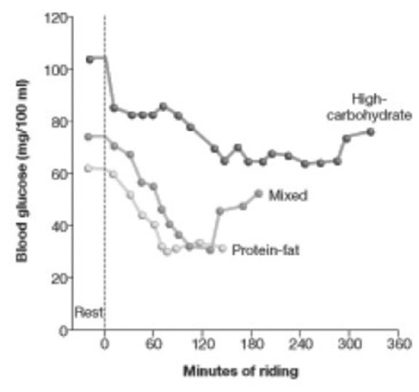 Three groups of cyclists consumed three different types of diets: high-carbohydrate; a diet mixed in carbohydrates, fat, and protein; or a diet higher in protein and fat. The average time each group could spend cycling over a six-hour period is shown in the accompanying graph. What conclusion from the data would help an athlete or trainer improve performance?
 (Multiple Choice)
4.9/5 (82)
(82) A fasting animal whose energy needs exceed those provided in its diet will draw on its stored resources in which order?
(Multiple Choice)
4.9/5 (81)
(81) If you were to jog 1 km a few hours after lunch, which stored fuel would you probably tap?
(Multiple Choice)
4.8/5 (70)
(70) Animals cannot produce enzymes to digest cellulose, yet many termite species consume cellulose from plant material as a main part of their diet. How do termites access the nutrients contained in cellulose?
(Multiple Choice)
4.8/5 (84)
(84) When the digestion and absorption of organic carbohydrates results in more energy-rich molecules than are immediately required by an animal, the excess is ________.
(Multiple Choice)
4.8/5 (84)
(84) The following table shows the contents of a multivitamin supplement and its percentage of recommended daily values (% DV).
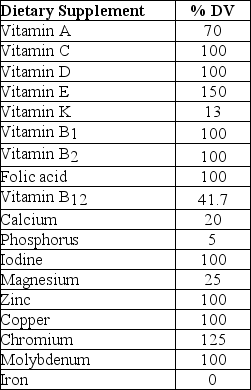 The most likely reason that some of the vitamins and minerals in this supplement are found at less than 100% is that ________.
 (Multiple Choice)
4.9/5 (68)
(68) Nutrient-rich blood from the intestine is carried through the ________ to the liver.
(Multiple Choice)
4.7/5 (81)
(81) The process of obtaining food is known as ________ and requires specialized feeding mechanisms.
(Multiple Choice)
4.8/5 (94)
(94) After surgical removal of an infected gallbladder, a person must be especially careful to restrict dietary intake of ________.
(Multiple Choice)
4.8/5 (87)
(87) Mechanical digestion, the process of breaking down large chunks of food into smaller pieces, is important because smaller pieces of food ________.
(Multiple Choice)
4.8/5 (85)
(85) An advantage of a complete digestive system over a gastrovascular cavity is that the complete system ________.
(Multiple Choice)
4.8/5 (88)
(88) Pepsinogen is converted to its active form in the stomach by ________.
(Multiple Choice)
4.8/5 (76)
(76) 
Filters
- Essay(0)
- Multiple Choice(0)
- Short Answer(0)
- True False(0)
- Matching(0)