



 Chat with AI
Exam 41: Animal Nutrition

Exam 1: Evolution, the Themes of Biology, and Scientific Inquiry51 Questions
Exam 2: The Chemical Context of Life61 Questions
Exam 3: Water and Life55 Questions
Exam 4: Carbon and the Molecular Diversity of Life58 Questions
Exam 5: The Structure and Function of Large Biological Molecules70 Questions
Exam 6: A Tour of the Cell66 Questions
Exam 7: Membrane Structure and Function68 Questions
Exam 8: An Introduction to Metabolism67 Questions
Exam 9: Cellular Respiration and Fermentation68 Questions
Exam 10: Photosynthesis65 Questions
Exam 11: Cell Communication65 Questions
Exam 12: The Cell Cycle66 Questions
Exam 13: Meiosis and Sexual Life Cycles64 Questions
Exam 14: Mendel and the Gene Idea62 Questions
Exam 15: The Chromosomal Basis of Inheritance58 Questions
Exam 16: The Molecular Basis of Inheritance65 Questions
Exam 17: Gene Expression: From Gene to Protein67 Questions
Exam 18: Regulation of Gene Expression66 Questions
Exam 19: Viruses54 Questions
Exam 20: DNA Tools and Biotechnology57 Questions
Exam 21: Genomes and Their Evolution44 Questions
Exam 22: Descent with Modification: A Darwinian View of Life60 Questions
Exam 23: The Evolution of Populations64 Questions
Exam 24: The Origin of Species67 Questions
Exam 25: The History of Life on Earth59 Questions
Exam 26: Phylogeny and the Tree of Life75 Questions
Exam 27: Bacteria and Archaea75 Questions
Exam 28: Protists79 Questions
Exam 29: Plant Diversity I: How Plants Colonized Land82 Questions
Exam 30: Plant Diversity II: The Evolution of Seed Plants80 Questions
Exam 31: Fungi75 Questions
Exam 32: An Overview of Animal Diversity67 Questions
Exam 33: An Introduction to Invertebrates83 Questions
Exam 34: The Origin and Evolution of Vertebrates82 Questions
Exam 35: Vascular Plant Structure, Growth, and Development65 Questions
Exam 36: Resource Acquisition and Transport in Vascular Plants74 Questions
Exam 37: Soil and Plant Nutrition52 Questions
Exam 38: Angiosperm Reproduction and Biotechnology60 Questions
Exam 39: Plant Responses to Internal and External Signals61 Questions
Exam 40: Basic Principles of Animal Form and Function68 Questions
Exam 41: Animal Nutrition64 Questions
Exam 42: Circulation and Gas Exchange67 Questions
Exam 43: The Immune System69 Questions
Exam 44: Osmoregulation and Excretion64 Questions
Exam 45: Hormones and the Endocrine System66 Questions
Exam 46: Animal Reproduction68 Questions
Exam 47: Animal Development70 Questions
Exam 48: Neurons, Synapses, and Signaling68 Questions
Exam 49: Nervous Systems65 Questions
Exam 50: Sensory and Motor Mechanisms67 Questions
Exam 51: Animal Behavior69 Questions
Exam 52: An Introduction to Ecology and the Biosphere68 Questions
Exam 53: Population Ecology69 Questions
Exam 54: Community Ecology71 Questions
Exam 55: Ecosystems and Restoration Ecology68 Questions
Exam 56: Conservation Biology and Global Change69 Questions
Select questions type


Fat digestion yields fatty acids and glycerol, whereas protein digestion yields amino acids; both digestive processes ________.
(Multiple Choice)
4.8/5  (83)
(83) The active ingredient orlistat acts to decrease the amount of fat that is absorbed by attaching to enzymes that digest fat. Which of the following are potential targets of orlistat?
(Multiple Choice)
4.7/5 (76)
(76) Upon activation by stomach acidity, the secretions of the parietal cells ________.
(Multiple Choice)
4.7/5 (77)
(77) What benefit is gained by intestinal bacteria living in a mutualistic relationship with an animal?
(Multiple Choice)
4.8/5 (77)
(77) Stomach cells are moderately well adapted to the acidity and protein-digesting activities in the stomach by having ________.
(Multiple Choice)
4.8/5 (67)
(67) Why do the cells of the digestive system secrete proteolytic enzymes, such as pepsin, in their inactive forms?
(Multiple Choice)
5.0/5 (71)
(71) Folic acid supplements have become especially important for pregnant women because ________.
(Multiple Choice)
4.9/5 (88)
(88) 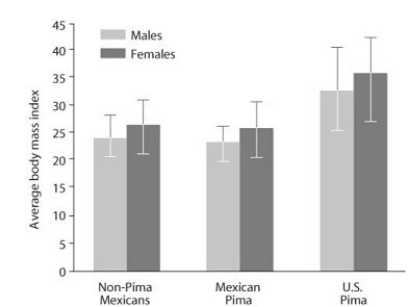 The Pimas are a group of people living in the southwestern United States and Mexico. Although Pima Indians living in the United States and Mexico have a similar genetic background, a five-fold increase in the incidence of type II diabetes mellitus among U.S. Pima has been reported. The body mass index of Mexicans of non-Pima descent, Mexicans of Pima descent, and Pimas living in the United States is shown in the figure. Based on this information and the graph, what can you infer about the incidence of type II diabetes mellitus?
 (Multiple Choice)
4.8/5 (73)
(73) Which of the following organs is incorrectly paired with its function?
(Multiple Choice)
4.9/5 (77)
(77) A significant contribution of intestinal bacteria to human nutrition is the benefit of bacterial ________.
(Multiple Choice)
4.9/5 (79)
(79) When used appropriately, antibiotic treatment can effectively reduce bacteria populations and help fight infections. However, antibiotic treatments can have unintended effects. What is one concern when using antibiotics?
(Multiple Choice)
4.7/5 (75)
(75) Animals that migrate great distances would obtain the greatest energetic benefit of storing chemical energy as ________.
(Multiple Choice)
4.7/5 (75)
(75) 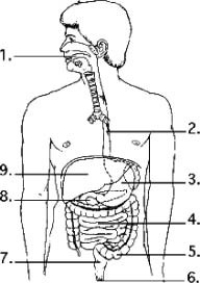 Examine the digestive system structures in the figure. The agents that help emulsify fats are produced in location ________.
 (Multiple Choice)
4.8/5 (78)
(78) Cattle are able to survive on a diet consisting almost entirely of plant material because cattle ________.
(Multiple Choice)
4.7/5 (85)
(85) If you were to jog one kilometer a few hours after lunch, which stored fuel would you probably tap?
(Multiple Choice)
4.8/5 (75)
(75) The process by which digested dietary substances cross cell membranes to be used by the body is known as ________.
(Multiple Choice)
4.7/5 (68)
(68) 
Filters
- Essay(0)
- Multiple Choice(0)
- Short Answer(0)
- True False(0)
- Matching(0)