



 Chat with AI
Exam 33: An Introduction to Invertebrates

Exam 1: Evolution, the Themes of Biology, and Scientific Inquiry51 Questions
Exam 2: The Chemical Context of Life61 Questions
Exam 3: Water and Life55 Questions
Exam 4: Carbon and the Molecular Diversity of Life58 Questions
Exam 5: The Structure and Function of Large Biological Molecules70 Questions
Exam 6: A Tour of the Cell66 Questions
Exam 7: Membrane Structure and Function68 Questions
Exam 8: An Introduction to Metabolism67 Questions
Exam 9: Cellular Respiration and Fermentation68 Questions
Exam 10: Photosynthesis65 Questions
Exam 11: Cell Communication65 Questions
Exam 12: The Cell Cycle66 Questions
Exam 13: Meiosis and Sexual Life Cycles64 Questions
Exam 14: Mendel and the Gene Idea62 Questions
Exam 15: The Chromosomal Basis of Inheritance58 Questions
Exam 16: The Molecular Basis of Inheritance65 Questions
Exam 17: Gene Expression: From Gene to Protein67 Questions
Exam 18: Regulation of Gene Expression66 Questions
Exam 19: Viruses54 Questions
Exam 20: DNA Tools and Biotechnology57 Questions
Exam 21: Genomes and Their Evolution44 Questions
Exam 22: Descent with Modification: A Darwinian View of Life60 Questions
Exam 23: The Evolution of Populations64 Questions
Exam 24: The Origin of Species67 Questions
Exam 25: The History of Life on Earth59 Questions
Exam 26: Phylogeny and the Tree of Life75 Questions
Exam 27: Bacteria and Archaea75 Questions
Exam 28: Protists79 Questions
Exam 29: Plant Diversity I: How Plants Colonized Land82 Questions
Exam 30: Plant Diversity II: The Evolution of Seed Plants80 Questions
Exam 31: Fungi75 Questions
Exam 32: An Overview of Animal Diversity67 Questions
Exam 33: An Introduction to Invertebrates83 Questions
Exam 34: The Origin and Evolution of Vertebrates82 Questions
Exam 35: Vascular Plant Structure, Growth, and Development65 Questions
Exam 36: Resource Acquisition and Transport in Vascular Plants74 Questions
Exam 37: Soil and Plant Nutrition52 Questions
Exam 38: Angiosperm Reproduction and Biotechnology60 Questions
Exam 39: Plant Responses to Internal and External Signals61 Questions
Exam 40: Basic Principles of Animal Form and Function68 Questions
Exam 41: Animal Nutrition64 Questions
Exam 42: Circulation and Gas Exchange67 Questions
Exam 43: The Immune System69 Questions
Exam 44: Osmoregulation and Excretion64 Questions
Exam 45: Hormones and the Endocrine System66 Questions
Exam 46: Animal Reproduction68 Questions
Exam 47: Animal Development70 Questions
Exam 48: Neurons, Synapses, and Signaling68 Questions
Exam 49: Nervous Systems65 Questions
Exam 50: Sensory and Motor Mechanisms67 Questions
Exam 51: Animal Behavior69 Questions
Exam 52: An Introduction to Ecology and the Biosphere68 Questions
Exam 53: Population Ecology69 Questions
Exam 54: Community Ecology71 Questions
Exam 55: Ecosystems and Restoration Ecology68 Questions
Exam 56: Conservation Biology and Global Change69 Questions
Select questions type


Echinoderms show enormous diversity in which of the following traits?
(Multiple Choice)
4.8/5  (77)
(77) Which characteristic is shared by cnidarians and flatworms?
(Multiple Choice)
4.8/5 (71)
(71) Use the graph to answer the following question.
 Which of the following factors, when used to label the horizontal axis of the graph, would account most directly for the shape of the plot?
 (Multiple Choice)
4.7/5 (94)
(94) 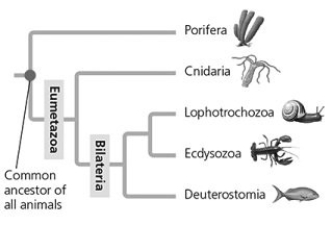 In Figure 33.2, which two main clades branch from the most recent common ancestor of the eumetazoans?
 (Multiple Choice)
4.9/5 (77)
(77) Use the information to answer the following question.
The nontaxonomic term sea slug encompasses a wide variety of marine gastropods. One feature they share as adults is the lack of a shell. One might think, therefore, that they represent defenseless morsels for predators. In fact, sea slugs have multiple defenses. Some sea slugs prey on sponges and concentrate sponge toxins in their tissues. Others feed on cnidarians, digesting everything except the nematocysts, which they then transfer to their own skins. Whereas the most brightly colored sea slugs are often highly toxic, others are nontoxic and mimic the coloration of the toxic species. Their colors are mostly derived from pigments in their prey. There are also sea slugs that use their coloration to blend into their environments.
This nudibranch, a type of sea slug, has many reddish cerata on its dorsal surface, as well as two white-tipped rhinophores located on the head.
 Which structure do sea slugs use to feed on their prey?
 (Multiple Choice)
4.7/5 (80)
(80) Use the following information to answer the question.
An elementary school science teacher decided to liven up the classroom with a saltwater aquarium. Knowing that saltwater aquaria can be quite a hassle, the teacher proceeded stepwise. First, the teacher conditioned the water. Next, the teacher decided to stock the tank with various marine invertebrates, including a polychaete, a siliceous sponge, several bivalves, a shrimp, several sea anemones of different types, a colonial hydra, a few coral species, an ectoproct, a sea star, and several herbivorous gastropod varieties. Lastly, she added some vertebrates-a parrot fish and a clown fish. She arranged for daily feedings of copepods and feeder fish.
If the teacher wanted to show the students what a lophophore is and how it works, the teacher would point out a feeding ________.
(Multiple Choice)
5.0/5 (81)
(81) Use the following information to answer the question.
An elementary school science teacher decided to liven up the classroom with a saltwater aquarium. Knowing that saltwater aquaria can be quite a hassle, the teacher proceeded stepwise. First, the teacher conditioned the water. Next, the teacher decided to stock the tank with various marine invertebrates, including a polychaete, a siliceous sponge, several bivalves, a shrimp, several sea anemones of different types, a colonial hydra, a few coral species, an ectoproct, a sea star, and several herbivorous gastropod varieties. Lastly, she added some vertebrates-a parrot fish and a clown fish. She arranged for daily feedings of copepods and feeder fish.
The bivalves started to die one by one; only the undamaged shells remained. To keep the remaining bivalves alive, the teacher would most likely need to remove the ________.
(Multiple Choice)
4.8/5 (88)
(88) Use the following information to answer the question.
An elementary school science teacher decided to liven up the classroom with a saltwater aquarium. Knowing that saltwater aquaria can be quite a hassle, the teacher proceeded stepwise. First, the teacher conditioned the water. Next, the teacher decided to stock the tank with various marine invertebrates, including a polychaete, a siliceous sponge, several bivalves, a shrimp, several sea anemones of different types, a colonial hydra, a few coral species, an ectoproct, a sea star, and several herbivorous gastropod varieties. Lastly, she added some vertebrates-a parrot fish and a clown fish. She arranged for daily feedings of copepods and feeder fish.
Normally, the clown fish readily swims among the tentacles of the sea anemones; the parrot fish avoids them. One hypothesis for the clown fish's apparent immunity is that they slowly build a tolerance to the sea anemone's toxin. A second hypothesis is that a chemical in the mucus that coats the clown fish prevents the nematocysts from being triggered. Which of the following graphs supports the first, but not the second, of these hypotheses?
(Multiple Choice)
4.8/5 (87)
(87) Use the following information and figures to answer the question.
Many terrestrial arthropods exchange gases with their environments by using tracheae, tubes that lead from openings (called spiracles) in the animal's exoskeleton or cuticle directly to the animal's tissues. Some arthropods can control whether their spiracles are opened or closed; opening the spiracles allows the carbon dioxide produced in the tissues to travel down the tracheae and be released outside the animal. Klok et al. measured the carbon dioxide emitted over time (represented by ⱽCO₂) by several species of centipedes. The figures present graphs of their results for two species, Cormocephalus morsitans and Scutigerina weberi.
 Look at the graph for Cormocephalus morsitans in the figure. What is the best interpretation of these results?
 (Multiple Choice)
4.9/5 (82)
(82) Use the following information to answer the question.
An elementary school science teacher decided to liven up the classroom with a saltwater aquarium. Knowing that saltwater aquaria can be quite a hassle, the teacher proceeded stepwise. First, the teacher conditioned the water. Next, the teacher decided to stock the tank with various marine invertebrates, including a polychaete, a siliceous sponge, several bivalves, a shrimp, several sea anemones of different types, a colonial hydra, a few coral species, an ectoproct, a sea star, and several herbivorous gastropod varieties. Lastly, she added some vertebrates-a parrot fish and a clown fish. She arranged for daily feedings of copepods and feeder fish.
One day, Tommy, a student in an undersupervised class of 40 fifth graders, got the urge to pet Nemo (the clown fish), who was swimming among the waving petals of a pretty underwater "flower" that had a big hole in the midst of the petals. Tommy giggled upon finding that these petals felt sticky. A few hours later, Tommy was in the nurse's office with nausea and cramps. Microscopic examination of his fingers would probably have revealed the presence of ________.
(Multiple Choice)
4.9/5 (68)
(68) Imagine that you are a research chemist who wishes to develop a chemical adhesive that will work under water. Which of the following organisms might give you a clue about where to start?
(Multiple Choice)
4.7/5 (86)
(86) Soft-shell crab is a prized dish in many ocean-side resorts. Why are the crabs' shells soft?
(Multiple Choice)
4.8/5 (71)
(71) One should expect to find cilia associated with the feeding apparatus of ________.
(Multiple Choice)
4.9/5 (73)
(73) Use the following information to answer the question.
Nudibranchs, a type of predatory sea slug, can have various protuberances (that is, extensions) on their dorsal surfaces. Rhinophores are paired structures, located close to the head, which bear many chemoreceptors. Dorsal plumules, usually located posteriorly, perform respiratory gas exchange. Cerata usually cover much of the dorsal surface and contain nematocysts at their tips.
The spiracles and tracheae of insects have a function most similar to that of ________.
(Multiple Choice)
4.7/5 (81)
(81) What would be the most direct effect of removing or damaging an insect's antennae? The insect would have trouble ________.
(Multiple Choice)
4.8/5 (80)
(80) What would be the best anatomical feature to look for to distinguish a gastropod from a chiton?
(Multiple Choice)
4.9/5 (92)
(92) Use the following information to answer the question.
A farm pond, usually dry during winter, has plenty of water and aquatic pond life during the summer. One summer, Sarah returns to the family farm from college. Observing the pond, she is fascinated by some six-legged organisms that can crawl about on submerged surfaces or, when disturbed, seemingly "jet" through the water. Watching further, she is able to conclude that the "mystery organisms" are ambush predators, and their prey includes everything from insects to small fish and tadpoles.
Sarah observed that the mystery pond organisms never come up to the pond's surface. If she catches one of these organisms and observes closely, perhaps dissecting the organism, she should find ________.
(Multiple Choice)
4.9/5 (78)
(78) You find a multi-legged animal in your garden and want to determine if it is a centipede or a millipede. You take the animal to a university where a myriapodologist quickly tells you that you have found a centipede. Which of the following traits may have allowed her to make this distinction?
(Multiple Choice)
4.8/5 (87)
(87) Use the following information to answer the question.
An elementary school science teacher decided to liven up the classroom with a saltwater aquarium. Knowing that saltwater aquaria can be quite a hassle, the teacher proceeded stepwise. First, the teacher conditioned the water. Next, the teacher decided to stock the tank with various marine invertebrates, including a polychaete, a siliceous sponge, several bivalves, a shrimp, several sea anemones of different types, a colonial hydra, a few coral species, an ectoproct, a sea star, and several herbivorous gastropod varieties. Lastly, she added some vertebrates-a parrot fish and a clown fish. She arranged for daily feedings of copepods and feeder fish.
The teacher and class were especially saddened when the colonial hydrozoan died. They had watched it carefully, and the unfortunate creature never even got to produce offspring by budding. Yet, everyone was elated when one of the students noticed a small colonial hydrozoan growing in a part of the tank far from the location of the original colony. The teacher was apparently unaware that these hydrozoans exhibit ________.
(Multiple Choice)
4.9/5 (83)
(83) 
Filters
- Essay(0)
- Multiple Choice(0)
- Short Answer(0)
- True False(0)
- Matching(0)