



 Chat with AI
Exam 7: The Economics of Health Care

Exam 1: Economics: Foundations and Models459 Questions
Exam 2: Trade-Offs, Comparative Advantage, and the Market System492 Questions
Exam 3: Where Prices Come From: the Interaction of Demand and Supply476 Questions
Exam 4: Economic Efficiency, Government Price Setting, and Taxes420 Questions
Exam 5: Externalities, Environmental Policy, and Public Goods262 Questions
Exam 6: Elasticity: the Responsiveness of Demand and Supply293 Questions
Exam 7: The Economics of Health Care337 Questions
Exam 8: Firms, the Stock Market, and Corporate Governance512 Questions
Exam 9: Comparative Advantage and the Gains From International Trade377 Questions
Exam 10: Consumer Choice and Behavioral Economics304 Questions
Exam 11: Technology, Production, and Costs326 Questions
Exam 12: Firms in Perfectly Competitive Markets296 Questions
Exam 13: Monopolistic Competition: the Competitive Model in a More Realistic Setting272 Questions
Exam 14: Oligopoly: Firms in Less Competitive Markets256 Questions
Exam 15: Monopoly and Antitrust Policy279 Questions
Exam 16: Pricing Strategy258 Questions
Exam 17: The Markets for Labor and Other Factors of Production279 Questions
Exam 18: Public Choice, Taxes, and the Distribution of Income258 Questions
Exam 19: Gdp: Measuring Total Production and Income260 Questions
Exam 20: Unemployment and Inflation290 Questions
Exam 21: Economic Growth, the Financial System, and Business Cycles251 Questions
Exam 22: Long-Run Economic Growth: Sources and Policies261 Questions
Exam 23: Aggregate Expenditure and Output in the Short Run305 Questions
Exam 24: Aggregate Demand and Aggregate Supply Analysis286 Questions
Exam 25: Money, Banks, and the Federal Reserve System278 Questions
Exam 26: Monetary Policy280 Questions
Exam 27: Fiscal Policy313 Questions
Exam 28: Inflation, Unemployment, and Federal Reserve Policy257 Questions
Exam 29: Macroeconomics in an Open Economy277 Questions
Exam 30: The International Financial System258 Questions
Select questions type


In the 1973 movie Save the Tiger, Jack Lemmon plays Harry Stoner, the CEO of a clothing manufacturer whose business has fallen on hard times. In one of the key scenes of the movie, Stoner tries to convince his partner that they should hire someone to burn one of their buildings in order to collect on their insurance policy. Harry Stoner's actions are an example of
(Multiple Choice)
4.8/5  (91)
(91) Higher deductibles for employer-provided health insurance will tend to shift the ________ curve for medical services to the ________.
(Multiple Choice)
4.9/5 (77)
(77) Adverse selection occurs in the market for used cars because used car buyers
(Multiple Choice)
4.8/5 (88)
(88) Because consumers who have insurance provided by their employers usually only pay a deductible for a visit to the doctor's office, they ________ of health care services than they would if they paid a price that better represented the true cost of providing the service.
(Multiple Choice)
4.9/5 (83)
(83) If a buyer in an economic transaction has more information than the seller, the buyer benefits at the expense of the seller. This phenomenon is due to
(Multiple Choice)
4.9/5 (76)
(76) What is the main difference between a single-payer health care system and socialized medicine?
(Essay)
4.9/5 (79)
(79) In the United States, out-of-pocket spending on health care as a percentage of all spending on health care has ________ since 1960.
(Multiple Choice)
4.9/5 (85)
(85) The health care system in the United Kingdom is referred to as ________, under which the government owns most of the hospitals and employs most of the doctors.
(Multiple Choice)
4.9/5 (83)
(83) In the United States in 2016, the percentage of people who received health insurance through a government program was about
(Multiple Choice)
4.8/5 (77)
(77) The increase in the number of surgeries performed outside hospitals will tend to shift the ________ curve for medical services to the ________.
(Multiple Choice)
4.8/5 (88)
(88) Figure 7-6 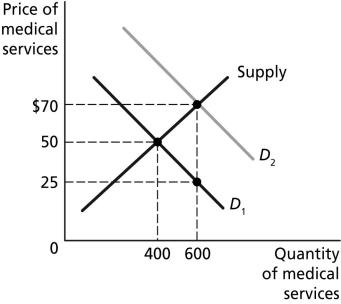 Figure 7-6 represents the supply and demand for medical services with and without a third-party payer.
-Refer to Figure 7-6. Answer the following questions:
1. What would be the equilibrium price and quantity if consumers had to pay the full price of medical services?
2. With insurance acting as a third-party payer, what price will consumers pay for medical service?
3. With insurance acting as a third-party payer, what price will doctors receive for medical service?
4. With insurance acting as a third-party payer, what will be the equilibrium quantity of medical services?
5. With insurance acting as a third-party payer, what will be the value of the deadweight loss?
Figure 7-6 represents the supply and demand for medical services with and without a third-party payer.
-Refer to Figure 7-6. Answer the following questions:
1. What would be the equilibrium price and quantity if consumers had to pay the full price of medical services?
2. With insurance acting as a third-party payer, what price will consumers pay for medical service?
3. With insurance acting as a third-party payer, what price will doctors receive for medical service?
4. With insurance acting as a third-party payer, what will be the equilibrium quantity of medical services?
5. With insurance acting as a third-party payer, what will be the value of the deadweight loss? (Essay)
4.8/5 (77)
(77) About ________ of research on new medicines is carried out in the United States.
(Multiple Choice)
4.7/5 (83)
(83) Briefly describe changes in life expectancy, average height, and infant mortality in the United States since 1850.
(Essay)
4.8/5 (76)
(76) In the United States in 2016, a majority of people received health care through
(Multiple Choice)
4.9/5 (75)
(75) In the United States in 2016, the percentage of firms that employed between 3 and 199 workers and did not offer health insurance as a fringe benefit to the workers was about
(Multiple Choice)
4.8/5 (80)
(80) Because of asymmetric information, most used cars that are offered for sale will be sold for prices that are greater than their true value. Because of this fact, the used car market falls victim to
(Multiple Choice)
4.9/5 (79)
(79) In 2016, ________ of the uninsured were younger than age 35.
(Multiple Choice)
4.9/5 (76)
(76) In a market with positive externalities, the market equilibrium quantity will be less than the efficient equilibrium quantity.
(True/False)
4.9/5 (81)
(81) 
Filters
- Essay(0)
- Multiple Choice(0)
- Short Answer(0)
- True False(0)
- Matching(0)