



 Chat with AI
Exam 7: The Economics of Health Care

Exam 1: Economics: Foundations and Models459 Questions
Exam 2: Trade-Offs, Comparative Advantage, and the Market System492 Questions
Exam 3: Where Prices Come From: the Interaction of Demand and Supply476 Questions
Exam 4: Economic Efficiency, Government Price Setting, and Taxes420 Questions
Exam 5: Externalities, Environmental Policy, and Public Goods262 Questions
Exam 6: Elasticity: the Responsiveness of Demand and Supply293 Questions
Exam 7: The Economics of Health Care337 Questions
Exam 8: Firms, the Stock Market, and Corporate Governance512 Questions
Exam 9: Comparative Advantage and the Gains From International Trade377 Questions
Exam 10: Consumer Choice and Behavioral Economics304 Questions
Exam 11: Technology, Production, and Costs326 Questions
Exam 12: Firms in Perfectly Competitive Markets296 Questions
Exam 13: Monopolistic Competition: the Competitive Model in a More Realistic Setting272 Questions
Exam 14: Oligopoly: Firms in Less Competitive Markets256 Questions
Exam 15: Monopoly and Antitrust Policy279 Questions
Exam 16: Pricing Strategy258 Questions
Exam 17: The Markets for Labor and Other Factors of Production279 Questions
Exam 18: Public Choice, Taxes, and the Distribution of Income258 Questions
Exam 19: Gdp: Measuring Total Production and Income260 Questions
Exam 20: Unemployment and Inflation290 Questions
Exam 21: Economic Growth, the Financial System, and Business Cycles251 Questions
Exam 22: Long-Run Economic Growth: Sources and Policies261 Questions
Exam 23: Aggregate Expenditure and Output in the Short Run305 Questions
Exam 24: Aggregate Demand and Aggregate Supply Analysis286 Questions
Exam 25: Money, Banks, and the Federal Reserve System278 Questions
Exam 26: Monetary Policy280 Questions
Exam 27: Fiscal Policy313 Questions
Exam 28: Inflation, Unemployment, and Federal Reserve Policy257 Questions
Exam 29: Macroeconomics in an Open Economy277 Questions
Exam 30: The International Financial System258 Questions
Select questions type


Figure 7-2  Figure 7-2 represents the market for vaccinations. Vaccinations are considered a benefit to society, and the figure shows both the marginal private benefit and the marginal social benefit from vaccinations.
-Refer to Figure 7-2. At the market equilibrium, the deadweight loss is equal to
Figure 7-2 represents the market for vaccinations. Vaccinations are considered a benefit to society, and the figure shows both the marginal private benefit and the marginal social benefit from vaccinations.
-Refer to Figure 7-2. At the market equilibrium, the deadweight loss is equal to (Multiple Choice)
5.0/5  (88)
(88) Figure 7-1  Figure 7-1 represents the market for vaccinations. Vaccinations are considered a benefit to society, and the figure shows both the marginal private benefit and the marginal social benefit from vaccinations.
-Refer to Figure 7-1. At the efficient equilibrium
Figure 7-1 represents the market for vaccinations. Vaccinations are considered a benefit to society, and the figure shows both the marginal private benefit and the marginal social benefit from vaccinations.
-Refer to Figure 7-1. At the efficient equilibrium (Multiple Choice)
4.8/5 (85)
(85) The overall mortality rate in the United States has remained fairly constant for the past 35 years.
(True/False)
4.8/5 (83)
(83) A key difficulty facing insurance companies is that people know more about their health than do insurance companies. What is this phenomenon called?
(Multiple Choice)
4.8/5 (95)
(95) The overall mortality rate in the United States has declined for the past 35 years.
(True/False)
5.0/5 (68)
(68) Figure 7-4  Figure 7-4 represents the market for medical services with and without insurance, and the effect of a third-party payer system on the demand for medical services.
-Refer to Figure 7-4. The efficient price of medical services is
Figure 7-4 represents the market for medical services with and without insurance, and the effect of a third-party payer system on the demand for medical services.
-Refer to Figure 7-4. The efficient price of medical services is (Multiple Choice)
4.9/5 (87)
(87) Economists John Cogan, Glenn Hubbard, and Daniel Kessler have estimated that ________ the tax preference for employer-provided health insurance would reduce spending by people enrolled in these programs by 33 percent.
(Multiple Choice)
4.9/5 (89)
(89) A goal of market-based reforms of the health care system is to give patients an incentive to pay more attention to the prices of medical services. This would tend to ________ economic efficiency by ________ the costs of medical services
(Multiple Choice)
4.8/5 (71)
(71) Over time, people in the United States and other high-income countries have, on average, become taller, which is an indication that their nutritional status has improved.
(True/False)
4.9/5 (79)
(79) In the United States in 2016, the percentage of firms that employed more than 200 workers and offered health insurance as a fringe benefit to the workers was about
(Multiple Choice)
4.8/5 (73)
(73) Of the following, which has most likely contributed the most to the rapid rise in health care costs in the United States?
(Multiple Choice)
4.7/5 (85)
(85) Of the following high-income countries, which has the highest life expectancy at birth?
(Multiple Choice)
4.8/5 (88)
(88) In 2016, infant mortality in the United States was ________ per 1,000 live births.
(Multiple Choice)
4.7/5 (81)
(81) Figure 7-2 Figure 7-2 represents the market for vaccinations. Vaccinations are considered a benefit to society, and the figure shows both the marginal private benefit and the marginal social benefit from vaccinations.
-Refer to Figure 7-2. Marginal social benefit is represented by which curve?
Figure 7-2 represents the market for vaccinations. Vaccinations are considered a benefit to society, and the figure shows both the marginal private benefit and the marginal social benefit from vaccinations.
-Refer to Figure 7-2. Marginal social benefit is represented by which curve? (Multiple Choice)
4.8/5 (92)
(92) Suppose you see a 2006 Scion xB Sport Wagon advertised in the local newspaper for $4,500. If you knew the car was reliable, you would be willing to pay $6,000 for it. If you knew the car was unreliable, you would only be willing to pay $2,500 for it. Under what circumstances should you buy the car at the asking price?
(Essay)
4.7/5 (64)
(64) Figure 7-3 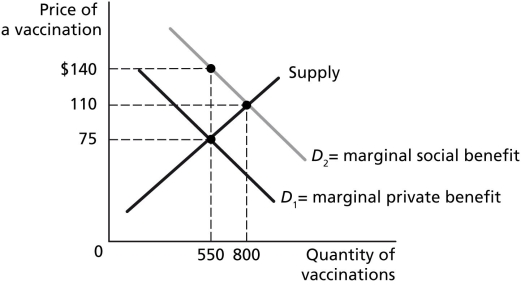 Figure 7-3 shows the effect of a positive externality on the market for vaccinations.
-Refer to Figure 7-3. On the above graph, identify the market equilibrium price and quantity, the efficient equilibrium price and quantity, and the value of the deadweight loss resulting from too few people receiving vaccinations.
Figure 7-3 shows the effect of a positive externality on the market for vaccinations.
-Refer to Figure 7-3. On the above graph, identify the market equilibrium price and quantity, the efficient equilibrium price and quantity, and the value of the deadweight loss resulting from too few people receiving vaccinations. (Essay)
4.9/5 (83)
(83) In the United States from 1981 to 2015, deaths from which of the following increased?
(Multiple Choice)
4.8/5 (83)
(83) Compared to the United States, health care spending per person in other high-income countries has been
(Multiple Choice)
4.7/5 (73)
(73) 
Filters
- Essay(0)
- Multiple Choice(0)
- Short Answer(0)
- True False(0)
- Matching(0)