



 Chat with AI
Exam 28: Inflation, Unemployment, and Federal Reserve Policy

Exam 1: Economics: Foundations and Models459 Questions
Exam 2: Trade-Offs, Comparative Advantage, and the Market System492 Questions
Exam 3: Where Prices Come From: the Interaction of Demand and Supply476 Questions
Exam 4: Economic Efficiency, Government Price Setting, and Taxes420 Questions
Exam 5: Externalities, Environmental Policy, and Public Goods262 Questions
Exam 6: Elasticity: the Responsiveness of Demand and Supply293 Questions
Exam 7: The Economics of Health Care337 Questions
Exam 8: Firms, the Stock Market, and Corporate Governance512 Questions
Exam 9: Comparative Advantage and the Gains From International Trade377 Questions
Exam 10: Consumer Choice and Behavioral Economics304 Questions
Exam 11: Technology, Production, and Costs326 Questions
Exam 12: Firms in Perfectly Competitive Markets296 Questions
Exam 13: Monopolistic Competition: the Competitive Model in a More Realistic Setting272 Questions
Exam 14: Oligopoly: Firms in Less Competitive Markets256 Questions
Exam 15: Monopoly and Antitrust Policy279 Questions
Exam 16: Pricing Strategy258 Questions
Exam 17: The Markets for Labor and Other Factors of Production279 Questions
Exam 18: Public Choice, Taxes, and the Distribution of Income258 Questions
Exam 19: Gdp: Measuring Total Production and Income260 Questions
Exam 20: Unemployment and Inflation290 Questions
Exam 21: Economic Growth, the Financial System, and Business Cycles251 Questions
Exam 22: Long-Run Economic Growth: Sources and Policies261 Questions
Exam 23: Aggregate Expenditure and Output in the Short Run305 Questions
Exam 24: Aggregate Demand and Aggregate Supply Analysis286 Questions
Exam 25: Money, Banks, and the Federal Reserve System278 Questions
Exam 26: Monetary Policy280 Questions
Exam 27: Fiscal Policy313 Questions
Exam 28: Inflation, Unemployment, and Federal Reserve Policy257 Questions
Exam 29: Macroeconomics in an Open Economy277 Questions
Exam 30: The International Financial System258 Questions
Select questions type


Article Summary
Since the Fed introduced its annual goal of an inflation target of 2 percent in January 2012, the personal consumption expenditures price index has fallen short of this goal more than 90 percent of the time. This has prompted some analysts and Fed officials to acknowledge that the Fed has lost some of its credibility in achieving its 2 percent target, and has Fed officials again discussing whether to hold off on raising interest rates. Fed Governor Lael Brainard stated that the Fed's failure to increase inflation to its 2 percent target may have influenced how companies and consumers view the inflation outlook, stating "Households and firms have experienced a prolonged period of inflation below our objective, and that may be affecting their perception of underlying inflation." Since expectations influence the actions of companies and consumers, they help determine where inflation actually ends up. Consumers who are accustomed to low inflation will resist paying up for goods and services, and therefore companies will avoid increasing wages, fearing they won't be able to raise prices to cover the added labor costs. It's a vicious circle that can hinder the Fed from achieving its inflation target.
-Refer to the Article Summary. Some analysts and Fed officials have acknowledged that the Fed has lost some of its credibility in achieving its 2 percent inflation goal, since inflation has fallen short of this goal over 90 percent of the time since it was announced in January 2012. Prior to this, over the past 25 years whenever a change in Fed policy had been announced, the change has ________ taken place, leading to ________ credibility.
(Multiple Choice)
4.9/5  (86)
(86) Two actions by the Fed during Alan Greenspan's term as chairman have been identified as possibly contributing to the financial crisis in 2008. Which of the following was one of those actions?
(Multiple Choice)
4.8/5 (79)
(79) Which of the following is an appropriate policy for a central bank to follow if the economy is plagued with deflation?
(Multiple Choice)
4.9/5 (80)
(80) Explain why an anticipated expansionary monetary policy would not result in reduced unemployment rates if workers and firms have rational expectations.
(Essay)
4.8/5 (95)
(95) During the 1960s, when confronted with moderate and stable inflation, people tended to form adaptive expectations of future inflation rates.
(True/False)
4.9/5 (84)
(84) With which of the following statements would a "real business cycle" theorist most closely agree?
(Multiple Choice)
4.7/5 (79)
(79) If the unemployment rate in the economy is steady at 4 percent per year, how does the short-run Phillips curve predict that the inflation rate will be changing, if at all? What will happen if the unemployment rate now rises to 7 percent per year? Assume there are no changes to inflation expectations. Provide an appropriate graph to support your discussion.
(Essay)
4.8/5 (80)
(80) Even if expectations of inflation are rational, sluggish adjustment of wages and prices will still create a short-run trade-off between inflation and unemployment.
(True/False)
5.0/5 (81)
(81) Does the short-run Phillips curve have a positive or negative slope? Explain how this slope is derived.
(Essay)
4.8/5 (87)
(87) In the short run, the Federal Reserve can affect which of the following?
(Multiple Choice)
4.8/5 (79)
(79) Last year, the unemployment rate was 4 percent and the inflation rate was 3 percent. If the natural rate of unemployment is 3 percent, how do you expect inflation to change?
(Essay)
4.9/5 (73)
(73) In conducting monetary policy, how has the Federal Reserve enhanced its credibility?
(Multiple Choice)
4.8/5 (87)
(87) Figure 28-7  -Refer to Figure 28-7. Consider the Phillips curves depicted in the graph above. The Fed announces its intention to decrease inflation from 10 percent to 5 percent per year, and it succeeds. If expectations of inflation are not altered by the Fed's announcement, the rate of unemployment will be ________ in the short run.
 (Multiple Choice)
4.9/5 (73)
(73) Figure 28-4 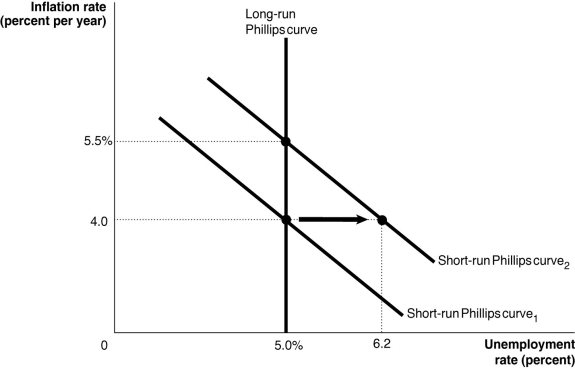 -Refer to Figure 28-4. Consider the shift in the short-run Phillips curves shown in the above graph. This shift may be explained by
 (Multiple Choice)
4.8/5 (75)
(75) If wages and prices adjust slowly, we would expect expansionary monetary policy to be
(Multiple Choice)
4.8/5 (79)
(79) According to ________, the economy is normally at potential GDP.
(Multiple Choice)
4.7/5 (76)
(76) When individuals use ________ about an economic variable to make a decision, expectations are rational.
(Multiple Choice)
4.9/5 (90)
(90) Which of the following would decrease the natural rate of unemployment?
(Multiple Choice)
4.8/5 (76)
(76) 
Filters
- Essay(0)
- Multiple Choice(0)
- Short Answer(0)
- True False(0)
- Matching(0)