



 Chat with AI
Exam 28: Inflation, Unemployment, and Federal Reserve Policy

Exam 1: Economics: Foundations and Models459 Questions
Exam 2: Trade-Offs, Comparative Advantage, and the Market System492 Questions
Exam 3: Where Prices Come From: the Interaction of Demand and Supply476 Questions
Exam 4: Economic Efficiency, Government Price Setting, and Taxes420 Questions
Exam 5: Externalities, Environmental Policy, and Public Goods262 Questions
Exam 6: Elasticity: the Responsiveness of Demand and Supply293 Questions
Exam 7: The Economics of Health Care337 Questions
Exam 8: Firms, the Stock Market, and Corporate Governance512 Questions
Exam 9: Comparative Advantage and the Gains From International Trade377 Questions
Exam 10: Consumer Choice and Behavioral Economics304 Questions
Exam 11: Technology, Production, and Costs326 Questions
Exam 12: Firms in Perfectly Competitive Markets296 Questions
Exam 13: Monopolistic Competition: the Competitive Model in a More Realistic Setting272 Questions
Exam 14: Oligopoly: Firms in Less Competitive Markets256 Questions
Exam 15: Monopoly and Antitrust Policy279 Questions
Exam 16: Pricing Strategy258 Questions
Exam 17: The Markets for Labor and Other Factors of Production279 Questions
Exam 18: Public Choice, Taxes, and the Distribution of Income258 Questions
Exam 19: Gdp: Measuring Total Production and Income260 Questions
Exam 20: Unemployment and Inflation290 Questions
Exam 21: Economic Growth, the Financial System, and Business Cycles251 Questions
Exam 22: Long-Run Economic Growth: Sources and Policies261 Questions
Exam 23: Aggregate Expenditure and Output in the Short Run305 Questions
Exam 24: Aggregate Demand and Aggregate Supply Analysis286 Questions
Exam 25: Money, Banks, and the Federal Reserve System278 Questions
Exam 26: Monetary Policy280 Questions
Exam 27: Fiscal Policy313 Questions
Exam 28: Inflation, Unemployment, and Federal Reserve Policy257 Questions
Exam 29: Macroeconomics in an Open Economy277 Questions
Exam 30: The International Financial System258 Questions
Select questions type


The short-run Phillips curve is ________ than the long-run Phillips curve.
(Multiple Choice)
4.9/5  (75)
(75) The short-run Phillips curve will not shift unless there is
(Multiple Choice)
4.7/5 (82)
(82) According to the short-run Phillips curve, which of the following would result in high rates of unemployment?
(Multiple Choice)
4.9/5 (82)
(82) In the 1960s, many economists and policymakers believed the trade-off between inflation and unemployment was permanent.
(True/False)
4.8/5 (87)
(87) All other factors held constant, increased growth in aggregate demand will
(Multiple Choice)
5.0/5 (77)
(77) Figure 28-6 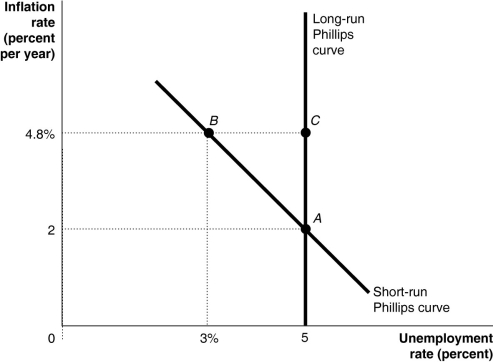 -Refer to Figure 28-6. If firms and workers have rational expectations, an expansionary monetary policy will cause the short-run equilibrium to move from
 (Multiple Choice)
4.8/5 (89)
(89) In the long run, the Phillips curve is a ________ at ________.
(Multiple Choice)
4.9/5 (71)
(71) If people assume that future rates of inflation will follow the pattern of inflation rates in the past, they are said to have
(Multiple Choice)
5.0/5 (68)
(68) The policy which holds that the federal government should not allow large financial firms to fail, for fear of damaging the financial system, is known as the ________ policy.
(Multiple Choice)
4.7/5 (84)
(84) If firms and workers have rational expectations, including knowledge of the policy being used by the Federal Reserve, the short-run Phillips curve will be
(Multiple Choice)
4.8/5 (73)
(73) The experience of Paul Volcker's fight against inflation during the late 1970s and early 1980s indicates that firms and workers may have
(Multiple Choice)
4.8/5 (83)
(83) If strong aggregate demand is pushing the economy beyond potential real GDP, which of the following must be true?
(Multiple Choice)
4.8/5 (87)
(87) Figure 28-2  -Refer to Figure 28-2. At which point is the unemployment rate equal to the natural rate of unemployment?
 (Multiple Choice)
4.9/5 (69)
(69) 
Filters
- Essay(0)
- Multiple Choice(0)
- Short Answer(0)
- True False(0)
- Matching(0)