



 Chat with AI
Exam 6: Energy Changes,reaction Rates,and Equilibrium

Exam 1: Matter and Measurement87 Questions
Exam 2: Atoms and the Periodic Table95 Questions
Exam 3: Ionic Compounds100 Questions
Exam 4: Covalent Compounds101 Questions
Exam 5: Chemical Reactions98 Questions
Exam 6: Energy Changes,reaction Rates,and Equilibrium102 Questions
Exam 7: Gases,liquids,and Solids98 Questions
Exam 8: Solutions98 Questions
Exam 9: Acids and Bases108 Questions
Exam 10: Nuclear Chemistry93 Questions
Exam 11: Introduction to Organic Molecules and Functional Groups123 Questions
Exam 12: Alkanes104 Questions
Exam 13: Unsaturated Hydrocarbons104 Questions
Exam 14: Organic Compounds That Contain Oxygen,halogen,or Sulfur112 Questions
Exam 15: The Three-Dimensional Shape of Molecules101 Questions
Exam 16: Aldehydes and Ketones114 Questions
Exam 17: Carboxylic Acids,esters,and Amides107 Questions
Exam 18: Amines and Neurotransmitters115 Questions
Exam 19: Lipids115 Questions
Exam 20: Carbohydrates100 Questions
Exam 21: Amino Acids,proteins,and Enzymes98 Questions
Exam 22: Nucleic Acids and Protein Synthesis98 Questions
Exam 23: Metabolism and Energy Production102 Questions
Exam 24: Carbohydrate,lipid,and Protein Metabolism99 Questions
Select questions type


The reversible reaction: PCl3(g)+ Cl2(g)  PCl5(g),has K = 0.5. Based on the molecular art shown below,what can be inferred about the reaction conditions?
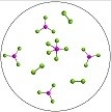
PCl5(g),has K = 0.5. Based on the molecular art shown below,what can be inferred about the reaction conditions? (Multiple Choice)
4.9/5  (75)
(75) When the pressure of a reaction at equilibrium decreases,in which direction does the equilibrium shift?
(Multiple Choice)
4.7/5 (69)
(69) The equilibrium constant expression for the reversible reaction: CHCl3(g)+ 3 HCl(g)  CH4(g)+ 3 Cl2(g)is
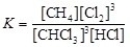 .
CH4(g)+ 3 Cl2(g)is . (True/False)
4.8/5 (72)
(72) When the equilibrium constant for a reaction is much less than one (K < 1),the concentration of the products is larger than the concentration of the reactants.
(True/False)
4.8/5 (82)
(82) One step in the metabolism of glucose is depicted below. Which statement best describes how the equilibrium system would respond if the amount of dihydroxyacetone phosphate is decreased? 
(Multiple Choice)
4.9/5 (96)
(96) Once equilibrium is reached in a chemical reaction,reactants stop forming products.
(True/False)
4.9/5 (84)
(84) A reversible reaction in which K = 9.65 × 10⁻¹⁴ contains a negligible amount of reactants at equilibrium.
(True/False)
4.9/5 (73)
(73) The ΔH for the reaction depicted by the energy diagram below is ________. 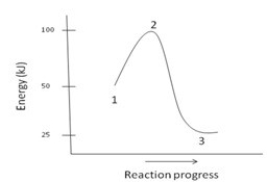
(Short Answer)
4.9/5 (98)
(98) Consider the reversible reaction at equilibrium: N2(g)+ O2(g)  2 NO(g). What is the effect of removing some N2(g)from the equilibrium system?
 (Multiple Choice)
4.8/5 (71)
(71) Which of the following is ALWAYS necessary for a chemical reaction to occur between two reactants,A and B?
(Multiple Choice)
4.9/5 (73)
(73) When reactants can come together and form products,and products can come together to re-form reactants,the reaction is called a ________ reaction.
(Short Answer)
4.8/5 (85)
(85) Le Châtelier's principle is a general rule used to explain the effect of a change in reaction conditions on equilibrium.
(True/False)
4.7/5 (87)
(87) In order to cause an endothermic equilibrium reaction to shift in a direction to form more products,the reaction must be heated.
(True/False)
4.8/5 (73)
(73) Consider the reaction,3 NO2(g)+ H2O(l)→ 2 HNO3(aq)+ NO(g),where ΔH = -137 kJ. How many kilojoules are released when 92.3 g of NO2 reacts?
(Multiple Choice)
4.8/5 (67)
(67) A chemical reaction requires 31.39 kJ. How many kilocalories does this correspond to?
(Multiple Choice)
4.9/5 (73)
(73) An equilibrium constant with a value of 8.0 × 10⁶ indicates that at equilibrium ________.
(Multiple Choice)
4.8/5 (88)
(88) 
Filters
- Essay(0)
- Multiple Choice(0)
- Short Answer(0)
- True False(0)
- Matching(0)