



 Chat with AI
Exam 23: Metabolism and Energy Production

Exam 1: Matter and Measurement87 Questions
Exam 2: Atoms and the Periodic Table95 Questions
Exam 3: Ionic Compounds100 Questions
Exam 4: Covalent Compounds101 Questions
Exam 5: Chemical Reactions98 Questions
Exam 6: Energy Changes,reaction Rates,and Equilibrium102 Questions
Exam 7: Gases,liquids,and Solids98 Questions
Exam 8: Solutions98 Questions
Exam 9: Acids and Bases108 Questions
Exam 10: Nuclear Chemistry93 Questions
Exam 11: Introduction to Organic Molecules and Functional Groups123 Questions
Exam 12: Alkanes104 Questions
Exam 13: Unsaturated Hydrocarbons104 Questions
Exam 14: Organic Compounds That Contain Oxygen,halogen,or Sulfur112 Questions
Exam 15: The Three-Dimensional Shape of Molecules101 Questions
Exam 16: Aldehydes and Ketones114 Questions
Exam 17: Carboxylic Acids,esters,and Amides107 Questions
Exam 18: Amines and Neurotransmitters115 Questions
Exam 19: Lipids115 Questions
Exam 20: Carbohydrates100 Questions
Exam 21: Amino Acids,proteins,and Enzymes98 Questions
Exam 22: Nucleic Acids and Protein Synthesis98 Questions
Exam 23: Metabolism and Energy Production102 Questions
Exam 24: Carbohydrate,lipid,and Protein Metabolism99 Questions
Select questions type


The electron transport chain is a multistep process that relies on five enzyme systems as well as mobile electron carriers.

Free
(True/False)
4.8/5  (90)
(90) Correct Answer: Verified
False
Which is the major product of stage [2] of catabolism?
Free
(Multiple Choice)
4.9/5 (82)
(82) Correct Answer:Verified
VerifiedB
Acetyl CoA contains an acetyl group bonded to coenzyme A by a thioester bond.
Free
(True/False)
5.0/5 (75)
(75) Correct Answer:Verified
VerifiedTrue
The conversion of Fe3+ to Fe2+ in the electron transport chain is an example of Fe3+ acting as an oxidizing agent.
(True/False)
4.9/5 (75)
(75) How many carbons enter into the citric acid cycle with each new Acetyl CoA?
(Multiple Choice)
4.8/5 (85)
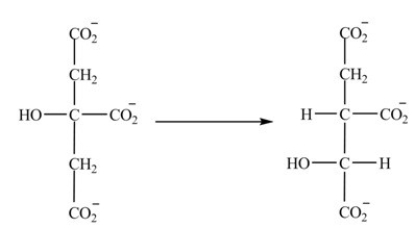
(85) 
At which stage of metabolism is the most energy in the form of ATP produced?
(Multiple Choice)
4.9/5 (83)
(83) Where does the hydrolysis of carbohydrates to monosaccharides begin?
(Multiple Choice)
4.7/5 (79)
(79) Which intermediate in the citric acid cycle is a secondary alcohol?
(Multiple Choice)
4.9/5 (75)
(75) Step 7 of the citric acid cycle is shown. Which statement best describes what occurs in this step? 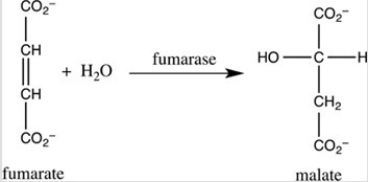
(Multiple Choice)
4.9/5 (79)
(79) ________ is a coenzyme synthesized in cells from vitamin B2,riboflavin.
(Short Answer)
4.8/5 (83)
(83) Coenzyme A is a biological oxidizing agent used to convert alcohols to carbonyl-containing compounds.
(True/False)
4.8/5 (92)
(92) Any process,such as walking,running,swallowing,or breathing,is fueled by the release of energy from the phosphorylation of ADP to ATP.
(True/False)
5.0/5 (70)
(70) Anabolism is an energy releasing process that involves the synthesis of large molecules from smaller ones.
(True/False)
4.9/5 (92)
(92) The hydrolysis of ATP is an energy-requiring reaction that cleaves one phosphate group,forming ADP and hydrogen phosphate,(HPO42-).
(True/False)
4.9/5 (77)
(77) Which product(s)of the citric acid cycle are funneled into the electron transport chain?
(Multiple Choice)
4.9/5 (73)
(73) Two electrons are donated by each NADH in the electron transport chain.
(True/False)
4.9/5 (78)
(78) The citric acid cycle is also called the tricarboxylic acid cycle (TCA cycle).
(True/False)
4.8/5 (66)
(66) 
Filters
- Essay(0)
- Multiple Choice(0)
- Short Answer(0)
- True False(0)
- Matching(0)