



 Chat with AI
Exam 23: Metabolism and Energy Production

Exam 1: Matter and Measurement87 Questions
Exam 2: Atoms and the Periodic Table95 Questions
Exam 3: Ionic Compounds100 Questions
Exam 4: Covalent Compounds101 Questions
Exam 5: Chemical Reactions98 Questions
Exam 6: Energy Changes,reaction Rates,and Equilibrium102 Questions
Exam 7: Gases,liquids,and Solids98 Questions
Exam 8: Solutions98 Questions
Exam 9: Acids and Bases108 Questions
Exam 10: Nuclear Chemistry93 Questions
Exam 11: Introduction to Organic Molecules and Functional Groups123 Questions
Exam 12: Alkanes104 Questions
Exam 13: Unsaturated Hydrocarbons104 Questions
Exam 14: Organic Compounds That Contain Oxygen,halogen,or Sulfur112 Questions
Exam 15: The Three-Dimensional Shape of Molecules101 Questions
Exam 16: Aldehydes and Ketones114 Questions
Exam 17: Carboxylic Acids,esters,and Amides107 Questions
Exam 18: Amines and Neurotransmitters115 Questions
Exam 19: Lipids115 Questions
Exam 20: Carbohydrates100 Questions
Exam 21: Amino Acids,proteins,and Enzymes98 Questions
Exam 22: Nucleic Acids and Protein Synthesis98 Questions
Exam 23: Metabolism and Energy Production102 Questions
Exam 24: Carbohydrate,lipid,and Protein Metabolism99 Questions
Select questions type


The citric acid cycle is activated with the amount of available ADP is low.
(True/False)
4.9/5  (83)
(83) Stage [3] of catabolism is sometimes called aerobic respiration.
(True/False)
4.7/5 (70)
(70) Which intermediate in the citric acid cycle contains two chirality centers?
(Multiple Choice)
4.8/5 (87)
(87) ________ is a cyclic metabolic pathway that begins with the addition of acetyl CoA to a four-carbon substrate and ends when the same four-carbon compound is formed as a product eight steps later.
(Short Answer)
4.8/5 (82)
(82) ________ is the breakdown of large molecules into smaller ones.
(Short Answer)
4.9/5 (73)
(73) Each FADH2 that enters the electron transport chain will result in the formation of ________ units of ATP.
(Multiple Choice)
4.8/5 (85)
(85) Which statement best describes what occurs with a substrate is oxidized using FAD to product FADH2?
(Multiple Choice)
4.9/5 (64)
(64) Which statement best describes how the interconversion of ATP and ADP is responsible for storing and providing energy for cellular reactions? 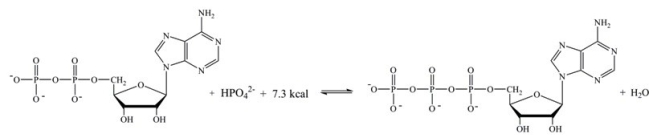
(Multiple Choice)
5.0/5 (83)
(83) The addition of a phosphate group to ADP,forming ATP,is an example of what type of reaction?
(Multiple Choice)
4.8/5 (87)
(87) Oxaloacetate is the starting material in the first step of the citric acid cycle and the product of the last step. The last step of the citric acid cycle,the oxidation of malate to oxaloacetate,is shown. What is the structure of oxaloacetate? 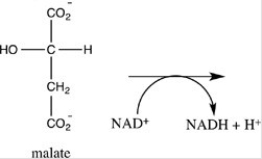
(Multiple Choice)
5.0/5 (74)
(74) If the phosphorylation of GMP to form GDP requires 7.3 kcal/mol of energy,what is the energy change associated with the hydrolysis of GDP to form GMP?
(Multiple Choice)
4.7/5 (68)
(68) Since more energy is released from the hydrolysis of creatine phosphate than is needed for the phosphorylation of ADP,the coupling of these two reactions results in the formation of ATP from ADP.
(True/False)
4.8/5 (86)
(86) H+ ions generated by reactions in the electron transport chain,as well as H+ ions present in the matrix of the mitochondria,are pumped across the inner mitochondrial membrane into the intermembrane space at three different sites.
(True/False)
4.7/5 (88)
(88) At the end of the electron transport chain,the electrons and protons (obtained from the reduced coenzymes or the matrix of the mitochondrion)react with inhaled oxygen to form ________.
(Short Answer)
4.9/5 (70)
(70) The number of moles of ATP that can be synthesized from ADP using the 750. Calories ingested during a meal is ________ moles.
(Short Answer)
4.9/5 (82)
(82) Which best describes the function of the coenzymes NAD+ and FAD in catabolic pathways?
(Multiple Choice)
5.0/5 (79)
(79) The structure of coenzyme A contains amine and amide functional groups.
(True/False)
4.8/5 (76)
(76) 
Filters
- Essay(0)
- Multiple Choice(0)
- Short Answer(0)
- True False(0)
- Matching(0)