



 Chat with AI
Exam 23: Metabolism and Energy Production

Exam 1: Matter and Measurement87 Questions
Exam 2: Atoms and the Periodic Table95 Questions
Exam 3: Ionic Compounds100 Questions
Exam 4: Covalent Compounds101 Questions
Exam 5: Chemical Reactions98 Questions
Exam 6: Energy Changes,reaction Rates,and Equilibrium102 Questions
Exam 7: Gases,liquids,and Solids98 Questions
Exam 8: Solutions98 Questions
Exam 9: Acids and Bases108 Questions
Exam 10: Nuclear Chemistry93 Questions
Exam 11: Introduction to Organic Molecules and Functional Groups123 Questions
Exam 12: Alkanes104 Questions
Exam 13: Unsaturated Hydrocarbons104 Questions
Exam 14: Organic Compounds That Contain Oxygen,halogen,or Sulfur112 Questions
Exam 15: The Three-Dimensional Shape of Molecules101 Questions
Exam 16: Aldehydes and Ketones114 Questions
Exam 17: Carboxylic Acids,esters,and Amides107 Questions
Exam 18: Amines and Neurotransmitters115 Questions
Exam 19: Lipids115 Questions
Exam 20: Carbohydrates100 Questions
Exam 21: Amino Acids,proteins,and Enzymes98 Questions
Exam 22: Nucleic Acids and Protein Synthesis98 Questions
Exam 23: Metabolism and Energy Production102 Questions
Exam 24: Carbohydrate,lipid,and Protein Metabolism99 Questions
Select questions type


Coupled reactions are pairs of reactions that occur together so that the energy released by one reaction provides the energy to drive the other reaction.
(True/False)
4.9/5  (79)
(79) By the end of step [4] of the citric acid cycle,________ carbons are lost as CO2 and ________ molecules of NADH are formed.
(Short Answer)
4.9/5 (69)
(69) The main function of the citric acid cycle is to produce ________ that enter the electron transport chain and ultimately produce ________.
(Short Answer)
4.8/5 (92)
(92) How many molecules of GTP are produced for each turn of the citric acid cycle?
(Multiple Choice)
4.7/5 (74)
(74) Which is the sum of all of the chemical reactions that take place in an organism?
(Multiple Choice)
4.8/5 (71)
(71) The energy produced by the citric acid cycle is stored in the bonds of a nucleoside triphosphate and reduced coenzymes.
(True/False)
4.9/5 (80)
(80) Any energy requiring reaction can be coupled with ATP hydrolysis to create an energetically favorable coupled reaction.
(True/False)
4.8/5 (75)
(75) The phosphorylation of glucose provides enough energy for the hydrolysis of ATP.
(True/False)
4.9/5 (76)
(76) 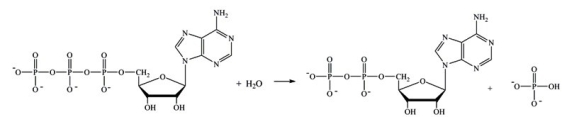
Considering the energy changes associated with the individual reactions below,which reaction can be coupled with the hydrolysis of ATP to generate a coupled reaction that is energetically favorable? 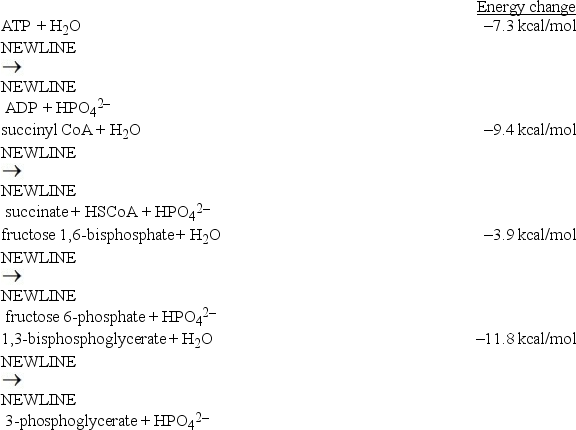
(Multiple Choice)
4.9/5 (97)
(97) How much ATP is generated for each acetyl CoA during stages [3] and [4] of catabolism?
(Multiple Choice)
4.9/5 (74)
(74) Which statement concerning the digestion of food groups is incorrect?
(Multiple Choice)
4.7/5 (71)
(71) The second step of the citric acid cycle,the isomerization of citrate to isocitrate,is shown. What is the structure of isocitrate? 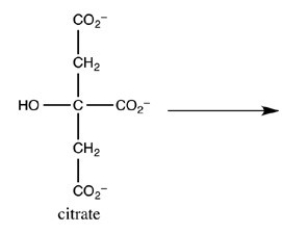
(Multiple Choice)
4.9/5 (64)
(64) Which coupled reaction properly indicates the role of the coenzyme as an oxidizing agent?
(Multiple Choice)
4.9/5 (82)
(82) Within the cell,energy production occurs in the matrix of the mitochondrion.
(True/False)
4.8/5 (94)
(94) Considering the energy changes associated with the two individual reactions below,what coupled reaction is an energetically favorable one? 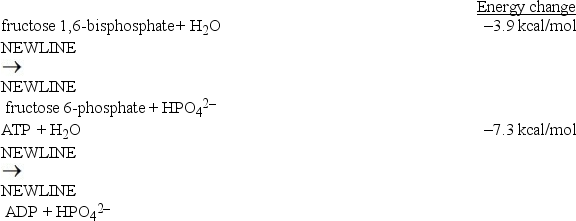
(Multiple Choice)
4.9/5 (86)
(86) Coenzyme A is synthesized in cells from pantothenic acid,vitamin B5.
(True/False)
4.8/5 (77)
(77) In the electron transport chain,H+ ions are pumped across the inner membrane of the mitochondrion,forming a high concentration of H+ ions in the intermembrane space,thus creating a potential energy gradient.
(True/False)
4.7/5 (91)
(91) 
Filters
- Essay(0)
- Multiple Choice(0)
- Short Answer(0)
- True False(0)
- Matching(0)