



 Chat with AI
Exam 3: Stereoisomerism and Chirality

Exam 1: Covalent Bonding and Shapes of Molecules118 Questions
Exam 2: Alkanes and Cycloalkanes101 Questions
Exam 3: Stereoisomerism and Chirality95 Questions
Exam 4: Acids and Bases94 Questions
Exam 5: Alkenes: Bonding, Nomenclature, and Properties88 Questions
Exam 6: Reactions of Alkenes97 Questions
Exam 7: Alkynes100 Questions
Exam 8: Haloalkanes, Halogenation, and Radical Reactions75 Questions
Exam 9: Nucleophilic Substitution and Beta-Elimination104 Questions
Exam 10: Alcohols102 Questions
Exam 11: Ethers, Epoxides, and Sulfides102 Questions
Exam 12: Infrared Spectroscopy74 Questions
Exam 13: Nuclear Magnetic Resonance Spectroscopy99 Questions
Exam 14: Mass Spectrometry75 Questions
Exam 15: An Introduction to Organometallic Compounds73 Questions
Exam 16: Aldehydes and Ketones122 Questions
Exam 17: Carboxylic Acids76 Questions
Exam 18: Functional Derivatives of Carboxylic Acids117 Questions
Exam 19: Enolate Anions and Enamines96 Questions
Exam 20: Dienes, Conjugated Systems, and Pericyclic Reactions75 Questions
Exam 21: Benzene and the Concept of Aromaticity77 Questions
Exam 22: Reactions of Benzene and Its Derivatives109 Questions
Exam 23: Amines92 Questions
Exam 24: Catalytic Carbon-Carbon Bond Formation84 Questions
Exam 25: Carbohydrates69 Questions
Exam 26: Lipids65 Questions
Exam 27: Amino Acids and Proteins77 Questions
Exam 28: Nucleic Acids58 Questions
Exam 29: Organic Polymer Chemistry68 Questions
Select questions type


How many isomers (constitutional and stereoisomers) exist for dimethylcyclopentane?
(Multiple Choice)
4.8/5  (68)
(68) In muscle tissue only (+)-lactic acid is found but in sour milk both (+)-lactic acid and (-)-lactic acid are present. This difference might be explained by the fact that the production of lactic acid in muscle tissue is catalyzed by biological catalysts or enzymes.
(True/False)
4.8/5 (77)
(77) Complete the following zig-zag structure so that it represents (2R,3R)-3-chlorobutan-2-ol. 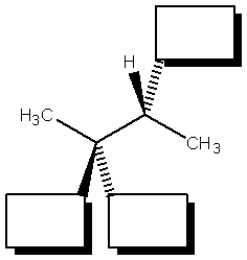
(Essay)
5.0/5 (95)
(95) Which of the following Newman projections represents (2R,3R)-dibromobutane? 
(Multiple Choice)
4.9/5 (66)
(66) What is the relationship between the following pair of structures? 
(Multiple Choice)
4.9/5 (83)
(83) Which of the following is the definition of a pair of enantiomers?
(Multiple Choice)
4.8/5 (81)
(81) Which of the following is the definition of a pair of diastereomers?
(Multiple Choice)
4.8/5 (83)
(83) An unknown sample is tested with a polarimeter for optical activity. The results of the test required no movement of the analyzer. This sample could be either a meso compound or a racemic mixture.
(True/False)
4.9/5 (89)
(89) How many isomers (constitutional and stereoisomers) exist for dimethylpentane?
(Multiple Choice)
4.8/5 (67)
(67) How many stereoisomers of 3-bromo-2-butanol, CH3CH(OH)CHBrCH3, exist?
(Multiple Choice)
4.8/5 (77)
(77) Which of the following structures is different from the other three? 
(Multiple Choice)
5.0/5 (79)
(79) Complete the following diagram so that it represents (R)-2-bromobutane. 
(Essay)
4.9/5 (66)
(66) How much of the R enantiomer is present in 10 g of a mixture which has an enantiomeric excess of 20% of the S isomer?
(Multiple Choice)
4.9/5 (83)
(83) Complete the following zig-zag structure so that it represents (2S,3R)-2,3-dibromobutane. 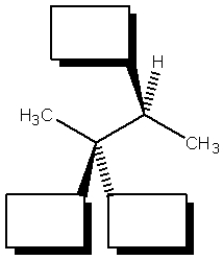
(Essay)
4.9/5 (74)
(74) 
Complete the following diagram so that it represents (R)-2-bromobutane. 
(Essay)
4.8/5 (85)
(85) Which of the following Newman projections represents meso-2,3-dibromobutane? 
(Multiple Choice)
4.8/5 (78)
(78) The terms that best describe the relationship between (2R,3S)-2,3-butanediol and (2S,3S)-2,3-butanediol are configurational and diastereomers.
(True/False)
4.8/5 (87)
(87) Which of the following structures has a center of symmetry (i.e., center of inversion)? 
(Multiple Choice)
4.7/5 (76)
(76) 
Filters
- Essay(0)
- Multiple Choice(0)
- Short Answer(0)
- True False(0)
- Matching(0)