



 Chat with AI
Exam 13: Nuclear Magnetic Resonance Spectroscopy

Exam 1: Covalent Bonding and Shapes of Molecules118 Questions
Exam 2: Alkanes and Cycloalkanes101 Questions
Exam 3: Stereoisomerism and Chirality95 Questions
Exam 4: Acids and Bases94 Questions
Exam 5: Alkenes: Bonding, Nomenclature, and Properties88 Questions
Exam 6: Reactions of Alkenes97 Questions
Exam 7: Alkynes100 Questions
Exam 8: Haloalkanes, Halogenation, and Radical Reactions75 Questions
Exam 9: Nucleophilic Substitution and Beta-Elimination104 Questions
Exam 10: Alcohols102 Questions
Exam 11: Ethers, Epoxides, and Sulfides102 Questions
Exam 12: Infrared Spectroscopy74 Questions
Exam 13: Nuclear Magnetic Resonance Spectroscopy99 Questions
Exam 14: Mass Spectrometry75 Questions
Exam 15: An Introduction to Organometallic Compounds73 Questions
Exam 16: Aldehydes and Ketones122 Questions
Exam 17: Carboxylic Acids76 Questions
Exam 18: Functional Derivatives of Carboxylic Acids117 Questions
Exam 19: Enolate Anions and Enamines96 Questions
Exam 20: Dienes, Conjugated Systems, and Pericyclic Reactions75 Questions
Exam 21: Benzene and the Concept of Aromaticity77 Questions
Exam 22: Reactions of Benzene and Its Derivatives109 Questions
Exam 23: Amines92 Questions
Exam 24: Catalytic Carbon-Carbon Bond Formation84 Questions
Exam 25: Carbohydrates69 Questions
Exam 26: Lipids65 Questions
Exam 27: Amino Acids and Proteins77 Questions
Exam 28: Nucleic Acids58 Questions
Exam 29: Organic Polymer Chemistry68 Questions
Select questions type


Identify the type of coupling that exists between the two protons in the following compound, given that the compound is asymmetrical. 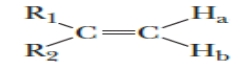
(Multiple Choice)
4.9/5  (78)
(78) The splitting of signals in the 1H NMR spectrum provides information about the number of neighboring protons of each proton in the compound.
(True/False)
4.7/5 (76)
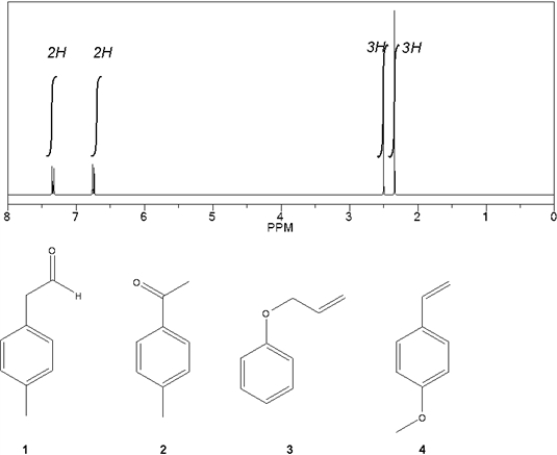
(76) Identify the compound (C4H8O) that gives the following 1H NMR spectrum. 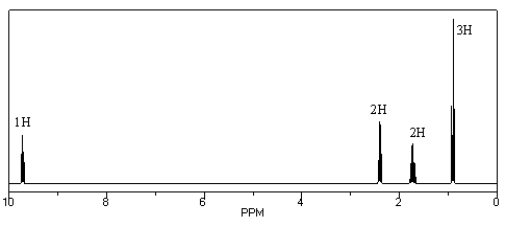
(Short Answer)
5.0/5 (86)
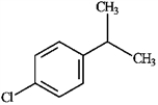
(86) For each of the compounds below tell how many signals you would expect the molecule to have in its normal, broadband hydrogen-decoupled 13C NMR spectra. Enter the numerical value in the blank provided to the left of the structure.
-_______ 
(Short Answer)
4.8/5 (75)
(75) Which of the following combinations of peaks appears in the 1H NMR spectrum of butane?
(Multiple Choice)
4.7/5 (71)
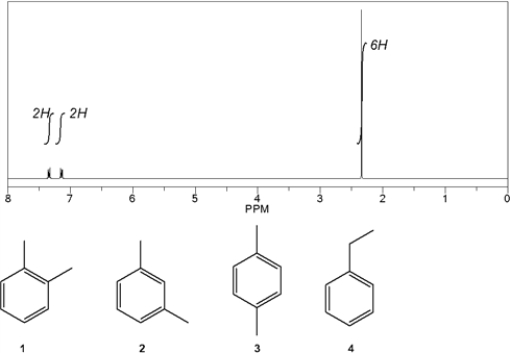
(71) Identify the compound (C8H10) that gives the following 1H NMR spectrum. 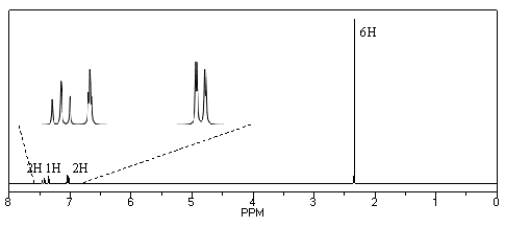
(Short Answer)
4.8/5 (88)
(88) Which of the protons in the following molecule appear furthest downfield in the 1H NMR spectrum?
i ii iii iv
(Multiple Choice)
4.9/5 (92)
(92) Consider the following structure. Answer the following questions by placing the appropriate number in the blank to the left.  -_____The number of signals in the hydrogen-decoupled 13C NMR of this compound.
 (Short Answer)
4.7/5 (80)
(80) What is the splitting of the signal in the 1H NMR spectrum for the methyl protons of ethane?
(Multiple Choice)
4.9/5 (80)
(80) What is the hydrogen deficiency index for a compound with a molecular formula of C10H16O2?
(Multiple Choice)
4.9/5 (70)
(70) 
Consider the following structure. Answer the following questions by placing the appropriate number in the blank to the left.
-_____The number of nonequivalent hydrogen atoms in this compound.
-_____The number of nonequivalent hydrogen atoms in this compound. (Short Answer)
4.7/5 (82)
(82) 
Which feature in the 1H NMR spectrum provides information about the electronic environment of the protons in a compound?
(Multiple Choice)
4.9/5 (84)
(84) Which of the protons in the following molecule appear furthest downfield in the 1H NMR spectrum? O
||
i ii iii iv
(Multiple Choice)
4.8/5 (77)
(77) Nuclear magnetic resonance spectroscopy provides information about a molecule's carbon-hydrogen framework.
(True/False)
4.8/5 (67)
(67) Consider the following structure. 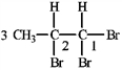 If the proton attached to C2 in 1,1,2-tribromopropane is coupled with the protons on C1 (J = 3.6 Hz) and C3 (J = 6.8), the tree diagram of the C2 proton is shown below.
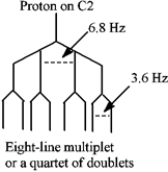
If the proton attached to C2 in 1,1,2-tribromopropane is coupled with the protons on C1 (J = 3.6 Hz) and C3 (J = 6.8), the tree diagram of the C2 proton is shown below. (True/False)
4.9/5 (78)
(78) Which C4H9Br compound gives a doublet at approximately 3.3 ppm in the 1H NMR spectrum? 
(Multiple Choice)
5.0/5 (73)
(73) Which of the following is not true regarding 1H NMR spectroscopy?
(Multiple Choice)
4.9/5 (87)
(87) 
Filters
- Essay(0)
- Multiple Choice(0)
- Short Answer(0)
- True False(0)
- Matching(0)