



 Chat with AI
Exam 16: Aldehydes and Ketones

Exam 1: Covalent Bonding and Shapes of Molecules118 Questions
Exam 2: Alkanes and Cycloalkanes101 Questions
Exam 3: Stereoisomerism and Chirality95 Questions
Exam 4: Acids and Bases94 Questions
Exam 5: Alkenes: Bonding, Nomenclature, and Properties88 Questions
Exam 6: Reactions of Alkenes97 Questions
Exam 7: Alkynes100 Questions
Exam 8: Haloalkanes, Halogenation, and Radical Reactions75 Questions
Exam 9: Nucleophilic Substitution and Beta-Elimination104 Questions
Exam 10: Alcohols102 Questions
Exam 11: Ethers, Epoxides, and Sulfides102 Questions
Exam 12: Infrared Spectroscopy74 Questions
Exam 13: Nuclear Magnetic Resonance Spectroscopy99 Questions
Exam 14: Mass Spectrometry75 Questions
Exam 15: An Introduction to Organometallic Compounds73 Questions
Exam 16: Aldehydes and Ketones122 Questions
Exam 17: Carboxylic Acids76 Questions
Exam 18: Functional Derivatives of Carboxylic Acids117 Questions
Exam 19: Enolate Anions and Enamines96 Questions
Exam 20: Dienes, Conjugated Systems, and Pericyclic Reactions75 Questions
Exam 21: Benzene and the Concept of Aromaticity77 Questions
Exam 22: Reactions of Benzene and Its Derivatives109 Questions
Exam 23: Amines92 Questions
Exam 24: Catalytic Carbon-Carbon Bond Formation84 Questions
Exam 25: Carbohydrates69 Questions
Exam 26: Lipids65 Questions
Exam 27: Amino Acids and Proteins77 Questions
Exam 28: Nucleic Acids58 Questions
Exam 29: Organic Polymer Chemistry68 Questions
Select questions type


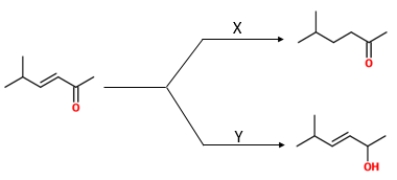

What is the major organic product obtained from the following reaction? 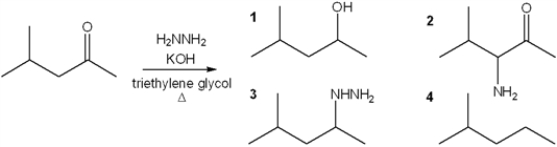
(Multiple Choice)
4.8/5  (71)
(71) What is the correct assignment of the names of the following functional groups? 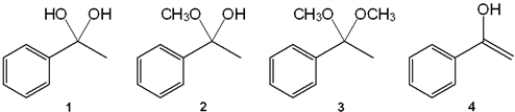
(Multiple Choice)
4.9/5 (85)
(85) What is the major organic product obtained from the following reaction? 
(Essay)
4.9/5 (77)
(77) What is the major organic product obtained from the following reaction? 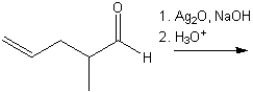
(Essay)
4.9/5 (79)
(79) 3-hydroxybutanal can exist in equilibrium as a cyclic hemiacetal.
(True/False)
4.8/5 (77)
(77) 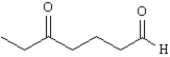
What is the correct assignment of the names of the following functional groups? 
(Multiple Choice)
4.8/5 (76)
(76) What is the major organic product obtained from the following reaction? 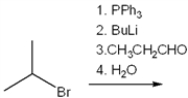
(Multiple Choice)
4.8/5 (82)
(82) Which combination(s) of alkyl bromide and carbonyl compound can be used to prepare the following product by addition of the Grignard reagent derived from the alkyl bromide to the carbonyl compound? 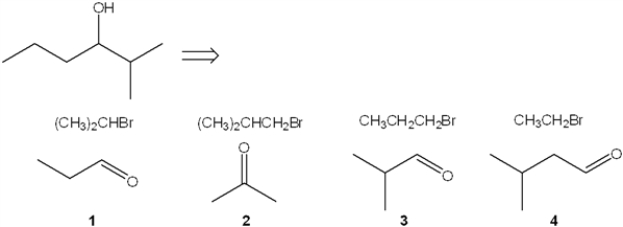
(Multiple Choice)
4.9/5 (73)
(73) What is the major organic product obtained from the following reaction? 
(Multiple Choice)
4.9/5 (85)
(85) What is the major organic product obtained from the following reaction? 
(Multiple Choice)
4.8/5 (81)
(81) 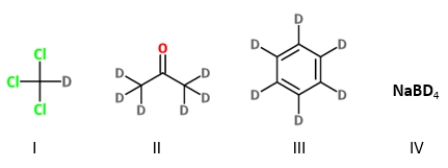
What is the correct assignment of the names of the following functional groups? 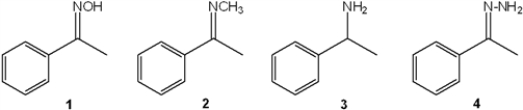
(Multiple Choice)
5.0/5 (74)
(74) Which of the following is not true about the Wittig reaction?
(Multiple Choice)
5.0/5 (82)
(82) Consider the reaction below to answer the following question(s). Use letters where appropriate to answer the questions.
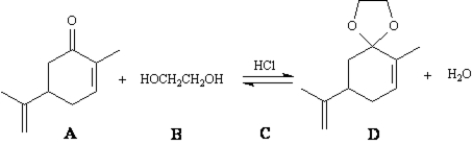 -The nucleophile in this reaction is _____.
 (Short Answer)
4.8/5 (92)
(92) Consider the following reaction. 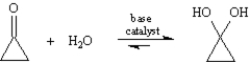 The mechanism for this reaction is shown below.

The mechanism for this reaction is shown below. (True/False)
4.9/5 (84)
(84) The reduction of aldehydes by LAH is carried out in aprotic solvents such as THF because _____.
(Multiple Choice)
4.7/5 (81)
(81) What is the relationship between the following two structures? 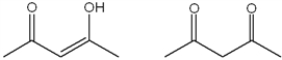
(Multiple Choice)
4.9/5 (79)
(79) What is the major organic product obtained from the following sequence of reactions? 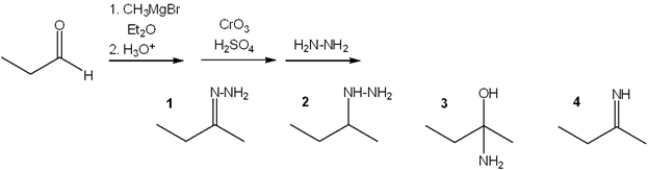
(Multiple Choice)
4.9/5 (72)
(72) 
Filters
- Essay(0)
- Multiple Choice(0)
- Short Answer(0)
- True False(0)
- Matching(0)