



 Chat with AI
Exam 17: Carboxylic Acids

Exam 1: Covalent Bonding and Shapes of Molecules118 Questions
Exam 2: Alkanes and Cycloalkanes101 Questions
Exam 3: Stereoisomerism and Chirality95 Questions
Exam 4: Acids and Bases94 Questions
Exam 5: Alkenes: Bonding, Nomenclature, and Properties88 Questions
Exam 6: Reactions of Alkenes97 Questions
Exam 7: Alkynes100 Questions
Exam 8: Haloalkanes, Halogenation, and Radical Reactions75 Questions
Exam 9: Nucleophilic Substitution and Beta-Elimination104 Questions
Exam 10: Alcohols102 Questions
Exam 11: Ethers, Epoxides, and Sulfides102 Questions
Exam 12: Infrared Spectroscopy74 Questions
Exam 13: Nuclear Magnetic Resonance Spectroscopy99 Questions
Exam 14: Mass Spectrometry75 Questions
Exam 15: An Introduction to Organometallic Compounds73 Questions
Exam 16: Aldehydes and Ketones122 Questions
Exam 17: Carboxylic Acids76 Questions
Exam 18: Functional Derivatives of Carboxylic Acids117 Questions
Exam 19: Enolate Anions and Enamines96 Questions
Exam 20: Dienes, Conjugated Systems, and Pericyclic Reactions75 Questions
Exam 21: Benzene and the Concept of Aromaticity77 Questions
Exam 22: Reactions of Benzene and Its Derivatives109 Questions
Exam 23: Amines92 Questions
Exam 24: Catalytic Carbon-Carbon Bond Formation84 Questions
Exam 25: Carbohydrates69 Questions
Exam 26: Lipids65 Questions
Exam 27: Amino Acids and Proteins77 Questions
Exam 28: Nucleic Acids58 Questions
Exam 29: Organic Polymer Chemistry68 Questions
Select questions type


The strongest acid of the following is indicated by the Roman numeral ______. | I II III IV
(Short Answer)
4.9/5  (81)
(81) What is the best choice of reagent(s) to perform the following transformation? 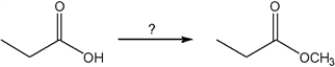
(Multiple Choice)
5.0/5 (80)
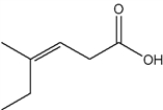
(80) 
What is the major organic product obtained from the following reaction? 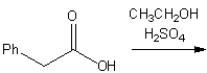
(Essay)
4.7/5 (83)
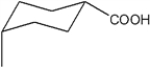
(83) 
It is possible to reduce aldehydes and ketones selectively by using the less reactive _____ as the reducing agent.
(Short Answer)
4.9/5 (88)
(88) Consider the data in the Table below to answer the following question:
Acidities of Substituted Benzoic and Acetic Acids
pKas at 25°C
Y−C6H4COOH
Y
Y−CH2COOH
meta
para
H
4.75
4.19
4.19
CN
2.47
3.64
3.55
OCH3
3.57
4.09
4.46
The structure of the strongest acid in the table above is NC−CH2−COOH.
(True/False)
4.8/5 (69)
(69) Based on the following IR spectrum, this compound would be classified as aromatic carboxylic acid.
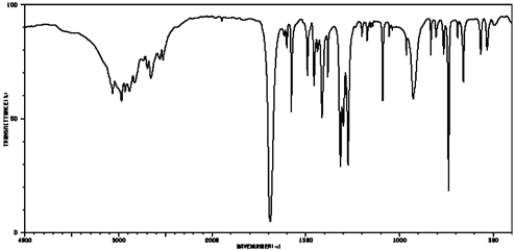
Spectrum obtained from: SDBSWeb : http://riodb01.ibase.aist.go.jp/sdbs/ (National Institute of Advanced Industrial Science and Technology, 11-07-08)
Spectrum obtained from: SDBSWeb : http://riodb01.ibase.aist.go.jp/sdbs/ (National Institute of Advanced Industrial Science and Technology, 11-07-08) (True/False)
4.8/5 (100)
(100) What is the correct assignment of the names of the following substituted benzenes? 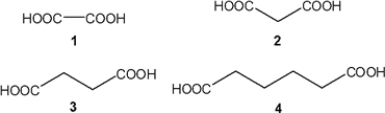
(Multiple Choice)
4.9/5 (70)
(70) The strongest acid of the following is indicated by the Roman numeral ______. 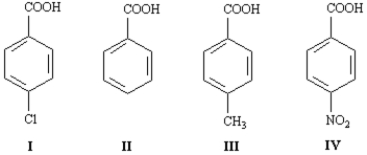
(Short Answer)
4.9/5 (76)
(76) What is the major organic product obtained from the following sequence of reactions? 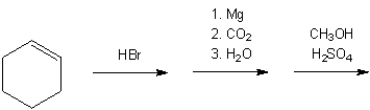
(Essay)
4.8/5 (73)
(73) Benzoic acid can be produced by the treatment of bromobenzene with 1. Mg, ether, and 2.) CO2 followed by acidification.
(True/False)
4.8/5 (62)
(62) What is the major organic product obtained from the following reaction? 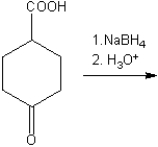
(Essay)
4.9/5 (83)
(83) What is the major organic product obtained from the following reaction? 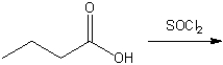
(Essay)
4.9/5 (86)
(86) 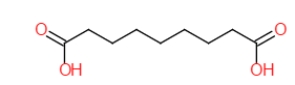
What is the major organic product obtained from the following reaction? 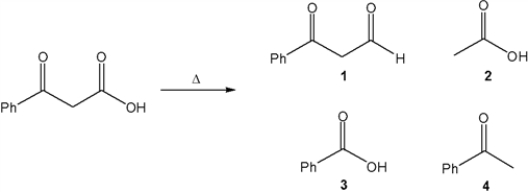
(Multiple Choice)
4.9/5 (86)
(86) Match the structures with the most appropriate boiling points.
-163oC
(Multiple Choice)
4.9/5 (78)
(78) 
Filters
- Essay(0)
- Multiple Choice(0)
- Short Answer(0)
- True False(0)
- Matching(0)