



 Chat with AI
Exam 20: Dienes, Conjugated Systems, and Pericyclic Reactions

Exam 1: Covalent Bonding and Shapes of Molecules118 Questions
Exam 2: Alkanes and Cycloalkanes101 Questions
Exam 3: Stereoisomerism and Chirality95 Questions
Exam 4: Acids and Bases94 Questions
Exam 5: Alkenes: Bonding, Nomenclature, and Properties88 Questions
Exam 6: Reactions of Alkenes97 Questions
Exam 7: Alkynes100 Questions
Exam 8: Haloalkanes, Halogenation, and Radical Reactions75 Questions
Exam 9: Nucleophilic Substitution and Beta-Elimination104 Questions
Exam 10: Alcohols102 Questions
Exam 11: Ethers, Epoxides, and Sulfides102 Questions
Exam 12: Infrared Spectroscopy74 Questions
Exam 13: Nuclear Magnetic Resonance Spectroscopy99 Questions
Exam 14: Mass Spectrometry75 Questions
Exam 15: An Introduction to Organometallic Compounds73 Questions
Exam 16: Aldehydes and Ketones122 Questions
Exam 17: Carboxylic Acids76 Questions
Exam 18: Functional Derivatives of Carboxylic Acids117 Questions
Exam 19: Enolate Anions and Enamines96 Questions
Exam 20: Dienes, Conjugated Systems, and Pericyclic Reactions75 Questions
Exam 21: Benzene and the Concept of Aromaticity77 Questions
Exam 22: Reactions of Benzene and Its Derivatives109 Questions
Exam 23: Amines92 Questions
Exam 24: Catalytic Carbon-Carbon Bond Formation84 Questions
Exam 25: Carbohydrates69 Questions
Exam 26: Lipids65 Questions
Exam 27: Amino Acids and Proteins77 Questions
Exam 28: Nucleic Acids58 Questions
Exam 29: Organic Polymer Chemistry68 Questions
Select questions type


Consider the following reaction.  This is an example of a sigmatropic reaction with a [3,3]-shift.
 (True/False)
4.8/5  (95)
(95) Which of the following laws relates absorbance to the concentration of a sample and the pathlength in ultraviolet-visible spectroscopy?
(Multiple Choice)
4.9/5 (83)
(83) 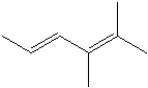
Which of the following arrangements of p atomic orbitals gives the lowest energy π-bonding molecular orbital of 1,3-butadiene? 
(Multiple Choice)
4.9/5 (84)
(84) A reaction in which two reactants add together in a single step to form a cyclic product is known as a _____.
(Short Answer)
4.9/5 (83)
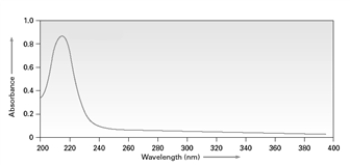
(83) 
What is (are) the major organic product(s) formed in the following reaction? 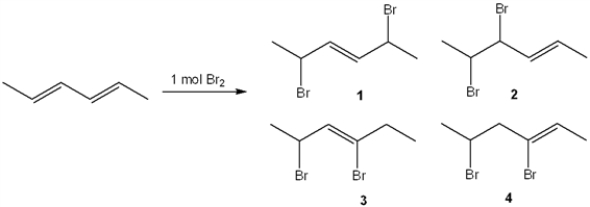
(Multiple Choice)
4.9/5 (76)
(76) Consider the reaction below to answer the following question(s): 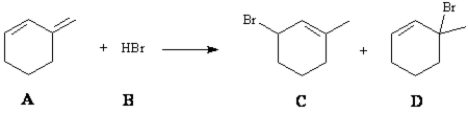 Enter the appropriate letter in the blank for each the following statements.
-The product that results from 1,4-addition is _____.
Enter the appropriate letter in the blank for each the following statements.
-The product that results from 1,4-addition is _____. (Short Answer)
5.0/5 (73)
(73) Consider the reaction below to answer the following question(s): Enter the appropriate letter in the blank for each the following statements.
-The kinetically controlled product in this reaction is _____.
Enter the appropriate letter in the blank for each the following statements.
-The kinetically controlled product in this reaction is _____. (Short Answer)
4.8/5 (64)
(64) Based on the following table.
Compound () 190 340 560 250
Compound ______ has the largest energy difference between the HOMO and LUMO.
(Short Answer)
4.9/5 (79)
(79) 
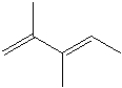
Consider the reaction below to answer the following question(s). 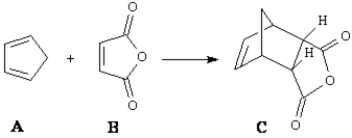 Fill in the blank in the question with the appropriate letter.
-The dienophile in the reaction is ____.
Fill in the blank in the question with the appropriate letter.
-The dienophile in the reaction is ____. (Short Answer)
4.7/5 (86)
(86) For Diels-Alder cycloaddition reactions to take place most rapidly and in highest yield a dienophile must be substituted with electron-donating groups.
(True/False)
4.8/5 (82)
(82) Which of the following is(are) formed upon addition of 1 mol of Br2 to 1,3-cyclohexane? 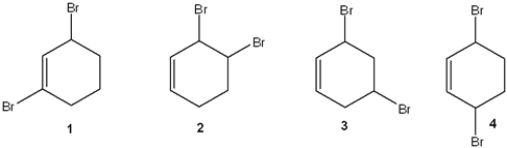
(Multiple Choice)
4.8/5 (80)
(80) Pericyclic reactions occur in a single step with the _____.
(Multiple Choice)
4.9/5 (73)
(73) Consider the reaction below to answer the following question(s). Fill in the blank in the question with the appropriate letter.
-This is an example of a(n) ____________ reaction.
A. sigmatropic reaction
B. electrophillic addition
C. Diels-Alder reaction
D. Cope rearrangement
Fill in the blank in the question with the appropriate letter.
-This is an example of a(n) ____________ reaction.
A. sigmatropic reaction
B. electrophillic addition
C. Diels-Alder reaction
D. Cope rearrangement (Short Answer)
4.7/5 (77)
(77) Which of the following electronic transitions is apparent in the ultraviolet-visible spectrum of 1,3-butadiene?
(Multiple Choice)
4.8/5 (98)
(98) How would you be able to distinguish between 1,3-cyclohexadiene and 1,4-cyclohexadiene using ultraviolet spectroscopy?
(Essay)
4.9/5 (79)
(79) The following compound could act as a diene in a Diels-Alder reaction. 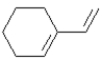
(True/False)
4.8/5 (95)
(95) 
Filters
- Essay(0)
- Multiple Choice(0)
- Short Answer(0)
- True False(0)
- Matching(0)