



 Chat with AI
Exam 22: Reactions of Benzene and Its Derivatives

Exam 1: Covalent Bonding and Shapes of Molecules118 Questions
Exam 2: Alkanes and Cycloalkanes101 Questions
Exam 3: Stereoisomerism and Chirality95 Questions
Exam 4: Acids and Bases94 Questions
Exam 5: Alkenes: Bonding, Nomenclature, and Properties88 Questions
Exam 6: Reactions of Alkenes97 Questions
Exam 7: Alkynes100 Questions
Exam 8: Haloalkanes, Halogenation, and Radical Reactions75 Questions
Exam 9: Nucleophilic Substitution and Beta-Elimination104 Questions
Exam 10: Alcohols102 Questions
Exam 11: Ethers, Epoxides, and Sulfides102 Questions
Exam 12: Infrared Spectroscopy74 Questions
Exam 13: Nuclear Magnetic Resonance Spectroscopy99 Questions
Exam 14: Mass Spectrometry75 Questions
Exam 15: An Introduction to Organometallic Compounds73 Questions
Exam 16: Aldehydes and Ketones122 Questions
Exam 17: Carboxylic Acids76 Questions
Exam 18: Functional Derivatives of Carboxylic Acids117 Questions
Exam 19: Enolate Anions and Enamines96 Questions
Exam 20: Dienes, Conjugated Systems, and Pericyclic Reactions75 Questions
Exam 21: Benzene and the Concept of Aromaticity77 Questions
Exam 22: Reactions of Benzene and Its Derivatives109 Questions
Exam 23: Amines92 Questions
Exam 24: Catalytic Carbon-Carbon Bond Formation84 Questions
Exam 25: Carbohydrates69 Questions
Exam 26: Lipids65 Questions
Exam 27: Amino Acids and Proteins77 Questions
Exam 28: Nucleic Acids58 Questions
Exam 29: Organic Polymer Chemistry68 Questions
Select questions type


Which of the following sets of substituents are all activating groups in electrophilic aromatic substitution reactions?
(Multiple Choice)
4.8/5  (72)
(72) Why does anisole undergo bromination with Br2 in the absence of FeBr3 whereas bromination of benzene requires the presence of FeBr3?
(Multiple Choice)
4.9/5 (80)
(80) What is the major organic product obtained from the following reaction? 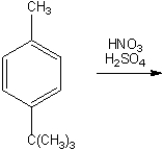
(Essay)
4.8/5 (81)
(81) Which of the following chlorobenzenes produces a single isomer upon treatment with NaNH2? 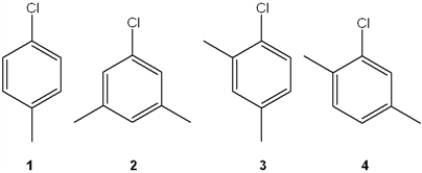
(Multiple Choice)
5.0/5 (80)
(80) What is the major organic product obtained from the following reaction? 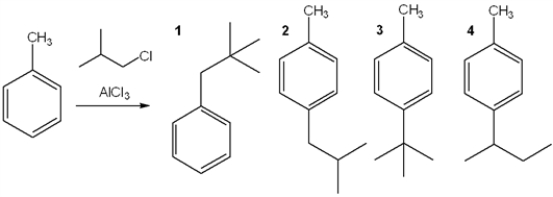
(Multiple Choice)
4.8/5 (83)
(83) Provide the structure (a single resonance contributor) of the key intermediate in the following reaction. 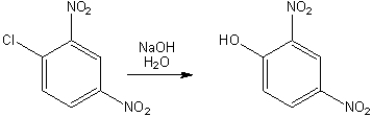
(Essay)
4.8/5 (85)
(85) What is the major organic product obtained from the following sequence of reactions? 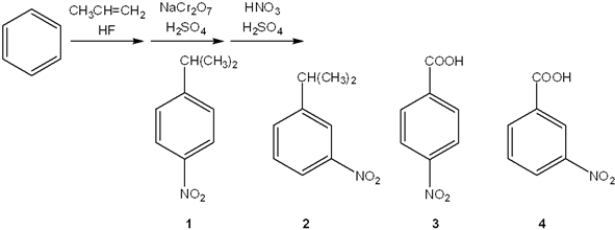
(Multiple Choice)
4.9/5 (96)
(96) What is the major organic product obtained from the following reaction (if a reaction is likely to give you a mixture of ortho and para disubstituted compounds you should assume that they can be separated; continue the synthesis with either one)? 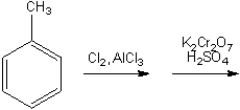
(Essay)
4.7/5 (81)
(81) What is the major organic product obtained from the following reaction (assume that mixtures of ortho and para disubstituted compounds can be separated; continue the synthesis with either one)? 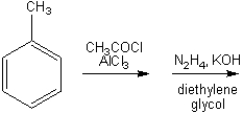
(Essay)
4.8/5 (77)
(77) Which of the following undergoes the most rapid bromination upon treatment with Br2/FeBr3?
(Multiple Choice)
4.9/5 (76)
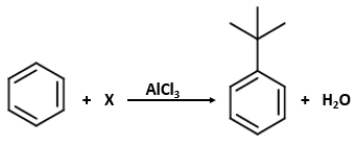
(76) 
Which of the following compounds undergoes the most rapid nucleophilic substitution with hydroxide ion? 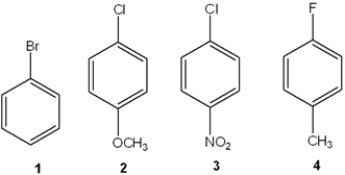
(Multiple Choice)
4.8/5 (73)
(73) What is the role of FeBr3 in electrophilic aromatic bromination of benzene using Br2?
(Multiple Choice)
4.8/5 (87)
(87) All of the following can act as an electrophile in an electrophilic aromatic substitution reaction.
SO3 (CH3)3C+ NO2+
(True/False)
4.9/5 (83)
(83) The best sequence in which to carry out the following reaction is 1) Br2, AlBr3, 2) H2SO4, SO3. 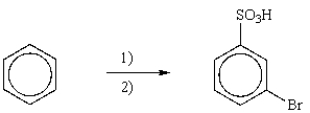
(True/False)
4.7/5 (90)
(90) What type of intermediate is formed in the reaction between chlorobenzene and tert-butyl chloride and AlCl3 to give 4-chloro-1-tert-butylbenzene?
(Multiple Choice)
4.8/5 (86)
(86) Which of the following sets of substituents are all ortho/para directing in electrophilic aromatic substitution reactions?
(Multiple Choice)
4.8/5 (75)
(75) What type of intermediate is formed in the reaction between bromobenzene and sodium amide to give aniline?
(Multiple Choice)
4.7/5 (79)
(79) 
Filters
- Essay(0)
- Multiple Choice(0)
- Short Answer(0)
- True False(0)
- Matching(0)