



 Chat with AI
Exam 7: Taxation and Government Intervention

Exam 1: Economics and Economic Reasoning121 Questions
Exam 2: The Production Possibility Model, Trade, and Globalization111 Questions
Exam 3: Economic Institutions144 Questions
Exam 4: Supply and Demand151 Questions
Exam 5: Using Supply and Demand136 Questions
Exam 6: Describing Supply and Demand: Elasticities176 Questions
Exam 7: Taxation and Government Intervention169 Questions
Exam 8: Market Failure Versus Government Failure160 Questions
Exam 9: Comparative Advantage, Exchange Rates, and Globalization107 Questions
Exam 10: International Trade Policy82 Questions
Exam 11: Production and Cost Analysis I160 Questions
Exam 12: Production and Cost Analysis II129 Questions
Exam 13: Perfect Competition137 Questions
Exam 14: Monopoly and Monopolistic Competition231 Questions
Exam 15: Oligopoly and Antitrust Policy111 Questions
Exam 16: Real-World Competition and Technology86 Questions
Exam 17: Work and the Labor Market130 Questions
Exam 18: Who Gets What the Distribution of Income100 Questions
Exam 19: The Logic of Individual Choice: the Foundation of Supply and Demand134 Questions
Exam 20: Game Theory, Strategic Decision Making, and Behavioral Economics76 Questions
Exam 21: Thinking Like a Modern Economist67 Questions
Exam 22: Behavioral Economics and Modern Economic Policy87 Questions
Exam 23: Microeconomic Policy, Economic Reasoning, and Beyond111 Questions
Select questions type


Suppose the equilibrium price of organic almond butter is $10 a jar. At that price, quantity of almond butter demanded and supplied is 100,000. If a $6 tax per jar paid by suppliers increases the equilibrium price to $14 per jar and reduces the equilibrium quantity sold to 90,000:
(Multiple Choice)
4.8/5  (84)
(84) If the minimum that the Smith family would be willing to sell their house for is $185,000, but they in fact sell it for $210,000, they will receive:
(Multiple Choice)
4.8/5 (72)
(72) Refer to the graph shown. Initially, the market is in equilibrium with price equal to $25 and quantity equal to 100. As a result of a per-unit tax imposed by the government, the supply curve shifts from S0 to S1. The effect of the tax is to: 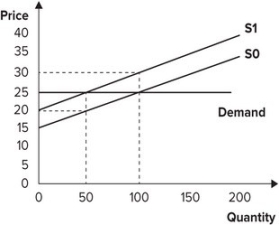
(Multiple Choice)
4.7/5 (73)
(73) Refer to the following graph. 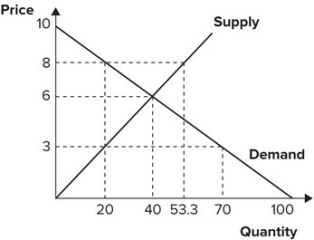 With an effective price ceiling at $3, the effect is an implicit tax on:
 (Multiple Choice)
4.9/5 (74)
(74) Refer to the graph shown. The market represented here is in equilibrium when the price is: 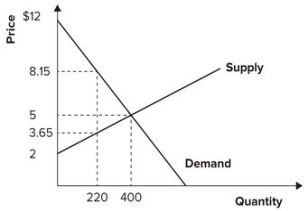
(Multiple Choice)
4.8/5 (83)
(83) Refer to the graph shown. In equilibrium, total surplus is equal to: 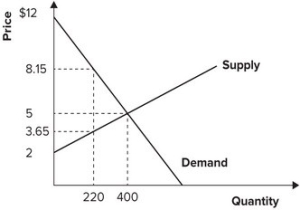
(Multiple Choice)
4.9/5 (65)
(65) Refer to the graph shown. If the elasticity of supply is 1, the burden of the tax will be shared equally by consumers and suppliers at which point? 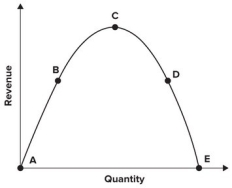
(Multiple Choice)
4.8/5 (78)
(78) Refer to the graph shown. Assume that the market is initially in equilibrium at a price of $6 and a quantity of 40 units. If the government imposes a $2 per-unit tax on this product, the equilibrium price will change to: 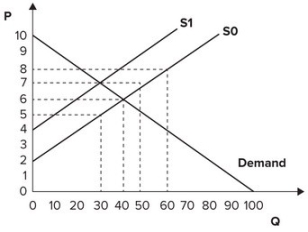
(Multiple Choice)
4.8/5 (75)
(75) Refer to the graph shown. With an effective price floor at $8, the effect is an implicit tax on: 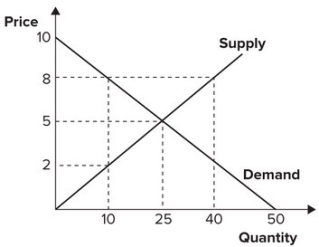
(Multiple Choice)
5.0/5 (86)
(86) The more inelastic the demand for agricultural output, the stronger the incentive for farmers to engage in rent-seeking activities.
(True/False)
4.8/5 (85)
(85) Government is lobbied to institute price controls because:
(Multiple Choice)
4.9/5 (59)
(59) Refer to the graph shown. Initially, the market is in equilibrium where the demand curve intersects S0. In the initial equilibrium, producer surplus is equal to: 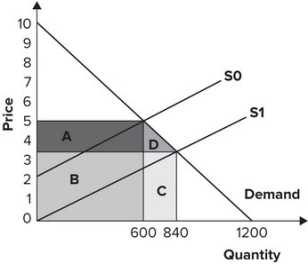
(Multiple Choice)
4.8/5 (85)
(85) Refer to the graph shown. Assume that the market is initially in equilibrium at a price of $6 and a quantity of 40 units. If the government imposes a $2 per-unit tax on this product, the deadweight loss from the tax will be: 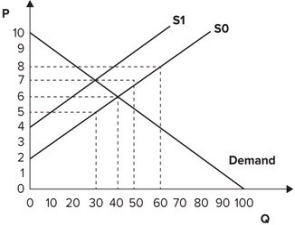
(Multiple Choice)
4.9/5 (77)
(77) Refer to the graph shown. Which statement best characterizes the difference between the effect of a price ceiling in the short run and the long run? 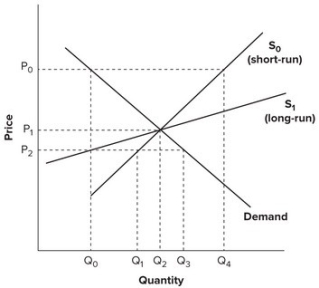
(Multiple Choice)
4.8/5 (76)
(76) Refer to the graph shown. After an increase in supply, the market is in equilibrium where the demand curve intersects S1. In this new equilibrium, consumer surplus is equal to: 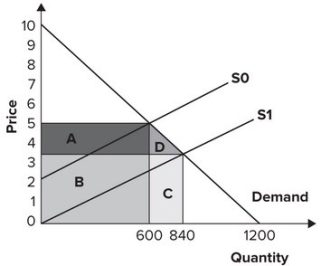
(Multiple Choice)
4.7/5 (85)
(85) Consumers have the greatest incentive to lobby for price controls in the short run when supply is:
(Multiple Choice)
4.8/5 (73)
(73) Refer to the graph shown. Assume the market is initially in equilibrium at point j in the graph but the imposition of a per-unit tax on this product shifts the supply curve up from S0 to S1. The amount of revenue the government will collect from this tax is equal to the area of: 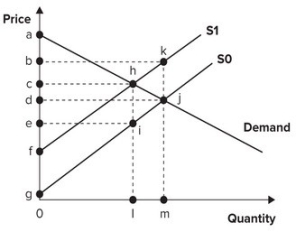
(Multiple Choice)
5.0/5 (74)
(74) Refer to the graph shown. When the market is in equilibrium, producer surplus is area: 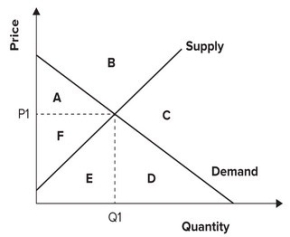
(Multiple Choice)
4.7/5 (86)
(86) Refer to the graph shown. Assume the market is initially in equilibrium at point b in the graph but the imposition of a per-unit tax on this product shifts the supply curve up from S0 to S1. The lost producer surplus of this tax is equal to the area: 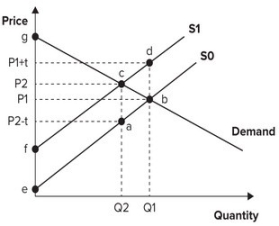
(Multiple Choice)
4.7/5 (78)
(78) 
Filters
- Essay(0)
- Multiple Choice(0)
- Short Answer(0)
- True False(0)
- Matching(0)