



 Chat with AI
Exam 12: General Equilibrium and the Efficiency of Perfect Competition

Exam 1: The Scope and Method of Economics241 Questions
Exam 2: The Economic Problem: Scarcity and Choice218 Questions
Exam 3: Demand, Supply, and Market Equilibrium309 Questions
Exam 4: Demand and Supply Applications173 Questions
Exam 5: Elasticity188 Questions
Exam 6: Household Behavior and Consumer Choice272 Questions
Exam 7: The Production Process: the Behavior of Profit-Maximizing Firms287 Questions
Exam 8: Short-Run Costs and Output Decisions386 Questions
Exam 9: Long-Run Costs and Output Decisions363 Questions
Exam 10: Input Demand: the Labor and Land Markets200 Questions
Exam 11: Input Demand: the Capital Market and the Investment Decision218 Questions
Exam 12: General Equilibrium and the Efficiency of Perfect Competition202 Questions
Exam 13: Monopoly and Antitrust Policy394 Questions
Exam 14: Oligopoly219 Questions
Exam 15: Monopolistic Competition235 Questions
Exam 16: Externalities, Public Goods, and Common Resources275 Questions
Exam 17: Uncertainty and Asymmetric Information134 Questions
Exam 18: Income Distribution and Poverty197 Questions
Exam 19: Public Finance: the Economics of Taxation281 Questions
Exam 20: International Trade, Comparative Advantage, and Protectionism287 Questions
Exam 21: Economic Growth in Developing Economies133 Questions
Exam 22: Critical Thinking About Research104 Questions
Select questions type


Suppose a policy change generates $200,000 of benefits for low-income families and $175,000 of costs for high-income and middle-class families. We can best describe the change as
(Multiple Choice)
4.8/5  (85)
(85) Refer to the information provided in Figure 12.4 below to answer the question(s) that follow. 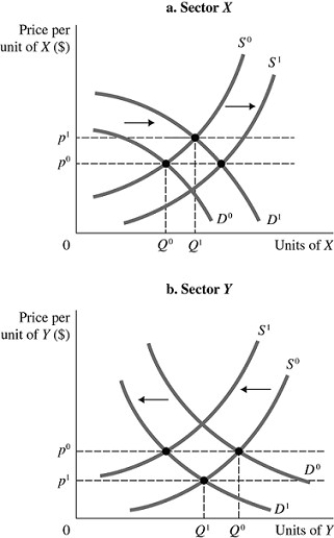 Figure 12.4
There are two sectors in the economy, X and Y, and both are in long-run, zero-profit equilibrium at the intersections of S0 and D0.
-Refer to Figure 12.4. Assume consumer preference changes toward X and away from Y. Ceteris paribus, the likely change in capital flow in sector X will cause the industry's short-run ________ curve to shift to the ________.
Figure 12.4
There are two sectors in the economy, X and Y, and both are in long-run, zero-profit equilibrium at the intersections of S0 and D0.
-Refer to Figure 12.4. Assume consumer preference changes toward X and away from Y. Ceteris paribus, the likely change in capital flow in sector X will cause the industry's short-run ________ curve to shift to the ________. (Multiple Choice)
4.8/5 (77)
(77) General equilibrium exists when any one market in an economy is in equilibrium.
(True/False)
4.8/5 (84)
(84) Refer to the information provided in Figure 12.4 below to answer the question(s) that follow. Figure 12.4
There are two sectors in the economy, X and Y, and both are in long-run, zero-profit equilibrium at the intersections of S0 and D0.
-Refer to Figure 12.4. Assume consumer preference changes toward X and away from Y. Ceteris paribus, sector X will likely see ________ and sector Y will likely see ________.
Figure 12.4
There are two sectors in the economy, X and Y, and both are in long-run, zero-profit equilibrium at the intersections of S0 and D0.
-Refer to Figure 12.4. Assume consumer preference changes toward X and away from Y. Ceteris paribus, sector X will likely see ________ and sector Y will likely see ________. (Multiple Choice)
4.9/5 (81)
(81) Which of the following is an example of an external benefit?
(Multiple Choice)
4.8/5 (75)
(75) The whole class of goods that will be underproduced or not produced at all in a completely unregulated market economy are referred to as
(Multiple Choice)
4.8/5 (70)
(70) Refer to the information provided in Figure 12.3 below to answer the question(s) that follow. 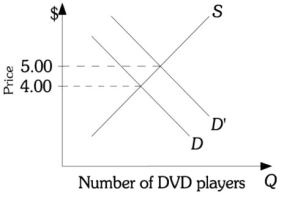 Figure 12.3
-Refer to Figure 12.3. The DVD industry is a constant-cost industry. As the demand for DVD players shifts from D to , which of the following is least likely to result?
Figure 12.3
-Refer to Figure 12.3. The DVD industry is a constant-cost industry. As the demand for DVD players shifts from D to , which of the following is least likely to result? (Multiple Choice)
4.9/5 (77)
(77) Because public goods are characterized by being collectively consumed,
(Multiple Choice)
4.9/5 (89)
(89) Refer to the information provided in Figure 12.4 below to answer the question(s) that follow. Figure 12.4
There are two sectors in the economy, X and Y, and both are in long-run, zero-profit equilibrium at the intersections of S0 and D0.
-Refer to Figure 12.4. Assume consumer preference changes toward X and away from Y. Ceteris paribus, the likely change in capital flow in sector Y will eventually
Figure 12.4
There are two sectors in the economy, X and Y, and both are in long-run, zero-profit equilibrium at the intersections of S0 and D0.
-Refer to Figure 12.4. Assume consumer preference changes toward X and away from Y. Ceteris paribus, the likely change in capital flow in sector Y will eventually (Multiple Choice)
4.8/5 (88)
(88) The existence of public goods can be a source of market failure.
(True/False)
4.7/5 (80)
(80) Partial equilibrium analysis refers to ________ examining the equilibrium conditions in individual markets and for households and firms.
(Multiple Choice)
4.8/5 (73)
(73) Refer to the information provided in Figure 12.4 below to answer the question(s) that follow. Figure 12.4
There are two sectors in the economy, X and Y, and both are in long-run, zero-profit equilibrium at the intersections of S0 and D0.
-Refer to Figure 12.4. Assume consumer preference changes toward X and away from Y. Ceteris paribus, the likely change in capital flows in sectors X and Y will eventually________ in industry X and ________ in industry Y.
Figure 12.4
There are two sectors in the economy, X and Y, and both are in long-run, zero-profit equilibrium at the intersections of S0 and D0.
-Refer to Figure 12.4. Assume consumer preference changes toward X and away from Y. Ceteris paribus, the likely change in capital flows in sectors X and Y will eventually________ in industry X and ________ in industry Y. (Multiple Choice)
4.8/5 (78)
(78) A new technology is developed for producing microwave ovens that reduces production costs by 10%. Which of the following is the most likely consequence of this technological change?
(Multiple Choice)
4.9/5 (76)
(76) Refer to the information provided in Figure 12.4 below to answer the question(s) that follow. Figure 12.4
There are two sectors in the economy, X and Y, and both are in long-run, zero-profit equilibrium at the intersections of S0 and D0.
-Refer to Figure 12.4. Assume consumer preference changes toward X and away from Y. Ceteris paribus, a new general equilibrium will eventually be reached in sector Y with a price of ________ and a quantity of ________.
Figure 12.4
There are two sectors in the economy, X and Y, and both are in long-run, zero-profit equilibrium at the intersections of S0 and D0.
-Refer to Figure 12.4. Assume consumer preference changes toward X and away from Y. Ceteris paribus, a new general equilibrium will eventually be reached in sector Y with a price of ________ and a quantity of ________. (Multiple Choice)
5.0/5 (81)
(81) For a policy to be Pareto efficient, it must make everyone at least a little better off.
(True/False)
4.9/5 (80)
(80) 
Filters
- Essay(0)
- Multiple Choice(0)
- Short Answer(0)
- True False(0)
- Matching(0)