



 Chat with AI
Exam 12: General Equilibrium and the Efficiency of Perfect Competition

Exam 1: The Scope and Method of Economics241 Questions
Exam 2: The Economic Problem: Scarcity and Choice218 Questions
Exam 3: Demand, Supply, and Market Equilibrium309 Questions
Exam 4: Demand and Supply Applications173 Questions
Exam 5: Elasticity188 Questions
Exam 6: Household Behavior and Consumer Choice272 Questions
Exam 7: The Production Process: the Behavior of Profit-Maximizing Firms287 Questions
Exam 8: Short-Run Costs and Output Decisions386 Questions
Exam 9: Long-Run Costs and Output Decisions363 Questions
Exam 10: Input Demand: the Labor and Land Markets200 Questions
Exam 11: Input Demand: the Capital Market and the Investment Decision218 Questions
Exam 12: General Equilibrium and the Efficiency of Perfect Competition202 Questions
Exam 13: Monopoly and Antitrust Policy394 Questions
Exam 14: Oligopoly219 Questions
Exam 15: Monopolistic Competition235 Questions
Exam 16: Externalities, Public Goods, and Common Resources275 Questions
Exam 17: Uncertainty and Asymmetric Information134 Questions
Exam 18: Income Distribution and Poverty197 Questions
Exam 19: Public Finance: the Economics of Taxation281 Questions
Exam 20: International Trade, Comparative Advantage, and Protectionism287 Questions
Exam 21: Economic Growth in Developing Economies133 Questions
Exam 22: Critical Thinking About Research104 Questions
Select questions type


You are unable to sleep because your hotel room is right underneath the noisy air conditioning system. We would classify this situation as an
(Multiple Choice)
4.8/5  (78)
(78) The condition that exists when all markets in an economy are in simultaneous equilibrium is known as
(Multiple Choice)
4.8/5 (88)
(88) In order to have an efficient distribution of final products to households,
(Multiple Choice)
5.0/5 (80)
(80) A household ________ as long as the utility from the good's consumption is less than its market price.
(Multiple Choice)
4.9/5 (84)
(84) The opportunity cost of using resources to produce more of one good instead of more of another good is its
(Multiple Choice)
4.8/5 (73)
(73) A government policy generates $10,000 of benefits to underprivileged youth at a cost of $5,000 to taxpayers. The policy is Pareto efficient.
(True/False)
4.9/5 (68)
(68) Refer to the information provided in Figure 12.4 below to answer the question(s) that follow. 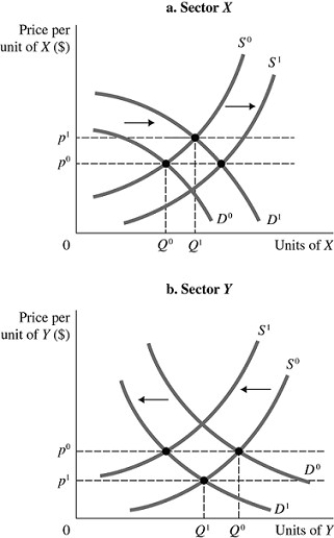 Figure 12.4
There are two sectors in the economy, X and Y, and both are in long-run, zero-profit equilibrium at the intersections of S0 and D0.
-Refer to Figure 12.4. Assume consumer preference changes toward X and away from Y. Ceteris paribus, the equilibrium quantity of X will ________ and the equilibrium quantity of Y will ________.
Figure 12.4
There are two sectors in the economy, X and Y, and both are in long-run, zero-profit equilibrium at the intersections of S0 and D0.
-Refer to Figure 12.4. Assume consumer preference changes toward X and away from Y. Ceteris paribus, the equilibrium quantity of X will ________ and the equilibrium quantity of Y will ________. (Multiple Choice)
4.9/5 (83)
(83) Refer to the information provided in Figure 12.5 below to answer the question(s) that follow. 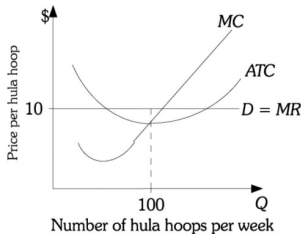 Figure 12.5
-Refer to Figure 12.5. A firm produces hula hoops in a perfectly competitive market and currently produces and sells 100 per week. At this production quantity of 100 per week, society would be best served
Figure 12.5
-Refer to Figure 12.5. A firm produces hula hoops in a perfectly competitive market and currently produces and sells 100 per week. At this production quantity of 100 per week, society would be best served (Multiple Choice)
5.0/5 (88)
(88) General equilibrium exists when all markets in an economy are simultaneously in equilibrium.
(True/False)
4.7/5 (82)
(82) Refer to the information provided in Figure 12.1 below to answer the question(s) that follow. 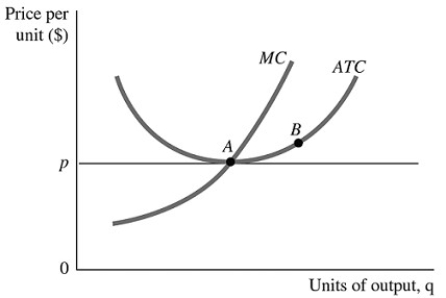 Figure 12.1
-Refer to Figure 12.1. This firm is currently at Point B on the ATC curve. If this firm moves toward Point A, this will make the
Figure 12.1
-Refer to Figure 12.1. This firm is currently at Point B on the ATC curve. If this firm moves toward Point A, this will make the (Multiple Choice)
4.9/5 (71)
(71) If more output could be produced with the same amount of inputs,
(Multiple Choice)
4.8/5 (72)
(72) In perfect competition, the condition that ensures that the right things are produced is
(Multiple Choice)
4.8/5 (74)
(74) An activity that makes some people better off and nobody worse off is a
(Multiple Choice)
4.7/5 (68)
(68) Market failures may be corrected through government intervention.
(True/False)
4.8/5 (87)
(87) 
Filters
- Essay(0)
- Multiple Choice(0)
- Short Answer(0)
- True False(0)
- Matching(0)